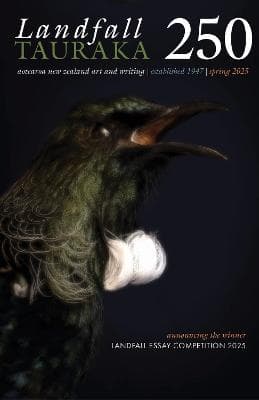
Review: Landfall Tauraka, edited by Lynley Edmeades
Reviewed by Claris Harvey
In an age where we are channeled content via the overlords of the internet, picking up a print copy of Aotearoa’s Landfall Tauraka right now feels like an act of subversion. It’s a quiet act of participation against the dopamine delivering machines we clutch.
But what exactly is a literary journal, and who is it for? The term itself can seem both pretentious and exclusive. I’m sadly yet to see someone reading a copy of Landfall Tauraka on a bus. Is it not a sort of gated community of writing - for writers?
The literary journal sits in a curious readerly space, akin to the experience of walking amongst not quite strangers at a party asking, ‘will I find someone good to talk with here?’ or worse still, perhaps the biggest fear of most when approaching a literary journal, “Am I smart enough to even be at this party?”
Journals such as the British publication Granta move around this by delivering a more singular cover theme to grab readers off the bat, such as ‘Death’ or ‘Family’. How then, does this collection by Otago University Press, our country’s longest standing journal, capture a new audience?
Somehow, nearly 80 years on from its inception – in today’s testy climate of eyeball harvesting –Landfall’s spring edition, edited by Lynley Edmeades (with a new name Landfall Tauraka) not only pulls this off, but it does so very well. It is dense. It is modern. It contains some of the best of Aotearoa’s new and not so new writers.
It also announces the winners of the famous Landfall/Tauraka Essay Prize, The Kathleen Grattan Poetry Prize and The Caselberg Trust international poetry prize in one huge issue.
Fiona Pardington’s arresting cover shows a tui deep in song. Likewise, the issue delivers a startlingly deep and modern collection. Pardington’s bird photographs, detailed by Starkwhite, are of stuffed specimens, many extinct or threatened.
From apple-fresh poems to mysterious short stories and a great sit down between former poet laureate Bill Manhire and current editor Lynley Edmeades, one can easily find a new friend at this literary party or enjoy a chat with an old one.
Tasmin Prichard’s winning essay ‘Four Hours in the dark, forgetting’ keeps a firm grip on the reader through atmosphere: ‘The operating room was a weird sky blue colour, like the bottom of a pool’. We are drawn into a maze of before and after gender re-affirming surgery, jovial nurse banter, the act of a person becoming more of themselves through the surgical removal of their breasts:
'How strange it is to call your mother, the woman who birthed you full and purple and tell her you mean to spend a lot of money to remove good healthy tissue, stuff that did nothing wrong.’
The prize-winning essay has similar parallels to Jackson McCarthy’s breathing landscapes in his poem ‘Three season songs‘:
‘Today I met the man I’m gonna be, I’m gonna be’
I was drawn to the bone-hard, brittle resentment in Xiaole Zhan’s poem ‘Harvest’. The poet visits family tombs in her native China and asks, ‘Tell me why should I love my ancestors? I’ve had enough of kneeling’.
Tōrea Scott-Fyfe’s captivating ‘Obsidian’ tells a mythic short story of an eerie lake woman and the drowning of a child. It traverses realms, epochs and cultures in creeping gothic fashion, whereas the ease that Joanna Cho deals with words makes her piece ‘Wentworth Falls’ feel like a quick road trip.
Outgoing poet laureate Chris Tse’s poem ‘Dance Floor Romance’ shimmers and stirs: ‘oh how I love to be sweetened by a glance while a heavenly B.P.M speeds me’ whereas incoming poet laureate Robert Sullivan lays down a challenge to readers with his choice for the Caselberg Poetry Prize - Helen Williford-Lower‘s ‘Toku Kōhine o Waikouaiti’, entirely in Te Reo.
Airini Beautrais’s poem ‘Topless Napoleon’ captures the hallucinatory nature of a new baby, detailing a breast feeding and reading all-nighter. I loved the cadence of John Dennison’s ‘Before the weave’: 'the many happy returns of decisions not taken' and Anna Wood’s story of ambergris hunting echoing the search for words and space to write in ‘Black Harvest’.
John Prins’ alarmingly honest essay ‘Landfall’s children’ asks ‘how writers publishing in Landfall have mined their memory of childhood, or their own children’s experiences.' He opens with a bare confession that becoming a parent unearthed a latent rage in him, then traverses a continent he’s mapped closely in his reading of some 700 stories–every short story ever published in Landfall. I wanted to share it and couldn’t, so instead sent a screenshot of the opening paragraphs to a friend from London, who has never heard of Landfall Tauraka.
Paula Morris’s essay ‘When we were young’ discusses the cloistered intellectual climate in Aotearoa out of which Landfall originally sprung. She quotes founding editor Charles Brash’s collection of letters, ‘Universal Dance’, with these words that resound throughout: ‘what was needed, he believed, was for New Zealand ‘to be revealed to itself in works of art of its own begetting’.’
Readers can both study and celebrate our reflections in this collection as well as return again for repeated readings, a top up of joy in writing done good, by our very own.
‘I came here to escape confessions but I must say: I suffer beauty & yet I still can’t describe its true shape’
Chris Tse, ‘Dance Floor Romance’