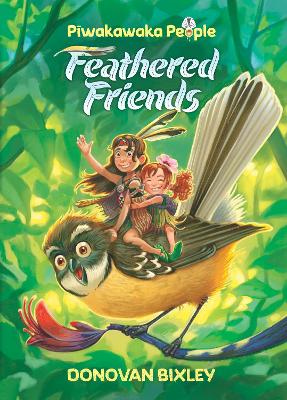
'a little princess riding a pīwakawaka': Donovan Bixley
Bestselling New Zealand author illustrator Donovan Bixley bridges young readers out of picture books with Pīwakawaka People (Upstart Press), the first in a charming series about a family of little people living next to a Pā on the coast of Aotearoa in the mid-1800s. The storytelling is much simpler and more direct than a normal chapter book, and also a lot more visual, to help children making the transition to independent reading.
He writes about the creation of Pīwakawaka People and his personal link to the story in this essay.
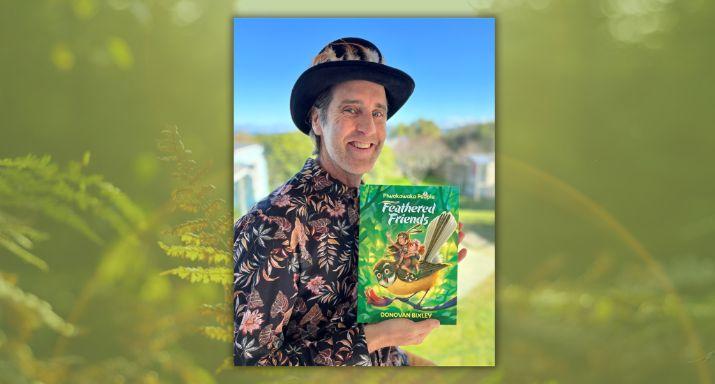
Whenever I visit schools, the most frequent question I get asked is, 'how do you come up with ideas?' As a boy, I used to draw pictures and then write stories to go with them – and my latest book, Pīwakawaka People, continues that tradition.
I’d drawn a picture for my granddaughter of a little princess riding a pīwakawaka, and she loved it so much that she wanted me to write a story about these characters (along with lots of darling suggestions as to what might happen in the story – usually involving a bouquet of flowers somewhere in the mix).
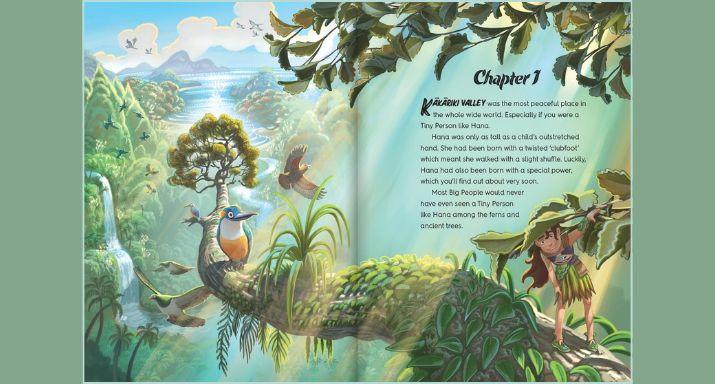
This book is really special to me, as our two granddaughters had been living with us for a few years and the main characters incorporate a lot of their personalities. Our eldest granddaughter was born with a clubfoot – and it’s a great character trait that she hasn’t let that slow her down, while her younger sister is obliviously fearless of any dangerous situation. Our grand-girls are both half Japanese, and we’ve loved seeing them embrace the unique culture of te ao Māori as well as a love of nature and the environment of Aotearoa. Those elements are really universal to a lot of families I meet at book events, who have made their home in New Zealand in recent years.
There’s also a link to my first ancestors to arrive in Aotearoa. They were two boys from Ireland, aged 9 and 11, who where sent out here in 1822 all by themselves and they never saw their family again. They settled in Whangaroa, in the Far North, and I’ve often thought about those two little boys making their way in an adult world in historic Aotearoa. Kids often feel like they have no power or voice in the world of big people and that’s a really strong element in a lot of great children’s literature. I exaggerated that idea to the extreme to make the main characters in my book Tiny People – a pioneer family starting a fresh life in the unspoiled environment of historic Aotearoa. Our main heroine has a club foot, which leads to her getting into some tricky situations, but luckily she also has a special power to be able to talk to birds. What child doesn’t like a heroine with special powers?
As both writer and illustrator, my whole career has been exploring different ways that words and pictures can work together – from comics and wordless picture books, to illustrated chapter books,like my Flying Furballs series, and traditional European-style picture books, like Leonardo’s Dragon. In Pīwakawaka People I’m making a beginner chapter book using the style of text and pictures that you find in a typical picture book. For me, the main difference is that a picture book should be able to be read just by looking at the pictures. It’s also great to explore a more complex story than I could fit into a standard 32 page picture book. I’m envisioning that Pīwakawaka People will be read to young children, then they can take it away and ‘read’ the story again by themselves, like a silent movie.
Hopefully I’ve created characters that readers will want to befriend and all the colourful detail will keep them coming back again and again to revisit that world and discover all the things they missed the first time round – from historic elements to te ao Māori and our unique flora and fauna. If Pīwakawaka People can do all of those things, then it’s a real winner!
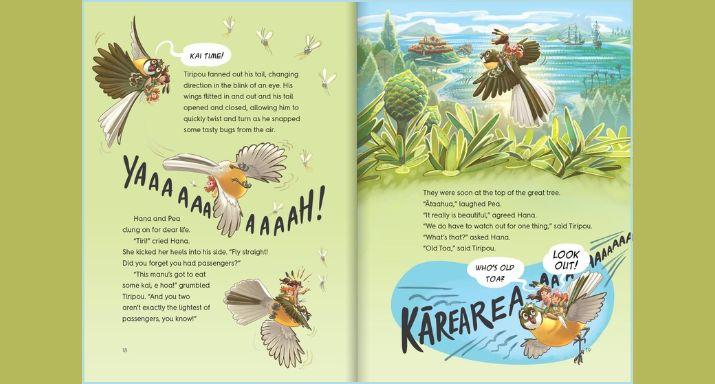
Pīwakawaka People: Book 1: Feathered Friends by Donovan Bixley is available in all good bookstores now.