All about the Victorian funeral business: Deborah Challinor
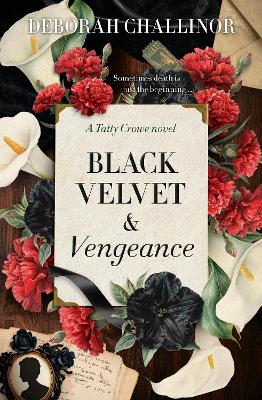
Deborah Challinor is the author of 20 bestselling historical fiction novels, two works of non-fiction, and a young adult novel. In 2017 she received a distinguished alumni award from Waikato University, and in 2018 she became a Member of the New Zealand Order of Merit for services to literature and historical research. Her latest book is Black Velvet and Vengeance, a page-turning tale of female friendship and triumph over adversity centred around a female undertaker in 1870s Sydney.
We chatted to her about the research she did for Black Velvet and Vengeance, and what she's planning to write after that.
.jpg&w=1920&q=75)
What prompted you to write a trilogy of books with a focus on Victorian funeral customs?
Some years ago I discovered the word ‘taphophile’, which describes someone with an interest in historic cemeteries and mourning practices. That’s me. So I thought I’d write something set during the mid-Victorian era when funerals were still a spectacle and something most people aspired to, whether they could afford it or not – and then I could research everything about the funeral vehicles, the mourning clothes, the traditions, the preparation of the body … And of course from that arose other issues, like what happened to widows financially, funeral clubs, what if there wasn’t the money to bury a loved one, etc.
What is the most interesting fact you learnt about the funeral customs of the era during your research?
I don’t know if this is interesting but it’s sad, although probably not unexpected. There was enormous shame attached to having a loved one buried ‘on the parish’ because a family couldn’t afford to pay for a funeral, hence the popularity of funeral clubs, which often exploited members’ fears and seriously over-charged them. I think these days we call that funeral insurance.
And the most morbid?
Two things. Until the nineteenth century, you could pay someone to eat bread off the chest of a corpse as the bread absorbed the sins of the deceased and were passed onto the ‘sin-eater’, and the dead person could then ascend to heaven unhindered by sin. What a job. The second thing relates to coronial inquests, at which the deceased had to be publicly presented so that the coroner and jurymen (and also the nosy audience) could inspect the body for any evidence it might yield. Gross.
The new book, Black Velvet and Vengeance, also delves into the birthing practices of the time. Did your research uncover anything surprising?
No. Most women gave birth at home alone or with the help of a local untrained ‘midwife’. If she was lucky things went well. If not, mother and baby might both die, or the mother might die later of infection (childbed fever). In Australia in 1875, the baby had a ten percent chance of dying in its first year. None of that was a surprise.
You’ve said your writing process on this book was thrown into disarray by one of the characters. Can you tell us a little more about that and do you think it will change your approach when you write your next book?
I originally set Henry up to be a love interest for Tatty but he came across as a bit dictatorial, which I didn’t think Tatty would tolerate, so I introduced Evan Hunter in Black Silk & Buried Secrets. However, I left the door open for Henry and lucky I did because by the time I was writing BV&V, I realised Tatty was more than capable of managing Henry, and when I looked back at Evan in BS&BS I realised he was quite smarmy, with his cockroach-coloured eyes, boxed sweets and nosy questions about Crowe Funerals. And no, I’ll still use outlines – they’re easy enough to change!
Can you give us any clues about the subject matter you plan to tackle in your next book?
I’m looking at fictionalising the 1914 Ralph Mine disaster in Huntly, in which forty-three people died. I’m gathering bits and pieces for that now. Also, there might be one more Tatty book: I don’t think she’s quite ready to settle down yet.
Black Velvet and Vengeance by Deborah Challinor (Harper Collins Publishers) is available in all good bookstores now.