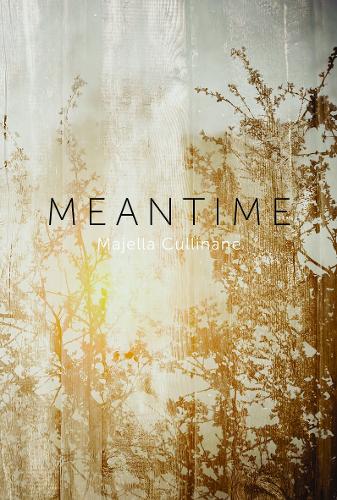
Author interview + Extract — Majella Cullinane, author of poetry collection Meantime
.jpg&w=1920&q=75)
Majella Cullinane in Aotearoa New Zealand and her mother in Ireland, a distance unbridgeable even by phone as Cullinane's mother's language was lost to dementia. Meantime, the author’s latest poetry collection, calls and keens across this terrible distance. With attentiveness, tenderness and extraordinary vulnerability, these poems speak directly to personal experience while also addressing a wider world shadowed and altered by illness, where everything once familiar and coherent is disintegrating, in flux, uncertain and strange. These poems are works of vigil and devotion, breathed into existence by a daughter who could not be at the bedside of her beloved, dying parent. Personal and universal in its themes, the poems in Meantime possess a gravitas born of sorrow, steeped in love. A warm and loving conversation about memory and forgetting, and a celebration of the power of voice to connect and heal, this is a collection for our times. Kete spoke to Majella about memory, grief, lockdowns and whether writing can be catharsis or not…
The title Meantime has multiple meanings: the meanness of the Covid-19 pandemic, and the devastating effect it had on all of us around the world; the intense meanness of grief and loss, of not being able to say goodbye to my mother properly. The idea of 'meantime’ in the sense of the actual definition – the time before something happens or before a specified period ends, so, referring to the kind of limbo I, and I’m sure many others, felt during the lockdowns and border closures of 2020-2022 – of not knowing when they might end, or when we could reunite with family and friends.
Were you able to write during the pandemic, or did the book come later?
I read that quite a few people had trouble writing and reading through the pandemic. I found myself reading a lot of poetry and personal essays, which I found hugely comforting. I started a diary and kept notes and impressions from 2019 onwards, and from these sources, and over the space of about two or three years, Meantime gradually emerged.
Memory is so much a part of this collection. Your memories as a child, her memories disappearing, the memories that cross distance and space. Did you set out to make the collection about memory first and foremost?
I don’t know that I set out with any particular goal of writing about memory per se, but it is a recurring theme in my work, and also appears quite a bit in my fiction as well – most especially juxtaposed with place. I’m fascinated about how memory is formed, what we remember and why, what we need to forget and why, and how memories, both ours and others, can have such indelible and long-lasting effects on us as individuals.
It’s your third collection, and it’s so very personal – the slow process of grief and loss, and speaks so tenderly. How does it compare in difficulty of writing with your other two books?
It was a difficult book to write, and I know some people baulk at the idea of writing as a cathartic process. I don’t. Joan Didion wrote: “I don’t write for catharsis; I have to write to understand.” I don’t think one necessarily has to preclude the other. I wrote for catharsis and to understand: to record and express my grief (and the universality of it) in a time of great social upheaval, to try and understand my mother and our relationship more, of how it changed in the last years of her life and as her memory deteriorated. The book is an elegy, yes, but it is also a way, as a friend pointed out to me recently, of paying homage to my mother and the profound effect she had on my life, and will continue to have.
Majella has kindly shared this poem from Meantime for our readers to enjoy.
Meantime
I wake to howling wind and rush of rain.
There’s talk of death and masks and
distancing. It’s a year and a half since I last
saw you.
The korimako darts through poroporo, striking the wet air with
song. My tongue burns. If I were to walk through autumn’s cool
air
I would find no relief.
I would compress seas and oceans, turn hemispheres upside
down to believe what has happened has not happened.
Reaching the halfway point of life
I recall all my days and how I have squandered them.
The rhododendron’s pink blush brightens the
garden, but it has come too soon.
It will not survive early winter frosts, the Antarctic-tinged air.
The cat spends hours at the foot of the bed,
asleep. I listen to the hum of the heat pump,
to my son rifling through boxes of Lego.
Clouds drift over pines and macrocarpa.
The trees are dark green dresses swaying in the
wind. A lace of raindrops hangs on the clothes
rack.
Is it any surprise we have so much locked inside
us? The dead are carried in trucks through
villages.
Sands are pierced with thousands of crosses, funeral pyres burn.
A man a woman a child struggle to
breathe. Death is a shared language.
I try not to think of you in the spring-churned earth, far
away— so cold in there so cold.
Soon Matariki and her daughters will wake and pulse in the sky.