'Cycling through torrential rain for 10 hours straight': Maria Gill and Nancy Wake
Maria Gill started writing for children when her daughter was three years old. Before that, she'd been a figure skater, teacher, gem fossicker, dancer and shepherdess amongst other roles. These experiences inform her children's books and educational writing. Her recent books are The King’s Medal, Remarkable Animal Stories from New Zealand and Australia, and New Zealand Disasters, but her latest, A Flame in the Dark, is a YA novel about Aotearoa-born hero Nancy Wake.
Kete was delighted to talk to Maria about putting her research into action and cycling across France, the pitfalls and joys of fictionalising a real-life story, and her admiration of author Catherine Chidgey's work.
.jpg&w=1920&q=75)
Kia ora Maria, thank you for speaking to Kete! Can you tell us about A Flame in the Dark?
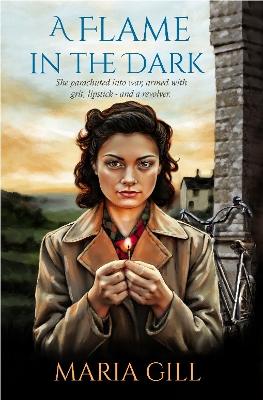
A Flame in the Dark tells the remarkable true story of Nancy Wake, a New Zealand-born journalist who became one of the most wanted people in Nazi- occupied France. As World War II engulfs Europe, Nancy joins the French Resistance, helping refugees escape, carrying secret messages, and eventually leading thousands of resistance fighters. Facing constant danger, betrayal, and loss, she refuses to back down in her fight against tyranny. Based on extensive research and Nancy's own experiences, this young adult novel brings to life the courage, determination, and resilience of one of history's most extraordinary women.
It must be pretty daunting tackling a real-life hero’s story in fiction?
It was daunting because Nancy Wake is such a well-known and admired figure. There had been biographies and picture books written about her, but no one had told her story for young adults. I wanted to capture not only her extraordinary heroism but also the heartache, love, friendship, and loss she experienced from the time she ran away from home at sixteen until the end of World War II.
One of the biggest challenges was separating fact from fiction. Over the years, many stories had been told about Nancy, and I wanted to stay as true as possible to the historical record while also making her feel real and relatable to young readers. I didn't want to portray her as a flawless hero. She most likely experienced PTSD on several occasions during the war, and I wanted readers to feel her fear, grief, and desperation during those moments. She also carried the pain of rejection by her parents, and that became an important thread running through the novel.
Another challenge was that I had spent my career writing nonfiction. To tell Nancy's story as a novel, I had to learn to write in deep point of view, find her voice, and weave historical details naturally into the narrative. It was a steep learning curve, but by the end of the editing process I felt I had done justice to both Nancy and her remarkable story. Thanks to my editor Christine Dale, my AUT MCW tutor James George, and writing friends who gave me feedback along the way.
What was your favourite part of the research?
That was when I travelled to France and visited the places Nancy Wake worked as a journalist, resistance fighter, and spy. I also cycled part of her 600-kilometre ride, when she searched for a radio operator to send an urgent message. She completed it in 72 hours; my son, his girlfriend, and I did 300 kilometres over five days.
At the time, cycling through torrential rain for 10 hours straight, I wouldn’t say I enjoyed it. But looking back, I’m proud we did it. We rode through quaint French villages and experienced, in a small way, just how tough it must have been for Nancy. She did it on a bike with no gears and probably no brakes — ours were far more modern.
The experience gave me a much deeper appreciation of her bravery and determination. When I returned home, I was able to weave so many more authentic details into the settings, which made the story much richer.
.jpg&w=1920&q=75)
The author and her family following Nancy Wake's France trail.
You’ve acknowledged in the book’s notes that you had to fill in historical gaps and dramatise parts of Nancy’s life where the historical record was blank. How difficult was this?
It required drawing on a wide range of sources — other people’s accounts in books, websites, and blogs describing similar experiences. For example, when Nancy climbed over the Pyrenees, I worked out where she likely started and finished, how long it would have taken, and the terrain she would have faced, then dramatised the physical and emotional difficulty of that trek.
At times I also drew on personal experience. In one scene where she has her first driving lesson with her husband and finds herself briefly on the wrong side of the road while turning a corner, the ashen-faced, still-in-shock husband was inspired by my mother after my own first driving lesson, when I did exactly that manoeuvre.
I’ve also experienced hallucinations after going without sleep for around two and a half days while travelling through Egypt and Israel, where it wasn’t safe to stop and rest. I used that experience when writing the bike ride where Nancy rides non-stop back to camp over roughly 30 hours.
So it was a combination of extensive research and selective personal experience that helped me fill in those historical gaps and bring a stronger sense of immediacy to those moments. I do acknowledge the sections that are imagined in the back of the book.
What made you choose to write this novel for teenagers particularly?
Her story had already been written in biographies, an autobiography, a loosely based novel for adults, and several books for younger children. But no one had written it for a young adult audience, and I felt teenagers would be particularly inspired by her journey.
Nancy Wake is an incredibly brave and resilient woman, and I wanted younger readers to connect with that — especially the idea that you can go through very tough times and still come out the other side stronger. I also think her story speaks to the complexities of growing up: having conflict with parents, making difficult choices, and, over time, gaining perspective and understanding.
Teenagers are at a stage where identity, courage, and independence really matter, and Nancy’s life naturally speaks to those themes in a very immediate way. I hoped it would show young readers that extraordinary courage doesn’t just belong to the past, it can start in ordinary people making difficult choices.
.jpg&w=1920&q=75)
Maria Gill outside the French chateau Nancy Wake lived in at the end of the war.
What Aotearoa New Zealand book do you wish you’d written?
I’m a huge fan of Catherine Chidgey’s stories so any of her books.
What’s been your best read this year so far?
Gosh, so hard to tie it down to one book.
For adults, it is The Ending Writes Itself which has a ‘killer twist’ involving writers and publishers on a private island, with seventy-two hours to write the end of a famous deceased author’s book. For young children, The Terrible Trio series by Swapna Haddow and Minky Stapleton – lots of belly laughs with these books. For teens, Song of the Saltings by Rachael King – beautiful writing.
And last, but definitely not least, what are you writing next?
I have a new book out in September with Bateman Books called William Pickering: Kiwi Rocket Man so I’m looking forward to promoting that. I’ve also got two books on the go: one is a nonfiction book about endangered New Zealand penguins and another is a junior fiction book set in World War II France. The latter is loosely based on a true story that hasn’t been told before.
A Flame in the Dark is available in all good bookstores now.