Essay: Thalia Henry on 'environment as story' in SORRY ROCK
On the wild west coast of Aotearoa, twelve-year-old Ned lives with his mother in a bach above Te Henga's black sand beach. He is thoughtful and observant, the sort of boy who knows that too much in his life is unexplained. His cousin Hugo is different. Restless, he pushes towards trouble. Alice stands apart from them, older, still tethered to memories of a childhood in the Northern Territory.
In this essay Thalia Henry tells Kete about the origins of her second novel Sorry Rock, published by Cloud Ink Press.
.jpg&w=1920&q=75)
*
'Sorry Rock is set in both Te Henga (Bethells Beach) and the Northern Territory, two contrasting landscapes that share an iron-rich chemistry that darkens Te Henga’s black sand while turning the Northern Territory a deep ochre red. I am interested in nature writing, and in how the environment is as integral to a story as the characters.
.jpg&w=1920&q=75)
The origins of this novel, and its title, came from something I learned that unsettled me. I had read about what are sometimes called 'Sorry Rocks' from Uluru, rocks taken by visitors as souvenirs and later returned, often accompanied by letters expressing regret. More troubling still is the belief, held by some, that these rocks bring misfortune. Uluru, also known as Ayers Rock, is a monumental sandstone formation in the Northern Territory, deeply significant to the Aṉangu people, its traditional owners.
The knowledge of these thefts lingered. I found myself returning to the question of what it means to carry something away from a place, and what it might take to return it. I thought about the rocks scattered around the world, taken out of curiosity and ignorance. How many of these rocks are in Aotearoa? How might I weave just one into a narrative with purpose?
Learning about the return of these rocks reminded me of similar occurrences in Aotearoa. I wanted to write a story that centres on a single rock but is ultimately about a beachside family who have experienced loss and made mistakes as they work towards healing. This is not a story about a rock causing misfortune. Rather, it reflects how things go wrong in human lives, sometimes through circumstance, and sometimes through the choices people make. A key thread is how adult actions affect young people.
.jpg&w=1920&q=75)
The cave at the end of Te Henga beach
Te Henga, with its striking black sand and strong currents, is a place I know well. However, when I began writing, I had not yet visited Alice Springs or Uluru. Visiting the site in 2018 became an important part of the writing process. At that time, another issue that I came to learn about, was that visitors were climbing Uluru, despite longstanding requests from Aṉangu that this practice cease. In October 2019, Uluru was closed to climbers, marking a significant and necessary shift. I visited on the cusp of that very important change.
During my visit, I hadn’t yet sought advice about my manuscript and nor did I know how to go about doing so. I kept notes in a notebook and quietly observed. I wanted to experience the atmosphere. It felt like a creative privilege to visit a place that was so unfamiliar, and stunning. I was captivated by the colours, huge open sky, sunsets and sunrises. The visit enabled me to write a very rough first draft. I was immersed in gathering ideas and enjoying writing.
.jpg&w=1920&q=75)
As a Pākehā New Zealand European writer, I am conscious of the position from which I write. Sorry Rock follows the perspectives of a New Zealand family, moving through landscapes that hold deep histories and ongoing presence. Writing the novel was, in part, a way of working through my own questions. It was a learning process.
I persisted with the narrative despite the huge challenges it presented to write both within and beyond my own experience. Cultural consultation became an essential part of the significant redrafting in the years that followed. I am deeply grateful for the guidance of Aboriginal readers, including Emu Lewis (Frank & Co Manuscript Service, Melbourne), who read the manuscript three times over the course of a year during its earliest drafting stages.
Meg Friel (On Time Typing, Editing and Proofreading, Darwin) who provided written feedback and, in the later stages, conversations over Zoom, supported by an editor, Sally-Anne Watson Kane. Through this process, Meg also identified aspects specific to Aṉangu that required further consultation, leading to input from Richard King (General Manager of the Aṉangu Pitjantjatjara Yankunytjatjara organisation, representing Aṉangu traditiona]l owners of the APY Lands in the Northern Territory).
Their insights, grounded in lived experience and cultural knowledge, were generous, rigorous, and at times challenging. Through their guidance, I was able to test the work in a respectful and confidential space, and to approach the story with greater care.
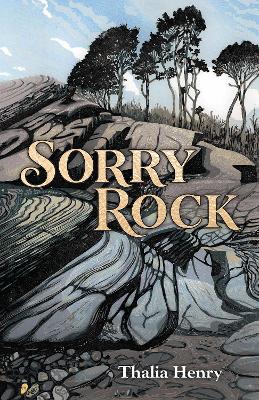
At its simplest, Sorry Rock is a story about a rock. More fully, it is a story about a family, and how people come to understand the past over time. The cover art is by UK artist Hazel McNab. It is a linocut titled Helford Passage in Cornwall. The image reminds me of Te Henga, and if you look closely, you’ll see an ochre rock in the foreground.'
Sorry Rock by Thalia Henry (Cloud Ink Press) is available in bookstores now.