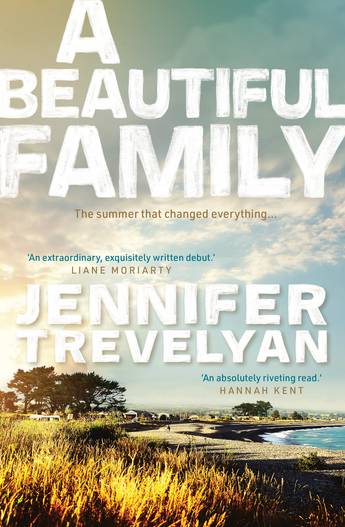
Extract: A Beautiful Family, by Jennifer Trevelyan
In the past we had always spent our summer holidays in remote places. That had always been my mother's preference. This year was different ...
As the summer holiday stretches ahead, with her older sister more interested in boys, her mother disappearing on long walks and her father, beer in hand, watching the cricket, the youngest in the family often finds herself alone.
.jpg&w=1920&q=75)
Extracted from A Beautiful Family by Jennifer Trevelyan, published by Allen & Unwin Aotearoa, RRP $36.99.
One
Driving to the holiday house, I made sure there was acres of empty seat between my sister and me. I sat hard up against the car door and watched the scrub by the side of the road blur past my window. My mother played Queen’s Greatest Hits on the car stereo and passed around a bag of hard jubes. At an intersection, my father stopped suddenly, spilling the jubes.
‘Fuckwit,’ he muttered. I wondered if he’d only just begun to use that word, or if it was a word he’d used for years, which I’d only just begun to hear.
The drive took a couple of hours and we stopped twice: once for corn on the cob and once for an antique shop. My sister, Vanessa, opted to stay in the car both times, so both times I opted to get out. The antique shop was dark and cool, and my mother bought a teapot to add to her collection.
In the past we had always spent our summer holidays in remote places where there were no fences and the local fruit shop was just an honesty box by the side of the road. That had always been my mother’s preference— my father would ask her, around the start of September, when we were just beginning to feel that winter was behind us and spring was coming: where to this year? And he would go down to the street and get the New Zealand road map out of our car, where it lived in the back pocket of the driver’s seat, and they would sit down together at the dining-room table and try to flatten out its hopelessly curled edges. My mother liked to lay open a map of the North Island, shut her eyes, and plant her finger somewhere (once, when my parents were ‘feeling flush’, she opened it to a map of the South Island). It was funny because sometimes her finger landed in the middle of the ocean, and my father would tease us about hiring a boat. But mostly her finger found land, and if it found a place that was too built-up, or too much like a town or city, she would screw up her face, shake her head, and start again.
This year was different. My father still went and got the road map from the car, but my mother had already made up her mind. She wanted to go to a place with people.
‘What people?’ my father asked. ‘Which people?’
‘Just any people. No specific people.’
‘Strangers?’
‘Well, yes, people.’
We were all a bit stumped. My mother had been known to rule out a beach on the basis that there was one umbrella already up, or a lone fisherman standing on a rock. She’d bypass a picnic spot if there was a couple kissing on a rug in a far distant corner. (Once, when we were trying to find somewhere for dinner, I saw a restaurant with nobody in it— every table completely empty. I pointed it out to my mother— I was sure that she would love it. She shook her head. Not that one. But it’s empty, I said, just the way you like it. It’s different for restaurants, she said.)
‘Why people?’ my father asked. ‘What purpose will they serve?’
My mother got exasperated then. ‘Oh, I don’t know, for goodness’ sake. I just want to try it— a place with people. Is that too much to ask?’
My father had only been teasing— anyone could tell. We all went quiet for a bit. My mother’s face was flushed. Then my father said, ‘Did you have anywhere in mind?’
My mother nodded. She walked over to the dining-room table where the road map lay. She was wearing an apron and was halfway through cooking dinner. I saw that she had taken off her rings, probably because she was afraid of losing them in the stew. She picked the road map up with oniony hands.
‘There,’ she said, putting it down and planting her finger.
My father peered at the point where my mother’s finger had left a watery mark. I saw that it was north of where we lived in Wellington, but not by much. ‘That’s a popular spot,’ he said. ‘I hope we haven’t left it too late.’
‘See what you can do,’ my mother shrugged. ‘It really doesn’t matter either way, it’s just a suggestion.’ She turned back to the kitchen, wiping her hands down the front of her apron, alternating front and back. The rest of what she said came to us over her shoulder, in a light, casual voice that barely carried through the open kitchen door. ‘Wherever we go, I’m sure we’ll have a lovely time, so long as the four of us are together.’
I reached out, spinning the map around so that I could see it, right way up. My mother’s watery mark had dried already. I scanned the coastline but couldn’t find the popular spot. My father was getting up from the table— he was stretching his arms, yawning. I hoped he’d taken proper note of where my mother’s finger had landed, because I didn’t believe what she’d said about it being only a suggestion. I believed that it mattered very much.
-
After the two-hour drive, I climbed out of the car and walked a few steps toward the holiday house with my shorts sticking to the backs of my legs. The garden was big and square and flat. Parched. The ground not dirt but sand you could sink your toes into, cool and fluid like a lake. Big, prickly weeds and little circles of tough, springy grass that felt like plastic. No trees. Not even a bush or a daisy. Just a wooden fence right around, with an opening wide enough to drive a car through. For weeks my father had been telling us how he’d found the most wonderful place, right where my mother had requested.
A house all to ourselves. A holiday house, with a lagoon on one side and a beach on the other. But this place had no lagoon and no beach. I turned a full circle in the tough, springy grass. The house sat at the end of a wide, flat road. I wondered if my father was going to get angry. Where was his lagoon? Where was his beach? But my father was unpacking the boot as if it was all exactly as he’d expected.
The house was as plain on the outside as a public toilet and not much bigger. My mother saw it and said, ‘It looks as if it’s been dropped from a great height.’ She was trying to make a joke, but I could tell she was disappointed too. I felt a pang of longing for our home in Wellington, where all the neighbourhood cats liked to hide in our hedges, and where we’d left our Christmas tree standing in a window with its lights on a timer to ward off burglars.
A Beautiful Family is in bookstores now. Read Craig Sisterson's review for Kete here.