Extract: A Way of Love, by James Courage
A Way of Love follows Bruce, a middle-aged architect, and Philip, a younger man still wrestling with his identity, as they try to make a life together in late-1950s London. Tender, uneasy and deeply observant, the novel explores desire, intimacy and the risks of openness in a society in which homosexuality remained criminalised.
James Courage (1903-63) was born in Christchurch and grew up near Amberley before spending most of his adult life in England. Five of his eight novels returned to Canterbury as their setting. A Way of Love is widely regarded as the first gay novel by a New Zealander.
This is the first reissue of Courage's novel since 1959.
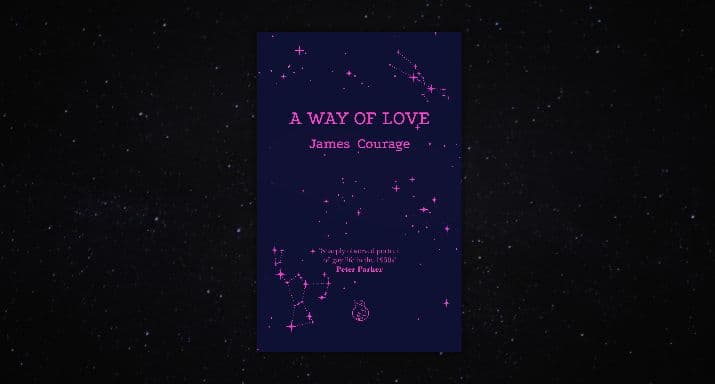
Extracted with kind permission from A Way of Love by James Courage, republished in 2026 by Lurid Editions.
My name is Bruce Quantock. I am an architect, forty-nine years old, a bachelor, living in my own small house to the north of Regent’s Park in London.
I want to write here of a particular personal relationship in which I was involved — how it began and how it ended. I shall write as though for myself alone, with no excuses and certainly without regrets. Writing is neither my art nor my profession, and if I sometimes use words bluntly or stiffly I must plead that I am doing my best. As for my character, enough of that will no doubt find its way into this little history in due course, for good or otherwise.
Meanwhile I must make a beginning, and a beginning is ready and waiting for me: an incident that happened about four years ago and that seems as important to me now as the opening notes, say, of a symphony would seem to a musician. Why a symphony? Because the incident I have mentioned took place at a concert, here in London. I am musical and I had taken myself alone to listen to music at the Festival Hall, one evening in early December. The night was cold. After the frost of the outer air I was glad to find myself in the floating resonant heat of the hall, one member of an audience fortuitously unified by a happiness in prospect and for the most part as accidental in their proximity, one to another, as so many grains of salt on a plate. From my seat at the back of the stalls I looked idly about me, seeing no person I recognized. Then, as the lights went down, my attention concentrated itself on the orchestra below: the magpie black and white of barathea and laundered linen, the polish on the brass, the chestnut-coloured wood of the violins, the glinting bellies of the drums, the narrow shoulders of the conductor. It was all as it should be, except that I was incidentally conscious of something very much in myself — a persistent thirst. For no particular reason I can remember I made a small resolution: I would keep the thirst until the end of the evening before quenching it. A sensual pleasure could be postponed.
Nevertheless, towards the finish of the concert, listening to the Schubert Symphony, the great C Major, I persistently thought of water. I thought of lakes among French mountains, of water flowing across limestone and gravel, of stone troughs brimming over, of rain lashing the tiles and moss of farmhouse roofs (I come from a farming family). Furthermore, I thought of thirst in itself: a sensation, a need, its slaking a physical indulgence for the body, that envelope of man I honour for its pleasures and its carnal beauty and whose desires I have been far from despising. But enough of that in a more appropriate place, later.
The concert ended. Tired, not unhappy, I took up my coat and began to leave the auditorium, walking between strangers, my thirst forgotten.
My steps took me into the aisle between the tiers of seats. My thoughts had turned back to Schubert, or rather to Schumann’s praise of Schubert’s ‘everlasting youth’, of the lyrical and perpetual adolescence of his music, when I became aware that the toes of my shoes had collided with something that retreated softly before them on the carpet of the aisle. I looked quickly down.
I saw the fur of a coat, a coat made from some cheapish rabbit-coloured pelts; a short coat, crumpled: a woman’s coat. At the same moment a voice spoke directly in front of me. It was an ungracious voice, male, belligerent:
‘That coat belongs to us, if you’d remove your feet.’
The speaker had turned to stare into my face, his left hand still resting on the elbow of his companion, the girl beside him. I saw a young man, less tall than myself, his brownish hair brushed to one side of a forehead that was pale, wide, still that of a boy. Surprised and almost without thought, I answered him at once.
‘Forgive me, I wasn’t looking — ’
A collision between faces can be painful to each. Both the young man and I bent down simultaneously to pick up the coat; cheek struck against chin. The tender skin of this unknown youth haphazardly hit the side of my jaw — that jaw I have inherited from a yeoman father and which is as hard as a plough handle. The contact, at any rate, was an astonishment to us both — a kind of detonation between strangers. A word of tact would have followed more aptly from me, but it was not I who spoke first after the recoil. Again the young man’s voice rasped at me:
‘You needn’t have done that!’
The golden glare of the eyes directed at mine was tigerish, something I would have expected only in an emotional crisis. I was taken aback and excusably truculent.
‘You might at least allow that I was trying to help,’ I began.
‘It wasn’t necessary, thank you.’
His glance dropped from my eyes to my mouth, my neck, to the herring bone pattern of my suit, then returned with less arrogance to my eyes. For a moment his hand went to his right cheek, where my jaw had struck it. He made an odd small sound that might have amounted to an apology, then handed the retrieved coat to his companion.
‘Here, Bronwen, you’d better put it on.’
‘I’m sorry I dropped it.’ Her remark was addressed partly to me; words of assuagement which I accepted. ‘It was kind of this gentleman...’
The young man had evidently nothing further to say. He draped the coat over the girl’s shoulders, took her arm and piloted her down the steps and towards the door of the hall. I saw their heads turn for a moment, hesitatingly, before they were lost to me among the departing audience. That was all.
It has taken me a couple of pages to describe an episode which occupied, I suppose, not more than forty seconds. I had exchanged a few sentences, not very pleasantly, with a pair of strangers — a pair who for all I knew of them might be husband and wife, might be engaged to one another, might be lovers or simply acquaintances. My impingement on their lives was presumably as fugitive a circumstance to them as theirs upon mine. I could forget it. But I did not forget it — I do not readily forget certain people. A snapshot impression remained with me, that evening four years ago, of a youthful face as resentful, as lost and as ignorant of its charm, as that of some tigercub surprised behind the bars of a cage. I remembered that face, that person.
Meanwhile I found myself outside the concert hall.
The frost had given the air a chill so arctic that the stars seemed to ache in the sky over the river and the city. A feeling of solitude, not unfamiliar, descended upon me. I did not wish to return to the night emptiness of my own house, or not at once. And I remembered again that I was thirsty. No ordinary thirst but now a poignant longing, a yearning of the whole flesh not unknown among men of my kind.