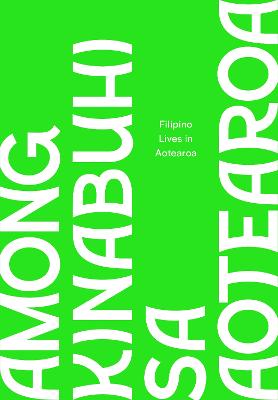
Extract: Among Kinabuhi sa Aotearoa: Filipino Lives in Aotearoa
Among Kinabuhi sa Aotearoa is a glimpse into the lives of 14 Filipinos—the third-largest Asian group in Aotearoa— trailblazers who build community in their adopted home, uphold the struggles of their people in the Philippines and stand in solidarity with tangata whenua.
This collection brings together a diverse group of artists, academics and activists engaged in the practice of radical imagination and collective action—working towards a future that is kinder, more equitable and just.
.jpg&w=1920&q=75)
This extract from ‘The fight for dignity, fairness and better working conditions’ in Among Kinabuhi sa Aotearoa: Filipino Lives in Aotearoa by Vivien Beduya, edited by Marc Conaco, is reproduced here with kind permission.
Nina Gabriella Santos
The driving force behind all my advocacies
I was incredibly fortunate to be raised in an unconventional family with two really strong-minded parents. My mum is the most grounded and humble person I know. A lot of who I am today is because of her, in both my career and personal life—my steadfastness, how I treat people and how I show up for my loved ones.
My dad has always been a grassroots activist, and I have inherited his deep-rooted commitment to social justice. My brother inspires me with his creativity and optimism.
My childhood was deeply shaped by the impacts of forced migration, which is one of the most pressing issues in the Philippines. Dire socioeconomic conditions, high unemployment and unliveable wages push millions of Filipinos overseas. For that reason, my dad was an OFW [Overseas Filipino Worker]. He worked abroad for better wages to financially support our family. I experienced the challenges that come with having an OFW parent and how that impacts the wider family.
In a story all too familiar to many OFW families, we spent years navigating a cycle of remittances and uncertainty. Despite my parents’ sacrifices, there was still an absence of long-term stability, especially as the cost-of-living crisis worsened.
With the little savings we had, my parents made the decision to move to Aotearoa, one of the few places that offered a pathway to residency for our family. My dad immigrated first, and the rest of us followed a year later.
As a new migrant in Aotearoa, my dad was exploited. He endured months without being paid because he wanted to secure the family’s residency visa to stay here. Being new migrants meant we had nothing. We didn’t have money to pay for lawyers, and we did not have the tools to navigate the system. My parents’ priority at that time was our survival. Over the years, my extended family was also subject to different types of exploitation.
I witnessed how the union fought for my dad and helped him get out of that exploitative workplace.
That experience shaped his life, as he later became a union organiser and had a steady focus on organising migrant workers and campaigning for their rights. It has naturally shaped mine too.
I am and will forever be a product of those who have nurtured me. My family and my home country are two main driving forces behind my advocacy, and just how I live my life more generally. I say this with an acknowledgement of all the privileges I had growing up in the Philippines, but there’s so much hardship faced by the Filipino working class. There is a stark wealth gap fuelled by corruption, entrenched political dynasties, and a semi-feudal, semi-colonial system shaped by American imperialism. Growing up with such a clear view of these inequalities made me want to contribute to change.
Living and organising in Aotearoa is a privilege I don’t take for granted. It has given me a level of safety that many activists and unionists in the Philippines do not have. Labour organisers and human rights defenders in the Philippines who are vocal and critical of the government are frequently red-tagged, abducted or killed by the state.
.jpg&w=1920&q=75)
The safety I have here gives me the responsibility and the courage to be bold. I remain an optimist. I hold on to the hope and belief things can be better than they are. I have seen what happens when people stand together. I am strong in my conviction that we all have a role in building a more dignified life for every person, everywhere.
My initial knowledge of Māori
Aotearoa wasn’t on my radar before my parents brought it up and told us we were moving. I moved here with absolutely no idea of the history of Aotearoa or its Indigenous people. One of the most formative things that ever happened to me as a 1.5 generation new migrant was being accepted into Auckland Girls Grammar School [AGGS]. It’s one of the most diverse schools in Tāmaki Makaurau. AGGS has a large Māori and Pasifika population and strong Māori presence. My earliest exposure to te ao Māori came from my schoolmates—seeing kapa haka practices in the courtyard, hearing waiata echo through assemblies, and watching how Māori girls proudly carried their culture.
I can’t remember the exact time, but outside of school, I started to notice a lot of the unhoused people I encountered were either Māori or Pasifika. A stereotype developed in my head that Māori people were outcasts and poor because of their own decisions. The news didn’t really help with that. When we came here, the National Party was in a nine-year stronghold. I was really young, but I understood the media was pushing stories that were very anti-Māori and framed them as ‘leeches of the system’—leaching off the benefits and spiking the unemployment rates.
The shift came later, and I recognise the privilege in being able to access university education, which helped me unlearn all of that. Studying sociology and law allowed me to learn more about the history of Aotearoa. Now I understand that the overrepresentation of Māori in statistics around poverty, incarceration, health and unemployment is not due to individual failure, but is the predictable outcome of colonisation, structural racism and political choices that systematically disadvantaged Māori. Over time, I realised that Māori were never the problem despite the narratives being pushed by the media and politicians. The status quo is a result of white supremacy embedded in state policy and upheld by consecutive governments that refused to honour tino rangatiratanga.
Affirmative action should always be welcomed
Being a good Te Tiriti partner is about constantly delving into what being tauiwi means and taking responsibility for our own learning so Māori people don’t have to carry that burden. It’s so cliché, but I feel like when I say “I’m on a journey”, it’s a learning journey that never truly ends. Understanding Te Tiriti, colonisation, and our place in Aotearoa is a lifelong commitment for tauiwi.
It is about knowing that the treaty is the document that enables the migrant dream. My family and I would not be here without Te Tiriti. When I was young, I was really opposed to, and didn’t get, the concept of affirmative action. As a young school kid who didn’t know anything, I thought that scholarships for Māori and Pasifika were really unfair. Why should they get separate scholarships?
We constantly have to recognise the historical disadvantages and the structural ways Māori have been marginalised from society. Once I learnt about the structural disadvantages Māori and Pasifika have been subjected to—land loss, political exclusion, intergenerational poverty, racist policy design—the justification for affirmative action became clear.
The reality is that, as tauiwi, we are part of the ongoing neocolonialism of the Indigenous people of Aotearoa. That’s why policies and practices like affirmative action should always be welcomed, and we should constantly be challenging our own biases, biases in the media, and the wider country. It all boils down to equity, and many people still don’t understand what that is and what it entails.
.jpg&w=1920&q=75)