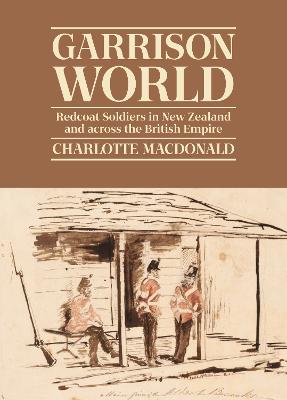
Extract: Garrison World, by Charlotte Macdonald
Garrison World explores the lives of soldiers, sailors and their families stationed in Aotearoa New Zealand and across the British empire in the nineteenth century. Spanning the decades from 1840 to 1870, this major new history from Charlotte Macdonald places the New Zealand Wars within the wider framework of imperial power. It shows how conflict and resistance throughout the empire, from rebellion in India to the Morant Bay uprising in Jamaica, were connected to the colonial project in New Zealand.
Extracted from Garrison World: Redcoat Soldiers in New Zealand and across the British Empire by Charlotte Macdonald, RRP $69.99, published by Bridget Williams Books (2025)
Garrison World reaches beyond the conflicts of 1840–72 that are now usually referred to as the New Zealand Wars to consider the wider impact of the permanent presence of soldiers on the colony’s early history. It also expands the military story, connecting it to broader economic, political, social and cultural developments both within and outside New Zealand during these formative decades.
By the mid-1800s, redcoat soldiers, Māori and settlers were all part of a network which extended from Pūkākā Marsland Hill, Taranaki, to London, and to myriad other locations: Parramatta in New South Wales, Cork and Dublin in Ireland, Poona (Pune) and Calcutta (Kolkata) in India, Kingston in Jamaica and also in Ontario, and to many places beyond.
New Zealand was distinctive in that it was a colony established following a negotiated treaty with the leaders of the Indigenous people and on ordered colonisation principles.
.jpg&w=1920&q=75)
The pā of Te Wherowhero, in the shadow of Taupiri maunga. By the mid-1850s, guarantees made under Te Tiriti o Waitangi were not fulfilled, and land acquisition was increasingly insistent. A number of iwi joined in a political movement, known as the Kīngitanga, to uphold rangatiratanga and form a powerful voice to challenge the settler government. The first Māori king, Pōtatau Te Wherowhero, was chosen in 1858. Lithograph by J.W. Giles, Alexander Turnbull Library, PUBL-0014-15
Nonetheless, within less than six years of the signing of Te Tiriti o Waitangi/Treaty of Waitangi in 1840, war was underway, drawing hundreds of imperial troops and Māori into destructive encounters. New Zealand proved a painful example of how the violent actuality of colonisation might overwhelm humanitarian principles and negotiated agreements. One of the questions that this book seeks to answer is: how did this colony become occupied by large numbers of armed soldiers and backed up by naval vessels within such a short time? Even more striking, why did this military presence become entrenched as a permanent fixture long after the conflicts of the mid-1840s had subsided? Why did a colony founded by a treaty and orderly colonisation need substantial force to maintain security and a colonial government? It was this sustained British military and political commitment that made New Zealand a garrison colony: that is, an entity underpinned by martial force and the finances that underwrote that force.
————
Escalating the pressure on British imperial governance between 1857 and 1867 was the succession of crises which unfolded across the empire: rebellion (‘Mutiny’) in India in 1857; the Taranaki and Waikato wars in New Zealand in 1860–66; and the Morant Bay rebellion, and its bitter political and legal aftermath, in Jamaica during 1865–68. In each place violence was met with violence. It seemed that Britain could hold on to its empire only with the use of force.
.jpg&w=1920&q=75)
Just a few years after New Zealand Company settlers landed on the beaches of the settlement they named Wellington, redcoat soldiers became a familiar sight in the town. Engravings, such as this one produced from original drawings by Samuel Brees, were popular among English readers in the three editions of Brees’s Pictorial Illustrations of New Zealand in 1847, 1848 and 1849. Brees came to Wellington on a three-year contract as principal surveyor and civil engineer but left disappointed when the Company was unable to continue to pay him. Engraving by Henry Melville from a watercolour by Samuel Brees, Alexander Turnbull Library, A-109-034
This history shows us the stark power of military force mobilised to enforce imperial interests. It is also a history of powerless men recruited to exercise that force; of the often brutal power imbalance between commanders and rank- and- file men; of young Irish and Scots men, themselves subject to English power, ordered to use rifles and bayonets against subject and Indigenous peoples. More than half of Britain’s soldiers were serving abroad through the Victorian era, making theirs an imperial service. A number of men who served to suppress rebellion in India in 1858 went on to fight against Māori in Aotearoa. The lives of these men, their garrison culture and the trajectories of their mobility have often remained hidden in the numerous accounts of the conflicts they were engaged in.
Garrison World tells the stories of these men who served under orders as members of Britain’s army and navy – as redcoats and bluejackets, names taken from the colours of their uniforms – and of the women who accompanied them.
At one level it tells the history of the people who made up the foot soldiers of empire. They lived in a time and in conditions very different from our own, yet they are connected to us by family, by place, by the consequences of their actions, by the material things they left behind, and by memory. They are also disconnected from us by loss, destruction, disavowal and ignorance. One other specific form of disconnection comes from their designation as ‘British’, which has limited the relationship of later generations of New Zealanders with their colonial history. This book challenges that designation. These men, drilled to conformity and obedience, dressed for uniformity, were nonetheless individuals, each with a unique circumstance and experience. Garrison World looks closely at these people, viewing them in this broad context but also as individuals caught up in events larger than themselves and as soldiers in a settler world.
In doing so, the book brings together two spheres that often exist apart. Histories of soldiers, war and garrison, and histories of settlement and colonisation have tended to inhabit different spaces, been told on separate pages. Histories of colonial peopling, of emigration and settlement exist apart from histories of frontier conflict. In the histories of colonial societies, soldiers and sailors serving the interests of an expanding empire or of missions, or of emigration and settlement, or of the broader notion of a ‘civilising’ purpose, though they form part of the history of administration and government. They are, in many respects, ‘un-civilising’ subjects.
Edwin Harris’s paintings of New Plymouth made in the winter of 1860 show starkly the imprint of the redcoat soldiers with their military tents and arms amid the homes and businesses of settlers living in the scattered, still raw colonial town.
.jpg&w=1920&q=75)
Edwin Harris painted this watercolour of soldiers in New Plymouth in August 1860. By then the town was occupied by the 40th and other regiments, camped amid houses and churches. Edwin and Sarah Harris had been among the early Plymouth Company migrants to Taranaki in 1841. They were a family of artists. Shortly before Edwin Harris painted this scene his only son, twenty-five-year-old Corbyn, was ambushed and killed while collecting firewood for the army kitchens on the beach near Camp Waitara. He was buried in the grounds of St Mary’s Church. Watercolour by Edwin Harris, Puke Ariki, A65.883
————
Men recruited into the army, those who took ‘the King’s shilling’ (the popular term for enlisting in the army), generally had few options. They were drawn from a different social strata from the majority of migrants, and formed a social body strictly organised around rank, discipline and duty. They were subject to the command imperative of the armed forces rather than the voluntaristic drivers of settler migration. Yet in New Zealand, unlike in India or Hong Kong where soldiers lived in cantonments, soldiers lived alongside and in the midst of colonial communities. It was a porous relationship, rather than one of separation. At the end of their service in Britain’s most distant colony, soldiers were ordered to leave the colony, and many moved to other barracks and camps in the garrison towns and forts of the sprawling empire. A smaller number took the opportunity to apply for their discharge from the army, becoming ‘soldier settlers’ in Aotearoa New Zealand.
Unlike the men and women, couples and families, who constituted the bulk of New Zealand’s European settler population, soldiers belonged to contingents and regiments that were overwhelmingly male communities. While a very small number of women and children travelled with regiments, or lived in barracks and camps with soldiers, the great majority of men in uniform were unmarried. And much of the work of sustaining military and naval force was devoted to managing men as men. Settler societies presented particular challenges for those tasked with this effort. Drunkenness and sexual violence against women were acknowledged and to some extent policed. The marriage of soldiers and settler women formed a particular point of tension between military commanders and civil authorities.
Soldiers and sailors, whether in Britain and Ireland or across the empire, lived in a world in which marriage, family and a new code of ‘manliness’ were increasingly seen as virtues. In settler colonies, great efforts were made to balance the disproportion of sexes in their migrant populations, and they relied on family economies where reproduction was highly valued and critical to economic and social survival. Garrison World examines the tensions between masculine institutions and family cultures, noting the ever- changing ways in which boys were brought up to be men. The army and navy represented an increasingly archaic culture of masculinity in an era when manliness came to be valued as a code to which middle- class and respectable working- class men might aspire. Military masculinity as cultivated in army regiments and naval ships was also at odds with the kind of democratic self- sufficiency, independence and ‘frontier’ or ‘bush’ manliness lauded in the new colonies.
Garrison World is available in bookstores now.