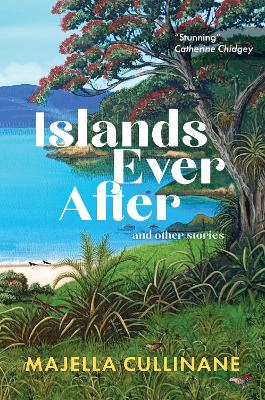
Extract: Islands Ever After and Other Stories, by Majella Cullinane
We are like islands in the sea, separate on the surface but connected in the deep.’
The separating seas in Majella Cullinane's fourteen beautiful and thought-provoking stories are variously wide, wild and deadly. They segregate islands that are both physical and metaphorical, and isolate the disparate characters that inhabit them. And yet, beneath the surface of each uniquely individual tale lies a connecting undercurrent of shared human experience.
Islands Ever After is a collection of short stories, spanning the 18th century to the modern day. Primarily set on isles across Ireland, Scotland and New Zealand, they explore the experiences of outsiders, immigrants, eccentrics and outcasts in search of connection, understanding and, above all, belonging.
.jpg&w=1920&q=75)
The following extract from Islands Ever After by Majella Cullinane (Quentin Wilson Publishing, $37.50) is published here with kind permission.
Falling softly
I first met the sisters outside the arts building at university in Dublin. They came from the Aran Islands, their first language Irish, and for a city boy like me they seemed as exotic as if they’d been two mermaids washed up on Dún Laoghaire harbour.
The sisters dressed in brightly coloured jumpers and corduroy trousers or tie-dye trousers. They wore brown leather Jesus sandals and thick woollen socks. Both were vegetarian, which was rare back then. So much so, I’d had to ask them what it meant. I wondered what their fisherman father would have made of his daughters turning their noses up at mackerel and pollack and shark. I imagined their mother sitting by the fire darning socks as she stared out to sea from the kitchen window, listening to her daughters stir in their rooms, thinking about her husband gone well before dawn. I saw her putting turf and wood into the range and, after she had breakfasted, heading out on a currach to reunite with her husband at some agreed fishing spot.
Their father was an old sea dog, of course, weary like Coleridge’s ancient mariner, with a long white beard speckled with red, a weathered face and cool blue eyes that could see beyond the horizon and the ceaseless waves to an eternity that he could never voice, for there was something secret in the perennial endeavour of fishing, something sacred. I didn’t see then how it would have really been. The days in trawlers, miles from home, casting nets, repairing them, hauling fish, writhing and silver, onto the deck, watching them suffocate with air. The sorting and handling and processing. Enduring freezing, cracked hands, chilblains and tired, aching muscles amid the merged grey of sea and sky.
Deirdre and Grainne were renting a double room out in Cherry Orchard, which was miles from the university, but to get a decent-sized place somewhere closer they needed another lodger, so an old schoolfriend, Seamus, suggested me. It was January, but since the start-of-term rush was well over, we thought it’d be easier finding a flat. As it happened, the pickings were slim. We looked at three. The first had some kind of strange liquid oozing from the slats of the sitting-room floor, most of the door handles were missing, and the landlord looked like he was just out of prison. Being in D4, the second was luxurious and well out of our price range: a renovated Georgian house with sash windows and central heating. The carpet smelled so fresh it could have just come out of the shop that day. The last wasn’t far from Ranelagh village, a popular student haunt. The street was nice enough: red-brick terraces mostly, with small gardens and neatly trimmed hedges. There was the odd spot of squalor along the path, with scattered bin bags and broken bottles. Number 49 looked reasonably well-presented: a black iron gate and railings around the front. The garden wasn’t exactly prize-winning, but tidy at least.
An old man finally answered the door. He wasn’t just old, he was ancient. His shoulders were hunched into his chest like a vulture, and he was dressed in a grey-blue tweed suit.
‘Come in, come in,’ he said in a broad accent, and, as soon as we stepped inside, I wished I’d gasped some air before he closed the door. The smell – a pong, really – that was part fish, part urine and part unknown. I thought I’d throw up. Several cats of various colours strode across the hall like a brigade.
‘Now,’ he said, ‘the flat is up those stairs there.’ Deirdre and Grainne followed behind him. ‘I’ll let you have a look around, and I’ll be back in a few minutes.’
‘It stinks of fish and piss,’ I said quietly as soon as he was out of sight.
‘Well, if it does, Michael, I don’t get it,’ Deirdre said.
‘You don’t?’
‘We’re used to the smell of fish,’ she said, glaring at me behind her Gandhi glasses.
A scene of familial harmony popped into my mind as I imagined seven girls gutting and filleting fish with the other island women on a wind-swept wharf, each having held a blade as soon as they could walk. The old man was back before we knew it, standing on the landing, watching us as we roamed around the four large, draughty rooms.
‘Where are you from?’ he asked Deirdre.
‘The Aran Islands.’
‘Na hÁrainneacha,’ he said. ‘Táim ó Chonamara.’
After that I was lost as they started nattering away in Irish. I was useless at Irish. Even after I left university, I used to dream I’d failed Leaving Cert Irish and couldn’t go to university. I’d only just passed.
After a few minutes the old man turned to me and glowered. Deirdre smiled, and I could have sworn I heard her say the word deartháir. She winked at me, and when Grainne caught my eye, I could see she was having a hard time not busting herself laughing.
Apart from the pong, the worst thing was the glass cabinet of stuffed pheasants on the landing. I’ve never been much of a man for birds in a cage, let alone stuffed ones staring out at you with unblinking eyes. If the girls’ animal-welfare sensibilities were offended, they didn’t let on as they continued to chat away in Irish.
There was no denying the upstairs, or the flat as it had been designated, would have been something in its day. Traces of its Georgian décor were apparent in the thick, worn carpets, the faded wallpaper, high ceilings and the large mantelpiece, although the fireplace had been closed in and fitted with an electric heater.
Sash windows rattled in the January wind, and the sitting room was as cold as a fridge, its grand-sized period furniture looking as old as the landlord himself. The kitchen was galley-sized; oil and grease on the stove top, and I could see no oven to speak of. The landlord showed us the meter by the kitchen door, demonstrating with a fifty-pence piece how we could get electricity and heat.
Deirdre continued chatting away, and I’d no idea what was being said. I looked at Grainne, hoping my expression might reveal what I was thinking – no way in hell, the place was a health hazard. But she just looked around the sitting room, inspecting it, her face impassive and difficult to judge. At last, we followed the landlord down the creaking staircase, and when he opened the door, the cold winter air was a welcome antidote to the stink.
Deirdre smiled as she bid him good bye.
‘Slán,’ she said, and as we passed through the gate and down the road, she stopped and turned to me. ‘I told him we’d take it.’
‘Are you crazy? The place stinks like a fish yard,’ and I immediately regretted my choice of words as Deirdre stared at me like an affronted schoolmarm.
‘Well, as I said, Michael,’ and she stressed my name through gritted teeth, ‘I didn’t get any fish smell.’
Islands Ever After and Other Stories is available in bookstores now.