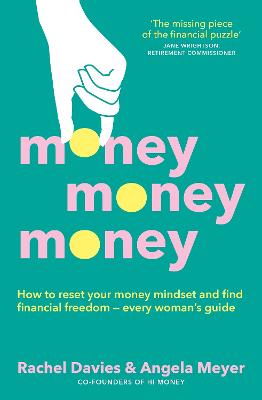
Extract: Money, Money, Money by Rachel Davies and Angela Meyer
Ever put your head in the sand when it comes to your finances? Or wondered how you will survive when you retire? Have you left your financial future up to your partner? Then this guide is for you.
Financial self-sufficiency is the key to living a happy and healthy life. And yet women today are experiencing a gendered financial crisis and have been predominantly left out of the conversation around what you need to know about money.
Money, Money, Money explains exactly what women are up against and provides you with clear steps you can take while navigating your finances, often against the odds.
.jpg&w=1920&q=75)
Extracted from Money, Money, Money by Rachel Davies and Angela Meyer, published by Allen and Unwin Aotearoa New Zealand, RRP $37.99. Out 17 March.
YOUR MONEY BELIEFS
Through everything that’s happened in your life — your family dynamics and cultural values, your relationships, influences, jobs and friends — you’ll naturally have picked up some ideas about money. These are your ‘money beliefs’. Money beliefs run subconsciously underneath everyday life, like programming that influences behaviour.
This is an invitation to locate some of your money beliefs, examine them, test them and update any beliefs that no longer make sense. That way, what you believe about money will become more aligned with who you truly are. And as a result, your feelings, behaviours and actions around money will also be more aligned with who you truly are. Great!
At the end of an in-person Hi Money workshop, a young woman rushed over. She said:
I’m having trouble reframing a money belief. I was born in a country in the Arab States. When I was old enough I asked my father if I could have a job. He said yes, but only if I gave him all the money I made. I said okay. I told him that I was giving him everything I earned. But secretly I saved some for myself. Once I’d saved enough, I ran away to New Zealand. Right now, I’ve got a job selling real estate. But something seems to be blocking me from making money. I wonder if deep down I might believe that money is bad?
Here was a money belief showing up in this woman’s life. Was it even true? If not, whose belief was it? How did it get there? And how could she let it go?
LET’S EXPLORE THE BELIEF: ‘MONEY IS BAD’
This belief comes up a lot. People don’t want to have money because they think it’s distasteful in some way. These beliefs include things like, ‘money is yuk’, ‘money is tacky’, ‘rich people are mean and selfish’.
Can money actually be bad?
Say a person has some coloured paints and a blank canvas. They could paint a beautiful picture. Or, they could paint a distasteful picture. Regardless of what they create, is it the paint’s fault? If the paint wasn’t there, the person wouldn’t be able to paint the picture, so the paint definitely has something to do with it. But perhaps it is the intentions and skills of the painter that are the biggest factor in determining how the painting turns out?
Could it be the same with money? If so, is money getting blamed for the way a person or group behaves with it? Does this blame actually belong elsewhere?
This belief could be reframed as:
• Money is neutral.
• Bad behaviour is bad.
• We can use money in lots of different ways, some good, some bad.
• Money can create radical positive change.
In the case of the woman who approached us after the workshop, there may also have been other, more complicated ideas connected to her belief that ‘money is bad’. Some religious structures promote the supremacy of certain groups (often men), claiming ‘divinely granted’ power, money and right of dominion over others. This belief can come from these structures. In this case the belief could be expressed as ‘money is bad for her to have, but okay for her father to have’, ‘men control money, woman don’t’ or ‘only men are allowed power and money’. These beliefs can get lodged into a person’s psyche, especially in their formative years.
With something potentially painful like this, it’s important to be even more gentle and grounded with any belief-reframing work.
Some ways these beliefs could be reframed are:
• It’s important for women to have money.
• I choose for myself what to do with my money.
• I can be a good person and have wealth.
• Power and money can be shared, and everyone can have what they need.
LET’S EXPLORE THE BELIEF: ‘THERE’S NEVER ENOUGH AND NEVER WILL BE’
Let’s look at a different belief now. A solo mother lived through the Depression. Finances were incredibly tight. For years she fought for survival for herself and her four girls. She was very resourceful, making the most of every possible opportunity. Years later, when cleaning out her things, her children found a box in her drawer labelled ‘pieces of string, too short to use’. Had their mother been operating from the money beliefs she’d formed during the Depression for all these years? If so, what were these beliefs?
Perhaps they were something like:
• Never throw anything away. You never know when you might need it.
• Always be on guard.
• I’ll never be safe enough to completely relax.
If so, how could their mother have updated these beliefs so that she could be ready for emergencies, and able to relax and let go of some very short pieces of string?
Some belief reframes could be:
• I trust that I know how to survive when things are hard.
• It’s okay to relax. We made it. We survived.
• I’m safe.
• If I ever need those skills again, I’ve got them. But right now, it’s time for other things.
• Money can be fun.
• Money can be easy too.
LET’S EXPLORE THE BELIEF: ‘SOMEONE’S COMING TO SAVE ME’
A Hi Money participant said, ‘I just realised that I’ve always thought that someone was coming to save me! But I’m 53. No one’s come yet. I think I’m just going to have to save myself!’
The group laughed, and there were some nods of recognition. She’d found her belief and updated it in the same sentence. ‘Someone’s coming to save me’ had become ‘I’m saving myself’. She beamed. She’d just set herself free to take charge of her own financial wellbeing.
HOW TO REFRAME YOUR MONEY BELIEFS
- Identify some of your money beliefs. You might find some of your family’s and friends’ money beliefs mixed in there too.
- Write them all down.
- Here are some money beliefs that women on the Hi Money course have shared:
• Wealth = yuk.
• I’ll get lucky, and everything will be okay.
• People only like me because I have money.
• Money causes fights.
• A good man will provide for me.
• I won’t get old, so I don’t need to worry.
• Everything I earn has to be invested for the future, with no treats today.
• I’m bad with money.
• You have to work really, really hard for money.
• Caring about money means you don’t care about people.
• I must give all my money to others and be of service.
• Money ruins relationships.
• Being financially powerful isn’t feminine.
• Too much money is vulgar.
• I can only have money if I do ‘good things’ with it.
• It’s not spiritual to value money.
• If others knew I had money, they wouldn’t respect me for who I am.
• I’m not good enough to have money.
• I can’t afford to pursue my dreams.
• I must sacrifice my happiness for financial security.
• To be a serious artist, I must be broke.
- Go through your list. Check each belief. How does it sit with you? Is it factual? Is it correct? Is it in alignment with your values? Could it be more accurate or more aligned?
- Update any beliefs that don’t sit right.
Money, Money, Money by Rachel Davies and Angela Meyer is in all good bookstores now.