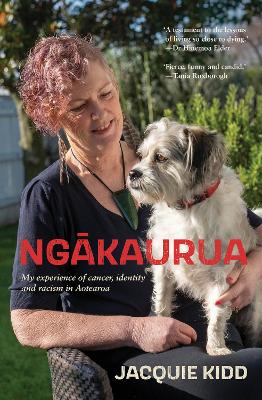
Extract: Ngākaurua by Jacquie Kidd
Jacquie Kidd, Ngāpuhi, has spent a lifetime standing with whānau Māori, who battle a health system designed for others and are twice as likely to die from cancer as Pākehā. Now sixty-two and facing her own terminal cancer diagnosis, Jacquie is telling her story.
The following extract from Ngākaurua by Jacquie Kidd (Cuba Press, $37.99) is published here with kind permission.
Nursing version 2.0
I exploded out of postnatal depression and the end of my marriage with energy and rage. This was not a time of gentle recovery. I’d felt restricted and restrained, stifled for as long as I could remember – starting when I was a young child, who had to learn how to exist safely in a volatile family situation. Then there was my marriage, where I felt that I had to struggle for every independent thought. I had this sense that everything was designed to hold me down, and I wasn’t going to let that happen again.
Beginning my first year of nursing training at Hawke’s Bay Polytechnic was wonderful. I was so excited to be doing something new and to be in a learning environment again. My sense of freedom was linked to having my own car – an elderly Ford Anglia, orange with a cream-coloured roof that had been painted with what I suspect was house paint. It was a two-door model, so the front seats were hinged – flipping forward so the kids could crawl into the back seat, where there were no seatbelts. The floor under the driver’s seat was so rusted that you could see the road. By the end of that year, I was using a slab of firewood to span the less rusty bits so the seat would sit mostly level. Now and again I had to call out the AA technician so he could hold the starter motor in place while I turned the key to get the engine going. But I was mostly mobile, and usually it got the girls and me to where we needed to be.
The first year of the nursing programme was largely spent in the classroom. In contrast to my previous experience of learning signs, symptoms and treatment for common illnesses, in this new education model we explored society and the origins of health and illness. I began to connect the dots about my own experiences and what I’d seen happen with Mum and Dad. The connections between education, financial stability and wellbeing were obvious once I’d been shown them, although on my own I was only dimly aware of how society worked. The feminist thinking I’d developed from my year inTaupō was amplified by lectures that covered social deprivation and neoliberalism; my mind was blown almost daily. I was so captivated by this new knowledge that for a time I didn’t notice there were big gaping holes in the neat presentations we were given about the population of Aotearoa.
At the same time, I was also coming to terms with the knowledge that what I thought I knew about myself as a learner from my school years was just not true. I knew that reading novels in class time and not doing homework had made it difficult for me to stay on track as a teenager, but underneath that, I also thought I wasn’t all that clever. But in this iteration of my education, I discovered that I was actually pretty good at maths, physics, chemistry and biology. They were all subjects I’d previously been mystified by and failed miserably at. Not this time! Each lecturer ensured that their topic was firmly linked within the wider nursing curriculum, so I not only knew what I needed to learn, but why it was important to understand, and how I would make use of my knowledge as a nurse. I’d take my textbooks to class and make study notes in the margins. I did my homework, including additional reading, for the first time ever. In sharp contrast to my high-school years, this time I studied carefully and aced every exam. I can’t explain how intoxicating it was to look at the grades on my assessments and understand that I was a successful student.
As an educator now, I am not only grateful for the skills of those lecturers in how they scaffolded and illustrated their content, but also for a cohesive curriculum that kept each paper connected to and working with the others. This approach is not common anymore, as a more university-based style of nursing education has evolved, where papers are largely independent of each other, and it’s the student nurse who has to figure out how each one relates to the rest. Apart from the clinically focused papers, which still have a clear progression from basic to complex, nursing education can be fragmented, so students don’t develop the same sense of purpose about their learning. While it’s good that nursing education has evolved, some of these changes definitely make it harder for students and lecturers alike to make sense of what content they need to cover, why it’s important, and where it all fits with practice.
The newness and excitement of classes made me feel focused and happy for a while but anger was just below the surface. As I sat through the lectures, I began identifying things that really pissed me off. I felt like my temper was constantly at a simmer.
First of all, the nursing curriculum in the 1980s was built around the assumption that the ‘ideal nurse’ was young, female and white. Apart from the sciences and two stand-out men in the mental health teaching team, all the lecturers were older, female, straight and white. Their worldview was narrow, smug and – in my view – unchallenged. They didn’t seem to turn a reflexive eye over their own experiences. Consequently, their lecture content was filled with assumptions that their student audience was the same and that no alternative perspective existed. I was one of very few mothers in the class, and apart from me there were three wāhine Māori students who were also mothers, and only one man. The bulk of the class were young white women who had just left school.
In class, the phrase ‘those people’ was applied freely to anyone non-white and not straight, and lecturers drew heavily on prejudicial stereotypes that often veered into outright racism and bigotry. The example that has stayed in my mind all these years, and still raises my blood pressure, came in a social science lecture. The topic was something about how people could improve their wellbeing by making healthy lifestyle choices. Examples were things like drug and alcohol use, education, contraception and healthy eating. Remember – this was in a small rural city, distant from the political centres of the 1980s, and an early year-one class filled with mostly privileged white girls who had little life experience. In a wider context, HIV and AIDS were coming to the attention of the Aotearoa population, but most media attention erroneously framed them as a problem for the marginalised and stigmatised populations of gay men and intravenous drug users. The land march led by Whina Cooper in 1975 and the 1981 Springbok tour protests were mere blips in white memory that had been eclipsed by the interwoven myths of Godzone as a place of heterosexual nuclear family bliss, racial harmony and meritocracy.
The class started as expected, with a description of what we now refer to as the ‘social determinants of health’. They’re logical. The healthiest among us tend to have a warm and dry house; a good education, which leads to a steady source of liveable income; a secure, nutritious food supply; social inclusion; and access to good healthcare within a healthy, non toxic environment. Like I said, they make sense. The difficulty with these social determinants of health comes when someone with a narrow life perspective tries to explain why some groups of people don’t have what they need to make them healthy. This lecturer was a small woman, grey haired, white skinned, with a British accent, and many years of nursing experience. Her concern for unhealthy populations related to ‘those people’ making poor choices. Her lecture started with the problems related to teen motherhood, known then as ‘being a solo mum’. I switched off for a moment when she made a statement about the unforgivable ignorance of those people who either get pregnant or allow their child to get pregnant as a teenager. At that point, my brain thought: ‘So she’s saying my mother – my mother – was ignorant and made a poor choice when she had me?’ When I zoned back in, she was in full flight about Māori (pronounced ‘Murries’, of course) because they didn’t care about being healthy and constantly made bad choices that overburdened poor nurses. I promptly switched off again, and instead started linking her statements together. This woman was running my mother down; now she was doing the same with my adored grandmother, and by extension, she was dismissing, discounting and disrespecting me as well, a ‘solo mum’ reliant on a benefit to stay in my nursing course. I was stunned, hurt and furious at her ignorance and casual dismissal of my whānau. It was a highly personalised, powerful moment of realisation for me, albeit still uninformed.
I’ve recounted my experience of that moment quite a few times over the last three decades. In all her ignorance and smug superiority, that nurse ignited in me a fire that underpinned my need to make a difference, to do everything I could to challenge ignorance – in myself and in other nurses, to furiously resist those neat, devastating stories about what it meant to be Māori. And I knew I needed to start paying attention to my whakapapa, because I could see that her way of thinking was going to damage it irreparably. Until that moment I hadn’t considered that Māori were under threat. By extension, my precious daughters were threatened too.
In that moment, and for the remainder of my first year, I was raging. I felt overexposed somehow, as though every injustice was a personal cut. And there were a lot of injustices. I stood for election for the student association and became president. In that role, I attended the polytech’s board meetings, where I personally encountered, for the first time, what seemed to be the absolute power of white businessmen. With my blue collar, avoidant upbringing, I hadn’t really encountered them before. There was one kuia who attended those meetings on behalf of her iwi. I would watch her shakily deliver requests for the development of structures to support Māori students, which were immediately voted against by men with eyerolls and smirks. I always cast the student vote with her, but it was two against everyone else.
I was also frustrated at nursing in general: how we functioned, our hierarchy, our narrow minds, our lack of power. I can’t believe I managed to graduate with all those thoughts in my head. Everything felt so unfair. Nobody listened. Nobody was interested in the people who didn’t have the power. I focused on injustices and inequalities, which meant I was always looking at deficits. I hadn’t reached the point where I could articulate issues of equity and the possibility of multi layered change.
Ngākaurua: My experience of cancer, identity and racism in Aotearoa is available in bookstores now.