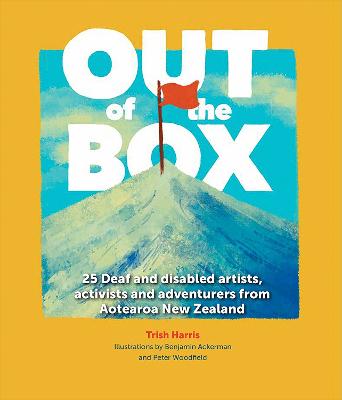
Extract: Out of the Box, by Trish Harris
In Out of the Box, an illustrated book for readers aged 12+, author Trish Harris shares the stories of 25 Deaf and disabled New Zealanders – artists, activists and adventurers – who have broken open the box and claimed their space. ‘They’ve put a flag in the ground, as in the drawing on the cover,’ writes Harris. ‘They’ve said, “I’m doing life my way” and “this is what I need, in order to be who I am”.’
The second half of the book provides a detailed timeline of significant Deaf and disability milestones in Aotearoa New Zealand, from the 1840s to the present day. This little-known history anchors the stories in the events and attitudes of their time, and enables readers to see how political decisions and social progress have a real impact on people’s lives.
.jpg&w=1920&q=75)
Extracted with kind permission from Out of the Box by Trish Harris, Otago University Press, RRP $45.00
A C T I V I S T
Don McKenzie
A fearless cyclist and his dogs
Don flew up the street, whizzing past parked cars. He loved riding his bike.
‘Wow – there’s that little blind kid, on a bike!’ a neighbour yelled.
Don could only see blurred shapes and his sight was getting worse. One time he crashed into a car – denting it and scratching himself. A neighbour yelled then, too.
It was the 1940s. Don’s parents had moved the family to Auckland so he could go to the school for blind children. That’s where he learned to read braille and type it on a big, noisy braille-writing machine.
Braille: A code or writing system made of raised dots that helps blind people read and write.
When he was seven Don’s eyes became more inflamed. The surgeons took them out. It felt as sudden as that. He started to wear dark glasses, but only so that other people wouldn’t feel uncomfortable. People stared when they saw his eyelids, sunken in because there was no eyeball behind them. When his eye sockets stopped growing, he got artificial eyes. These weren’t bionic eyes because such things didn’t exist. But they looked like real eyes and that made people more comfortable around him. He said good riddance to the dark glasses.
When he was older Don used memory and his senses to navigate on and off trams and through streets to get home. But he knew there was an easier way. He’d heard about dogs in the United States helping blind people travel anywhere and he wanted one.
Don won a scholarship to study physiotherapy in England and that’s where he met Jassel, his first guide dog. She was amazing. He went all around England with Jassel and then brought her home. Only three other people in Aotearoa New Zealand had guide dogs then, in the mid-1960s, and businesses didn’t understand how they worked.
Don rang up the local bus company to ask if he could bring Jassel on the bus. They said no. Don rang another bus company.
‘Will she bark? Will she run around the bus? What if she wants to go to the toilet?’
‘She’s been specially trained to be quiet,’ replied Don. ‘She’ll tuck herself under my seat and won’t get in anyone’s way.’
They went for a trial ride and Jassel behaved perfectly.
‘You and Jassel can come on the bus any time,’ said the bus company.
Don and other people with guide dogs travelled around the country to explain the wonderful job their dogs did. They wanted New Zealanders to understand that guide dogs were working dogs and needed to go into public buildings and other places dogs weren’t usually allowed.
In 1980 Don became the first blind person to become president of the Royal New Zealand Foundation for the Blind. He also became a leader in wider disability groups.
‘Even though someone in a wheelchair needs different things than someone who is, say, blind, if we work together we have more power to make important changes that will help everyone.’
Don says guide dogs made a huge difference in his life.
‘Jassel knew where I wanted to go almost before I knew it myself. She was my constant companion for eight years.’ Don loved her so much, it still makes him sad to talk about her.
‘After Jassel, I had Haley, then Siena, then Holly. Now I have Asia. All my dogs have loved working and wag their tails when the harness goes on, as it means an adventure. We’re a team – that’s what matters. Labradors also love their food. Right now, Asia is nudging me because it’s time for dinner!
.jpg&w=1920&q=75)
Out of the Box is in all good bookstores now.