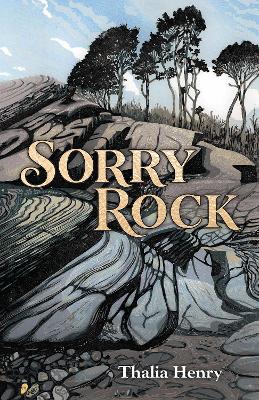
Extract: Sorry Rock, by Thalia Henry
Find me here where the sea meets the land
Where the rocks are black and so is the sand
On the wild west coast of Aotearoa, twelve-year-old Ned lives with his mother in a bach above Te Henga's black sand beach. He is thoughtful and observant, the sort of boy who knows that too much in his life is unexplained. His cousin Hugo is different. Restless, he pushes towards trouble. Alice stands apart from them, older, still tethered to memories of a childhood in the Northern Territory.
With an ochre rock at the beating heart of this story, their journey draws Ned, Hugo, and Alice from New Zealand's volcanic shoreline to Australia's red desert. Along the way, they begin to uncover the silences surrounding the women who raised them, absent fathers, and the consequences of choices made long before they were old enough to question.
-1.jpg&w=1920&q=75)
Extracted with kind permission from Sorry Rock by Thalia Henry, Cloud Ink Press, RRP $34.95
Set years before the events of Sorry Rock, this childhood memory takes place at the Moeraki Boulders. It sits early in the novel, where small moments begin to pose questions and gather weight.
***
Candice picked up the album beside Tom. It tilted, and a photograph slipped out. She picked it up, trying not to look, but after a few seconds she couldn’t resist. The picture wouldn’t have fallen out if she hadn’t been meant to see it.
Surprisingly, the photo didn’t feature her parents. The grainy image showed Candice and her two sisters sitting on a smooth Moeraki boulder. On holiday in the South Island, they dangled their legs towards the sea with their backs to the camera. The girls were huddled together, in order of age, with Layla in the middle. Candice and Gwen were clinging to her, so they didn’t lose balance and topple off. It must have been cold that day, with everyone wrapped up, though Candice couldn’t recall the chill. Children don’t notice the cold as much.
In the background, the sea was calmer than it was at Te Henga but still blustery, and the waves behind the boulders rolled with caps of white foam. It was funny how she hadn’t remembered the day being cold, yet she recalled the grey sand at Moeraki. East Coast grey, so different to the black sands of Te Henga. She could feel her cheeks streaked wet, and her insides heavy.
‘There were once many more boulders on Moeraki Beach,’ Candice’s mother told her that day, ‘but the smaller ones people stole, to decorate gardens.’ Thieves had taken pieces that’d fallen off the gigantic boulders too, and carried them away. Enormous boulders remained, battered by wind, rain, sun and sea. Remaining fragments lay about, amongst the larger boulders, like infants.
Some of the boulders’ fragments and insides were gouged out, with segmented white veins running across their surfaces at lightning-bolt angles. Inside one of the boulders she’d found a rock pool filled with clear salt water and a magical world with limpets, sticky looking goo that wavered about, shrimp whizzing about attending to business, and a starfish.
Young Candice had been curious.
‘Mum, why do the boulders exist? Are they dinosaur eggs? Or the skulls of buried giants?’
In some places she’d seen that people had engraved their names into the soft surface of the mudstone. A secret part of Candice wanted to take a boulder home too, except only big ones were left. She could imagine it in their garden by the bach, unlike any of the pieces of bare smooth river stone or jagged volcanic rock that other people had in theirs. The boulder would be a magic fortune-telling orb with thin lines running through it like fingerprints.
The photograph slipped from the album as Candice moved it, fluttering to the floor like a leaf detaching from its branch. She hesitated, then picked it up again. In that moment, Candice saw the boulders not just as geological formations but as symbols of endurance. Smoothed by centuries of wind and sea, these ancient rocks had weathered storms and witnessed generations come and go. Some had been taken, their absence like human longing. She hadn’t seen that as a child, but she had wondered about many things.
‘Why did people take the rocks?’ she’d asked her mother.
Her mother told her that people took boulders as souvenirs. Some had been returned to the local marae or Otago Museum over time. The place was protected now or was supposed to be.
‘Do you think if there were small boulders still here or pieces that were broken off and easy to carry, people would steal them still?’
Her mother was quiet for a moment, then she nodded. ‘Some people always ruin it for others.’
‘Wouldn’t the people who took the boulders get in trouble?’
‘I don’t think so. Not in those days.’
Her mother talked then for a long time about the earth and how no-one really knew how the boulders got there. She reckoned they were a bit like oyster pearls, starting with a grain of sand. They were, she mused, the result of pressure, time, and the world’s own kind of patience, transforming the smallest particles into something extraordinary.
Candice told her two sisters about this later, when they were back in the North Island, sitting inside the cave at the end of Te Henga, telling secrets.
Layla scooped sand in her hands. ‘That’s silly,’ she said. ‘People should leave the rocks where they are, even ancient dinosaur eggs. Did you see that some of the eggs had cracked open? At least a few of the dinosaurs must have hatched.’
Candice hadn’t thought of that. Could it be that baby dinosaur remains were still trapped inside, like when insects sometimes got stuck in fossilised tree sap? Her oldest sister, Gwen, was quiet and didn’t reply. Gwen was often silent like this and didn’t give much away. She thought about things too much and was staring towards the cave’s exit, where light formed a path across the sand. It didn’t look like Gwen was listening. She must have been thinking of other things instead.
Sorry Rock is available in bookstores now.