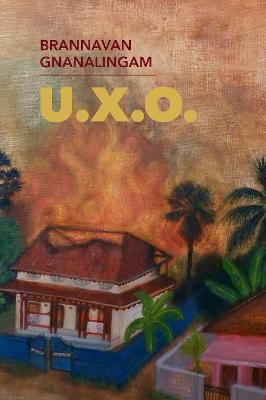
Extract: U.X.O, by Brannavan Gnanalingam
A happy story: a grandfather recounts the daring of his younger years to his grandson.
A memoir: an ex soldier writes to his only grandson in contemporary Aotearoa about serving in the Indian Peacekeeping Force.
A confession: an ex soldier writes of the horrors of Jaffna during the Indian Peacekeeping Force intervention (1987-1990) during the Sri Lankan Civil War.
U.X.O. is a powerful investigation into the extent to which people can be held to account for war crimes, decades later in a country on the other side of the world.
.jpg&w=1920&q=75)
Extracted with kind permission from U.X.O by Brannavan Gnanalingam, published by Lawrence & Gibson, RRP $30.00
2 March 2026
I once told Arjun this wasn’t the first town called Wellington I’d lived in. I then had to elaborate that I’d been places, because I’d been in the Indian Army. We’d trained in a town called Wellington.
The boy had such an impressive memory that he remembered those throwaway lines when, years later, he had to do a project on one of his grandparents. I was the most interesting of us for a young boy, in that I offered the promise of adventure, derring-do, something the others didn’t.
Ever since Nalini, my wife, died, I was the boy’s only direct connection to his Indian heritage. His father – my son, Bala – doesn’t remember much of his life in India. We moved to New Zealand in 1992 when he was six, and he quickly assimilated into the Kiwi way of life.
Bala had no interest in hearing my stories of what I did before we came to New Zealand. I came to accept that disinterest, as I’d rather he was a success here than be limited by the markers of success in India.
Yet, he married a Sri Lankan girl, a bargain struck by the time us parents could intervene. As parents, there was something convenient about love marriages, even if Nalini was concerned about the long-term resilience of Bala’s choice. I enjoyed there was none of this nonsense about dowries, pushy relatives, or endless cups of over-milked tea.
Bala’s wife, Kaushiki, never asked about our life in India, either, even when feigning politeness in the way daughters-in-law are forced to. I was simply Bala’s father, a Mama to her, and she was required to show the same amount of interest in me that Bala did, which was, needless to say, not much. When Arjun came, he became our fallback to the silences that punctuated our conversations. Both of her parents were dead, too, so I couldn’t form a bond at her parents’ generational level.
I was unprepared emotionally when Arjun asked me about my past. He was earnest, with a pad and paper at the dinner table, mimicking the behaviour of a television journalist. It was as if he’d been plotting all day. Most of all he wanted to know of my life before we came to New Zealand, even when I suggested a more interesting story would be about moving to a new country in my thirties, when I had no familial or social connections.
But Thaathaa, Arjun said, your life here is the same as everyone else’s. I want to know what you did in the Army. Do you know how to use a gun? Did you have to use a gun?
Bala had me around most weeks, thinking I wasn’t capable of feeding myself ever since Nalini died. Of course, he wouldn’t have dared invite us over for dinner if Nalini were still alive, in case he was inadvertently criticising his mother’s cooking and unduly lauding Kaushiki’s. Nalini had grudging respect for Sri Lankan Tamil cuisine, but I wasn’t going to get in the middle of any tension in that regard. I didn’t complain now, though, as the regular visits gave me some structure across those formless days of retirement.
Kaushiki furrowed her brow, almost as if Arjun's question was one she should have asked in the past. She tried to shush him in case I’d be offended by the suggestion, or maybe she’d hear things she didn’t want. I’d never told her I’d been to Sri Lanka, after all. I don’t know why I never told her. It just never came up. Maybe she’d have thought I’d talk to her about Galle and the beaches.
Arjun looked at me with such expectation I didn’t want to disappoint him. Like, did you fire at the baddies in the War?
Bala said, Thaathaa wasn’t in a war.
I had never told Bala I used to write his name on my arm when I was on duty.
Undeterred, Arjun said, Thaathaa told me he was in the Army. Do you know what a gun is?
I wanted to talk. I never could say no to Arjun. I remember what it was like to be a young boy. You trusted adults in a way that made you truly listen to what they were saying. It was obvious for Bala and Kaushiki, this wasn’t their preferred dinner table conversation.
Their hesitancy could also have come from their confusion. They’d shown no interest in my life. Bala, in particular, seemed unnerved by the news. I’d assumed he’d have asked Nalini what I used to do, where I’d been for that long period in his early childhood, but he obviously hadn’t. Or maybe he thought I was just being a nuisance, telling the kind of tall tales only a grandfather can do, the type of stories he’d have found embarrassing when he was Arjun’s age.
Bala said, Eat your food, and Arjun put down his blank pad of paper with disappointment.
The following week, Arjun told me he had to do his report and he’d like me to tell him what I did in the Army. You can tell me if you know how to use a gun, he said.
I tried to ignore the disapproving comment from Kaushiki about not bothering Thaathaa. I got the sense she half wanted to know. She was Sri Lankan Tamil, after all. Her father had passed before they moved to New Zealand, so she didn’t have that fatherly influence in the same way, either.
I said to her, I was like him as a boy, it’s OK. My uncle fought in World War Two, in Monte Cassino and throughout the Italian Campaign, and I’d wanted to know all of the details from him. Of course, my curiosity about my uncle’s exploits weren’t shared by my uncle himself. He never wanted to talk about the war unprompted, but he’d do his best to respond to my incessant requests for tales of heroism, the details of the battles, the specifics of the weapons. He’d finish talking the moment any questions stopped, though, refusing to elaborate for the sake of the story.
I promised Arjun I would write something down, something he would understand. I always liked to write, scribbling in notebooks even if I was never nostalgic enough to keep them. Maybe I’ll write something he’d be able to read when he’s older instead, when he’d be more aware of the complexities of our past lives, more attuned to the twisting of memories into complete sentences.
My Appa always told me to get my head out of books. That I would gain nothing from reading the English classics, which you could buy for only a few rupees in the big bookstores in Madras, as all they would do was distract me from my studies. Amma, though, would buy on request. She had a long-term strategy she refused to articulate, and I knew Amma and Appa would argue over the amounts of money she’d spend inciting my passion for books. She was right. I’d pore over abridged versions of Dickens, Robert Louis Stevenson, Dumas, along with books on unsolved mysteries and great cricket achievements. The stark white pages would fall out as the cheap binding couldn’t cope with my frantic re-reading. I’d have to hide the books under my mattress whenever Appa was on a rampage. That was the reason why my English was so much better than my peers’.
I never stopped keeping a diary, even if I had burned certain editions from my past life. I recently discovered a box of my early New Zealand memories, but I struggled to recognise the me that wrote those. They were so earnest and naïve about New Zealand. I like to keep a record of what I’ve seen and done, and what I’ve thought, on any given day. I repeat as a mantra, each time I start a new diary, that these are simple collections of leaves of paper, and that words will always be fragile. They only last as long as you want them to. There was no obligation on me to re-read. Maybe one day, Arjun might read my memories, much like the younger generations of New Zealanders who have translated their forefathers’ diaries from World War One and World War Two.
This time, Arjun wanted to read my memories. I didn’t know if I could trust those. I was never very good at remembering details. Nalini was much better at that.
Kaushiki said, Mama, no. He doesn’t need to know about fighting, we’re trying to teach him other values.
I told Kaushiki, Don’t worry, I won’t go on for a thousand pages. I won’t be writing War and Peace. I’ll just touch on the key parts, maybe weave it all into more of a story Arjun can follow. Just a story. Not a history.
She wasn’t curious enough to ask me what war: Sri Lanka, Kashmir, Nagaland, Bihar. She probably didn’t know much about the history of conflict in our vast subcontinent.
Anyway, you need to stay for dinner, she insisted, and after a show of pretending I already had leftovers waiting for me at home, I relented.
So here I am now, trying to remember, at the bottom of the world, filling in the latest incarnation of my diary, as a gale-force Southerly howls over the hills. I have a nice bottle of scotch with me, too, for those memories. Another war is starting – bombing, missiles, chaos – and I can’t bring myself to listen to the news.
Arjun’s eyes had been pleading at the dinner table, and I wasn’t going to let him down. So, I will write about the War, the Army, the camaraderie, and record what happened so he won’t ever forget.
U.X.O is available in all good bookstores now.