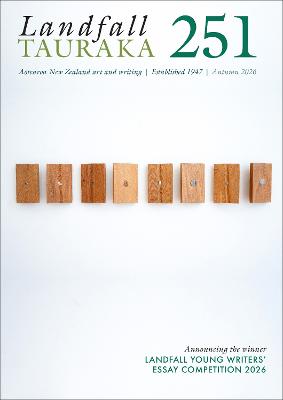
Four authors from Landfall Tauraka 251 speak
'It’s always lovely to sit down with Landfall Tauraka and find an array of voices in it: young and old, familiar and new.' Anuja Mitra
Kete asked four of the writers with work included in Landfall Tauraka 251 to tell us about their pieces and what being published in the journal meant to them. Read on to be inspired to pick up this issue, published in May 2026!
.jpg&w=1920&q=75)
‘Blood Moon’, by Molly Crighton
Tell us more about your piece and what it means to you?
‘Blood Moon’ is about a woman in an emotionally and financially abusive relationship. She reaches her absolute breaking point, which manifests as an extreme bodily transformation. I like writing about emotional extremes, and I was thinking a lot about Greek tragedy and stories like Ovid’s ‘Metamorphoses’ as I was writing. Sometimes ancient writing captures unthinkable acts (and their consequences) better than we do: extreme tragedy, extreme torment, extreme rage. I wanted this story to be gruelling right up until the end, where I wanted the reader to feel sudden catharsis.
How do you feel about having it in Landfall Tauraka?
I was nervous about submitting this piece for publication, especially as I wrote it toward the end of the relationship that it’s based on. But now that it’s out in the world, I feel really glad I sent it in. It’s hard to recognise abusive behaviour when you’ve been distracted by making yourself as small and unobtrusive as you can be, so digging deep and pulling up my own feelings and memories to lay them bare on the page felt really cathartic. I loved writing the ending for that reason – I got to free Freya in the way I wanted to be freed, and eventually was. Though less dramatically!
‘ascension’, by Hana Buchanan
Tell us more about your piece and what it means to you?
‘ascension’ is inspired by my mother, Mary Buchanan (nee English) 1945-2022. It’s a mihi to her and an exploration of the different aspects of her that spoke most strongly to me. I often write ‘on location’ and the bones of this poem were composed on the side of the road near my old family home in Pōneke. The ‘action’ of the poem also largely takes place in Pōneke, or in Taranaki. ‘ascension’ is a celebration – he kupu mihi, and a teardrop or two flowing into the great tides of grief and loss – he kupu aroha.
How do you feel about having it in Landfall Tauraka?'
Very satisfied! Mum grew up in central Southland and studied at Otago University. I felt this would be a good home for ‘ascension’, and it turned out to be so. As a Māori writer from Te Ika a Maui, the recent adoption of the fuller name Landfall Tauraka also makes this a more comfortable landing place for my toikupu-poetry with acknowledgements to Te Wai Pounamu and Kāi Tahu.
‘No Second Stone’ and ‘Rails Pinned to Sleepers’, by Brent Kininmont
Tell us more about your piece and what it means to you?
My two contributions to Landfall Tauraka 251 are prose sonnets, though they might be very, very short stories. ‘Rails Pinned to Sleepers’ features a steel rail spike I bought in a second hand shop in Rangiora. Every line actually happened. It was just a matter of figuring the right combination of details, which took months. The other sonnet, ‘No Second Stone’, is the best of my recent work. The words and sounds just seem to belong together. It begins with a memory of my widowed father cooking a big Sunday dinner and freezing plates of the meal for the days ahead. After that, imagination took over.
How do you feel about having it in Landfall Tauraka?'
Though I have lived in Tokyo for years, I mostly submit poems only to publications in Aotearoa. That’s where the readers in my head live. At the top of the heap is Landfall. If I receive an acceptance email from the journal, it’s akin to getting an A+ from an English teacher you really respect. It also comes with a sense that, despite the physical distance, I am still part of the arts community in Aotearoa. Acceptance is a spur for my writing, and my spirits.
‘Canary Row’, Anuja Mitra
Tell us more about your piece and what it means to you?
The poem weaves together several related strands of my personal and family history revolving around the theme of reading, and my Dad’s prophetic habit of giving me books when I was young that I would only appreciate later (for example, gifting me poetry before I wrote poetry!) I’m often anxious about being transparently autobiographical in my work, so this is a special piece — everything in it is true or at least ‘true’ in my memory. The anecdote my Mom told me about visiting ‘Canary Row’ in California is definitely true. We still read and discuss National Geographic, which my Dad subscribed to since around the 1970s, even though my Dad sadly isn’t here to read it with us.
How do you feel about having it in Landfall Tauraka?'
It’s an immense honour (and confidence boost!) having the poem in Landfall Tauraka. It’s my second piece in the journal, the first having been included in Issue 244 and now appearing in my chapbook ‘Bruised history’ featured in AUP New Poets 12. It’s always lovely to sit down with Landfall Tauraka and find an array of voices in it: young and old, familiar and new. I hope it continues highlighting diverse writers and their stories for years to come.