Review: Harry Turbott: New Zealand’s First Landscape Architect
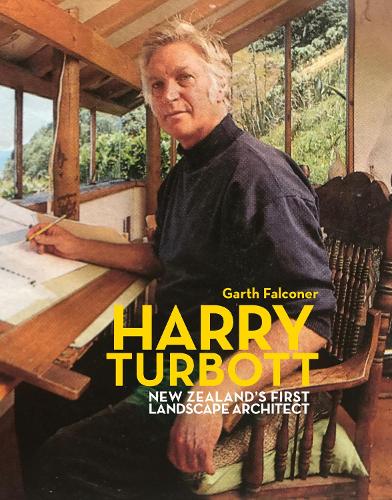
Harry Turbott (1930 – 2016) was probably the first New Zealander to practise as a landscape architect. In the early 1960s, when he began his 40-year career, “landscape architecture” in this country was barely a thing. There was landscaping activity, of course, carried out by gardeners, horticulturalists and roading engineers, but since European settlement began there had been little holistic consideration of the bigger environmental picture. Turbott was one of the first landscape practitioners to address in a systematic way the issue of how our built environment might exist in harmony with our natural environment. He believed a building and its landscape should be treated as one.
Garth Falconer’s book in honour of Harry Turbott’s life and work is partly a biography, in which Falconer draws on his interviews with Turbott in the last months of his life, and partly a professional profile (“Harry’s greatest hits”). It also includes contributions from several other writers, among them an insightful commentary from architecture academic Michael Dudding, who gets to the nub of Turbott’s significance: “Harry’s genius is in the way his designs bring forth the land as a context for human action and reflection.” The book is unashamedley a polemic, timely amidst all the calls for “shovel ready” projects, for a humanist and culturally sensitive approach to intervening in the landscape.
It is also an apologia, most explicitly in a section on the North American origins of the modern discipline of landscape architecture, for a profession that is still sensitive to the squeeze of architecture on one side and planning on the other. (Falconer is himself a landscape architect).
The figure who emerges from Falconer’s book is engaging and accomplished. Turbott wasn’t a rebel but he had an independent streak and was not one of life’s joiners. Born in Gisborne, he was brought up in Auckland by his Presbyterian solo mother after his father, an eminent doctor, scandalously conducted an affair (with his nurse). Falconer doesn’t explore the pyschological implications of this family fracture – it’s not that sort of book – but the scars seem to have run deep. Turbott and his father never reconciled.
Turbott attended Mt Albert Grammar, got a job in the office of W.H. Gummer, the preminent Auckland architect of his day, and then studied architecture at Auckland University College. He was a diligent, teetotal student who played soccer for the YMCA and the cello in the Auckland Youth Orchestra. He opted to undertake post-graduate in the emerging field of landscape architecture and a Fulbright scholarship allowed him to attend the prestigious Graduate School of Design at Harvard University. Upon graduating, he wrote to influential American landscape architect Dan Kiley asking for work. Kiwi ingenuousness was rewarded when Turbott and his wife, Nan Manchester, turned up in the middle of the night at Kiley’s home in rural Vermont. Turbott had misinterpreted a polite New England rejection letter as a job offer.
Turbott worked for Kiley until his visa expired and it was an important time in his life. Kiley was a model of individualism and industriousness; his work fused Modernism with the geometric formalism of the great 17th century French landscaper André Le Nôtre, designer of the gardens at Versailles. Turbott shared these enthusiasms. After he and his wife left America, their Kombi van European tour included Le Nôtre gardens and buildings by le Corbusier, the most celebrated Modernist architect.
Returning to New Zealand, Turbott built a career that combined design work and teaching at Auckland University. He built a family home at Karekare on Auckland’s west coast, the place that, more than anywhere, was his tūrangawaewae. Turbott was often frustrated by the limited opportunities in New Zealand to practice at a significant scale, and by a bureaucratic lack of vision, but made the most of commissions to work on motorway projects and in the National Parks. He contibuted to visitor centres at Lake Waikaremoana and the Waitangi Treaty Grounds. He landscaped Auckland Council’s Modernist housing estate at Freemans Bay and a large resort in Fiji. He restored a 19th century “palace” in the Cook Islands and, at the end of his career, designed the Arataki Visitor Centre in Auckland’s Waitākere ranges. He was a staunch defender of the Waitākeres against development and was instrumental in saving Mimiwhangata in Northland from a Gold Coast-type real estate scheme.
There was much more. When researching his book, Falconer examined Turbott’s designs for 800 projects. In the book, Turbott’s career is cast as a journey away from Modernism – the villain of the piece, for Falconer – and deep into the territory of “organic” design. Perhaps; it is certainly true that Turbott was increasingly, and impressively, concerned to work with nature, not against it, and to express the spirit of this place. Turbott never completed the books he started to write. Falconer is to be commended for ensuring Turbott’s work has been entered into the record and that a good New Zealand life has been remembered.
Reviewed by John Walsh