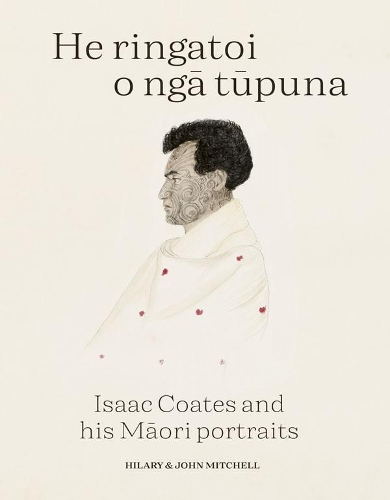
Review: He Ringatoi o Ngā Tūpuna: Isaac Coates and His Māori portraits
Some of the most familiar portraits of the famous mid-19th century Māori leaders Te Rauparaha and Rangihaeata, copied and replicated hundreds of times, are now known (since 2000) to be originally the work of one Isaac Coates.
Coates (1808-78) was an English artist who spent the years 1841 to 1845 in New Zealand, mostly in the Wellington and Nelson provinces, during which time he produced watercolour portraits – invariably profiles – of 58 Māori from the region. Coates is now the subject of this comprehensive study by the indefatigable research team of Hilary and John Mitchell who have published many studies of the history, especially the complex Māori history, of the “top of the South.”
Although many of Coates’ subjects are men and women of the chiefly class, he was not exclusive in his focus and included some commoners and even one slave among his subjects. A valuable feature of his practice is that he usually included the name, tribal affiliation and place of residence as a caption to each picture. This gives his portraits unique historical importance (especially to Māori) as in many cases they are the only existing record of the person’s appearance.
The Mitchells’ study is constructed in five parts. The first part deals with Coates’ family background; he belonged to a well-established Quaker family from the country of Durham in Northern England. Coates was in business, mainly in the bookselling and printing trade, for some years before emigrating to New Zealand in 1841. The second part sets the context for Coates’ five years in the colony with accounts of tribal movements in the region, especially the migration of Te Rauparaha’s Ngāti Toa tribe from Kawhia in the Waikato to the Kapiti Coast, of the activities of the New Zealand Company in its settlements of Wellington and Nelson and of the background to the celebrated Wairau affray in which Te Rauparaha and Te Rangihaeata clashed with land-hungry settlers on the Wairau plains – a defining event for race relations in mid-19th century New Zealand.
Part three deals with the known facts of Coates’ career as an artist in New Zealand and includes a useful assessment of his art by Julie Catchpole, director of Nelson’s Suter Gallery. An especially interesting chapter is devoted to the distribution of Coates portraits in collections around the world, only one of which is in New Zealand. The Alexander Turnbull Library in Wellington has around 30 of Coates’ portraits or copies made by himself or others but the largest collection is at the Pitt Rivers Museum at Oxford University which includes 52 of the known portraits. Smaller collections are also held at Peabody Essex Museum in Massachusetts, USA, at The Australian National Library in Canberra and at Nelson Provincial Museum. The Mitchells have studied the originals and copies of the portraits in all of these institutions.
Part Four, Coates’ Māori Subjects, is the core of the book with each portrait getting a full-page colour reproduction plus smaller images of all known copies. The well-informed text includes numerous genealogical tables (whakapapa). This part occupies more than 250 pages, well over half of the book. A fifth final part deals briefly with Coates’ rather tragic life after leaving New Zealand for Adelaide; his young wife and daughter died of illness. Coates also spent some time on the Australian goldfields before returning to England about 1860.
It is a weighty and well-researched publication which will be an invaluable work of reference and will also appeal to readers with an interest in art history, Māori history and the culture of early European settlement.
Reviewed by Peter Simpson