'Injustice is a common theme': Eugene Bingham, author of THE CHIEF AND THE EMPIRE
Eugene Bingham (Pākehā, Ngāpuhi) has won multiple awards as one of Aotearoa's most respected investigative journalists, reporting and producing news and current affairs across newspapers, television, digital and podcast platforms. Memorable projects include the Teina Pora miscarriage of justice case, and investigative documentaries The Valley, Infinite Evil and Life + Limb. He co-produced the internationally acclaimed podcast The Commune as well as other award-winning podcasts Witi Underwater, True Story and The District. He's a director of Te Pūrongo Productions with long-time collaborator Adam Dudding and executive producer of Mata Reports.
Eugene lives in Tāmaki Makaurau Auckland with his wife, journalist Suzanne McFadden, their children and mokopuna. Kete is excited to share this interview, covering Eugene's new book The Chief and the Empire, his draw to stories involving injustice, and a gifted medal that was missing for 204 years. Read on to find out more.
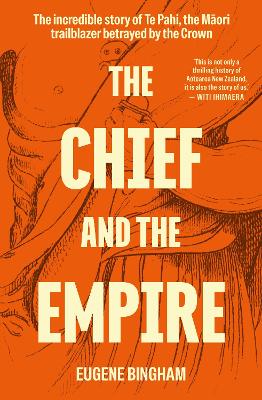
The Chief and the Empire by Eugene Bingham, published by Allen and Unwin Aotearoa NZ, RRP $39.99. Out now. The story will also be released as a video documentary and podcast titled Te Pahi: The Chief, the King and the Thieves, on rnz.co.nz from 12 May.
.jpg&w=1920&q=75)
Kia ora Eugene. Thanks so much for taking the time to speak with Kete! Can you tell us about The Chief and the Empire and your motivations for writing it?
Tēnā koe, otirā, tēnā koutou! At the heart of the book is the story of Te Pahi, an important rangatira who lived in Pēwhairangi (the Bay of Islands) at the turn of the 19th century. His story tells us so much that is often forgotten about the true nature of early Māori-Pākehā contacts, prior to the signing of the Treaty of Waitangi. So I really wanted to explore that.
But there’s a particular encounter he had while he was on a visit to Sydney in 1805-06 which I really wanted to find out about. He’d gone to New South Wales to learn about Pākehā – what made them tick and how they ran their society. So, as part of that, he went to observe a court case; some men had been charged with stealing pork. At the conclusion of the trial, Te Pahi was outraged – he thought it was barbaric. And so he really went into bat for the men, pleading for their lives. Parts of that story have been told before, but there were many details we didn’t know, such as who they were and what happened next? I was determined to find out. The Chief and the Empire is the result. It’s part-history, part true-crime investigation.
Are you drawn to stories where an injustice needs righting?
Absolutely! Āe rā! I’ve been a journalist for three decades and when I look back at the stories which have really drawn me in, injustice is a common theme. When I was barely a cadet I relentlessly followed the story of a young man who had died in the back of a police car after suffering a mental health episode. Later, with long-time collaborator Paula Penfold, we investigated the case of Teina Pora who had been convicted of a murder he didn’t commit.
He was still in jail when we started but eventually he was freed, his convictions overturned and he was given compensation from the Government. It didn’t right the enormous wrong, but it was important to have been part of an effort to expose a terrible injustice. Another story that stands out, with the Stuff Circuit team, was a documentary called Life + Limb when we travelled to Afghanistan to meet the mothers of innocent children killed by unexploded ordnance left behind on firing ranges when Aotearoa finished its deployment. After the documentary, New Zealand arranged for the ranges to be cleared.
Can you tell us about the research you did for this book?
In terms of the court case Te Pahi attended, I started off by searching newspaper reports from the time he was in Sydney – yes, there was a newspaper in 1805 (just one, mind). By cross-referencing details, I was able to identify the case, then go to the New South Wales State Archives and find the judge’s original hand-written notes. I later found out the notes had nearly been lost – they were among long-forgotten documents discovered in a bag left in an attic. With details of the case, and the names of the men, genealogists Fran Tyler and Deb Morris helped me track down descendants to uncover their stories.
Besides the court case, though, there was so much to learn about Te Pahi. He was a subject of much interest to Europeans, and so there were many accounts about him in journals and letters. But I always tried to view them in the context they had been written – through European eyes, with European values and judgements. So it was just as important to gather the perspectives and stories of Te Pahi’s people and his uri (descendants). He is remembered in kōrero tuku iho (stories handed down), particularly about the foresight he had for the new world which was on its way via the many ships arriving in Aotearoa at that time.
What was the most fascinating thing you found out during your research?
Oh, there is so much! But if I have to choose one, it’s some new details I was able to find out about a medal Te Pahi was gifted by Governor King to commemorate the visit. It vanished in 1810 (a long story), before eventually turning up again in 2014 at a Sydney auction house, put up for sale by an anonymous vendor. One of Te Pahi’s descendants, Professor Deidre Brown, had done some incredible research to piece together some of the history of the medal during those 204 missing years. But there were still large gaps in our knowledge. By following some leads from Deidre, I was able to track down more about the medal, including the identity of the vendor and how it came into his family’s hands. There’s an intriguing story which includes a possible link to a sultan …
Who do you hope reads The Chief and the Empire?
I hope it's read by people looking for a better understanding of an often over-looked part of our history, those pre-Treaty contacts. But it’s also a story of great characters who were living fascinating lives; a very human story of compassion, intrigue, and betrayal. So I hope that even if history is not your thing, you’ll discover that it’s a gripping story from a perspective you might not have read before.
You’re going to be appearing at the Auckland Writer’s Festival in May. What are you looking forward to at the festival?
Getting away from my laptop and actually talking to people about the book! As much as I’ve enjoyed researching and writing, I’m looking forward to meeting readers as they discover the story of this tupuna rangatira. I’m fascinated to find out what questions people have and what parts of his story resonate with them. I’m also looking forward to checking out other writers’ sessions – it’s such a great event.
You’ve been learning te reo Māori since 2021. Can you tell us about this journey and why it was important for you?
I’m following the path of my mum and her grandmother – they are my inspiration. I’d long wanted to learn, but always found an excuse. But then a conversation with Jennifer Te Atamira Ward-Lealand in 2020 made me take the leap. She said I could always find a reason not to – busy with work, kids etc – so if I really wanted to, I just had to go for it.
Karawhiua! And so I did – and I’m still going. Anyone who has learned te reo Māori will tell you you’re not just learning a language. Tika tau. For me it’s been about learning to see the world through te ao Māori, and about reconnection. We grew up knowing we had Māori whakapapa, but with lots of blanks. This haerenga has enabled me to find out more about our tūpuna. He tāonga nui tēnei.
Can you share what else you are currently working on? Is there another book in the pipeline?
Alongside Adam Dudding (who I’ve made a number of podcasts with including The Commune, Witi Underwater, and Quarantine Nation), I’ve got a production company called Te Pūrongo Productions. We’re currently making a podcast called Reo Journeys for RNZ which we’re excited about.
And, yes, there is another book I’m currently researching as well. It’s early days, but I can say it’s another important story from te ao Māori involving a courageous figure. There is an injustice in this one, too. I’m also talking with some people about other aspects of Te Pahi’s story. There are a few other parts connected to his story which deserve to be told. Let’s see…
The Chief and the Empire is in all good bookstores now.