Review: Landmarks
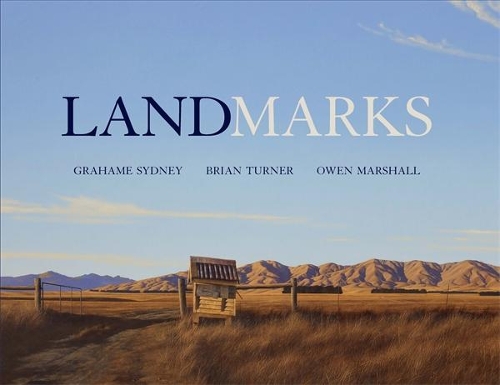
This handsome wide-format hardback almost exactly replicates, in every respect apart from the actual contents, a book published 25 years ago, Timeless Land (Longacre Press, 1995). Like its popular predecessor, the book brings together the work of three artists in different media who are (as they were a quarter of a century ago), close personal friends: painter Grahame Sydney (born 1948), poet Brian Turner (born 1944) and fiction writer, Owen Marshall (born 1941).
Now in their seventies, and still continuously active (and acclaimed) as artists, the three men all have a close association with and love for the region of Central Otago, uniquely distinctive for its landscapes, climate and history; they either live there (Sydney, Turner) or write frequently about the area (Marshall). Indeed, from the reader’s point of view it is the characteristics of the region – its beauty, its harshness, its fragility – which characterises and justifies the book rather than the circumstantial affinities of the artists.
As with the previous volume, each of the artists gets roughly equal allocation of space. About 60 of Sydney’s paintings (made between 1996 and 2020) are reproduced in full colour, one per page (it is the ‘landscape’ format of most of the paintings which determines the shape of the book). There are around 40 poems by Turner, most of them well-crafted shortish lyrics, linked explicitly to place and local characteristics (e.g. Taieri Days, Ida Valley Sunset), with some attempt (but not insistent) to match particular poems with appropriate pictures.
Marshall is represented by seven prose works (six stories and a chapter of a novel) and a group of poems which also have Central Otago settings. The wide format, perfect for paintings, and adequate for poems, is less so for stories printed in two columns which are physically awkward to read unless seated at a desk, especially on double-page spreads. Marshall’s strong empathy for a wide range of characters – women and men, young and old – and his sharp sense of place are everywhere displayed.
Apart from a few new pieces, the written material by Marshall and Turner has all been published in other books as have many of Sydney’s paintings. In other words, the book is more in the nature of an anthology and selection than an original publication. It is really three separate books of previously published work pushed together in service to the regional theme.
Perhaps because of the old adage that pictures speak more loudly than words, it is Sydney who is the dominant presence in the book with the others performing complementary supporting roles. Sydney occupies an odd position in New Zealand art. He sprang to fame in the 1980s with some of his early paintings receiving instant wide recognition. Many of the most iconic and familiar were included in Timeless Land.
A flurry of exhibitions around the country brought wide attention to his work. More recently, though his popularity has been maintained, his new work is seen less often, much of it disappearing instantly into private collections around the world without ever being seen in public. There is rumoured to be a waiting list for new works. But it is years since a public gallery held a solo exhibition; the most recent widely seen exhibition was On the Road, a touring exhibition assembled by the Hocken Library in 1999. Not the least pleasure of this book is the opportunity it provides of seeing an extensive selection of the work Sydney has been making during the past two decades.
Not much has changed, though he paints in oil these days not the egg tempera of his early works. Mountain ranges often spread from edge to edge, either snow-covered or burnt bare in summer and with huge skies above them featuring an amazing range of cloud formations, exquisitely depicted (Loading Ramp, Home Hills, for example, shows half a dozen different cloud shapes and colours). Humans are almost entirely absent (an exception being the lonely figure standing by the roadside in Freshman Creek), though signs of the human – roads, fences, power poles, farm buildings, road signs - are present everywhere to remind us that this is an inhabited landscape not a wilderness.
Many paintings have settings at the beginning or end of day, diurnal and seasonal signs being expertly recorded. Usually the horizon is low, the ranges distant, the foreground empty. Often a central shape – a rock, a tree (not many of those), a modest building, a fence – gives symmetry to a composition, while a moon or single bird adds focus. Most modern painters, post-Cézanne, tip the landscape towards the viewer rendering far things closer, but in Sydney things far off remain distant, increasing the likeness of his works to photographs, a feature intensified of course by photographic reproduction.
One of Marshall’s stories speaks of a “landscape of masculine reticence”, a quality shared by all three contributors. Fiona Farrell’s eloquent Foreword adds a welcome female variant to the somewhat blokeish flavour of the enterprise.
Reviewed by Peter Simpson