Marti Friedlander: Portraits of the Artists
When I was moving from New York City to Dunedin with my Kiwi fiancé, my friend Alice Belgray told me that I should meet Marti Friedlander: “She’s a renowned photographer,” Alice exclaimed. “And she’s Jewish. You’ll love her.”
At the time, I knew very little about New Zealand and certainly nothing about the resident Jewish community. I’d met my fiancé on an aeroplane going from London to New York; Alice was one of the few New Yorkers who had actually been to New Zealand. She’d met Friedlander through the late historian and writer Michael King whose great-uncle had been her husband’s long lost relative.
I didn’t know Friedlander was a portraitist and documentary photographer, picturing her instead as the Antipodean equivalent of the glamorous tall and slender Italian photo-journalist Oriana Fallaci.
To my surprise, Friedlander was short and feisty with an inky black pixie cut and a gravelly voice sandpapered by cigarettes smoked on the sly. She embraced me with the full force of her power, shepherding me into her life as mentor, friend and family, seeing my path in her own as we were both Jewish women artists who had left metropolises behind for New Zealand and the love of a good Kiwi. She introduced me to the artists, writers, musicians, actors, photographers and Jewish community denizens who sustained her, orchestrating lively dinners on her porch that overlooked the majestic Hobson Bay, her living room filled with the extraordinary artwork of those New Zealanders she had befriended when taking their portraits.
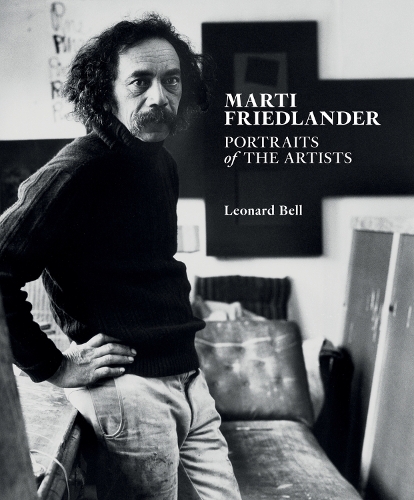
Many of the artists whose work adorned her Parnell home are found in the beautiful new volume, Marti Friedlander: Portraits of the Artists written and curated by the art historian Leonard Bell, who was Marti’s close friend and literary executor. The bulk of these portraits have not been seen before in the three major prior publications on Friedlander’s work: the catalogue of her 2001 Auckland Art Gallery retrospective, Leonard Bell’s own monograph Marti Friedlander (AUP, 2009) and Marti’s memoir Self-Portrait (AUP, 2013). There are many surprises. Bell deftly accompanies each portrait with a capsule biography evaluating the artist’s work as well as their individual relationship to Friedlander and their lasting or evanescent legacies.
This organisational construct is appropriate for Friedlander’s portraits and ‘relational’ in the sense “that the interaction between her and the person photographed drove their making”. These portraits relate not only the artists’ complex stories but Friedlander’s genesis as well. She arrived in New Zealand in the late 1950s from London where she worked as the coveted assistant to the New Zealand expatriate portraitist Douglas Glass and the esteemed fashion photographer Gordon Crocker. Settling with her new husband Gerrard in the then rural West Auckland suburb of Henderson, she initially assisted her husband in his dental practice, ultimately transforming one of his practice areas into her darkroom.
Living in rural New Zealand allowed her to not only see but be seen in a way that would never have been possible in the ebullient chaos of post-war London. In New Zealand, there were yearning empty vistas that echoed her loneliness. It was also a time of “far-reaching sometimes unsettling sociocultural changes”. Ultimately, she wanted to explore the innocence and provocation of this new world so she joined a Camera Club in Titirangi and started taking her own photographs.
Her first published portrait was in 1959 in Landfall, the first New Zealand journal that treated photography as a serious art form. It was a photo of the young author Maurice Gee whose parents were her next door neighbours. She wanted to gift his parents his image and that first photograph shows the skill with which she used natural light. “If you can see light, you can take a picture,” she would say. In that photograph, Gee is leaning forward into a cone of illumination which halos his youthful intelligence and promise.
Friedlander soon began publishing her portraits in the New Zealand Herald, the Listener, performance programmes and exhibition catalogues. She took photographs for Art New Zealand and the New Vision Gallery whose name was inspired by the Bauhaus master László Moholy-Nagy who believed that “photographs enabled us to see things in the world that our eyes alone could not”.
Her photographs were impromptu and never taken in her own studio. She captured artists in their own tableaux surrounded by their own art work, transforming them into the subjects of her own artistic compositions.
By photographing artists, writers, potters, musicians in their unique milieu, Friedlander found a kind of intellectual conversation she’d known in London and missed. “We were a subversive underground, so it was necessary to mix with people who understood what other people perceived as madness.” New Zealand was still the nation of the six o’clock swill and Protestant stoicism. In the company of artists, she discovered her own bohemian rhapsody, rebelling against societal strictures and similarly ignoring traditional attitudes about women’s place. “Her portraits speak,” Bell remarks, “about the quest for recognition and the status of women in the arts in New Zealand.”
One of Friedlander’s first extensive projects was to take photographs for Jim and Mary Barr’s seminal Contemporary New Zealand Painters A-M (1980) which featured 22 painters and sculptors and 84 portraits in colour and black and white. She also took photos for the planned but never published second volume (N-Z). Many of those portraits are presented in this volume.
Friedlander particularly liked to photograph the interaction between couples, finding them endlessly fascinating. “It’s not just the similarities that draw people together, it’s also the differences, and it’s the differences that I aim to portray,” she said. She loved to highlight hands grasping worn paintbrushes or coated in sticky clay molding pottery on the wheel. She was also keen to photograph her subjects’ bare feet, which was one of the Kiwi phenomena she most loved.
I knew Friedlander at the end of her life when she was celebrated and lauded, the subject of Shirley Horrocks’ wonderful documentary Marti: the Passionate Eye, declared a living Icon by the Arts Foundation of New Zealand and the recipient of an honorary doctorate from the University of Auckland. She was warm, outspoken, mischievous, philanthropic and loving. She was never sweet, but she was tender. I never left her company without the gift of a great artwork or a book that she insisted I read or a piece of fruit in case I would get hungry going home.
Her legacy is an extraordinary body of photographic work. She often said, “One day, we’ll all only be images.” She did not hope for the serendipitous decisive moment like the great Henri Cartier-Bresson; she knew what she was seeing and she waited impatiently for the right moment to capture it, just hurrying it along. She always photographed in natural light and she never took endless exposures, she was that skilled. When my dog was a wriggling puppy, we brought her to meet Friedlander. At that point, Bella didn’t sit still for anyone but Friedlander wanted to take her portrait and ordered her to stay and Bella obeyed. Similarly, she once ordered my husband, a keen amateur photographer, to take out his I-Phone and photograph me because the light was wonderful. And he did. And it remains one of my favorite photos.
For 60 years, Marti Friedlander captured the joy and struggle of the artists she most admired. Included in this volume are a poignant series of black and white photographs taken over time of her great friend Ralph Hotere whose sculptural form echoes his scratched mirror paintings and carved wooden crafts. She similarly captured the profound love and respect as well as painful fissures of her long friendship with the author C.K. Stead; the iconic dignity of Rita Angus and the self-possession of a young Kiri Te Kanawa. As Leonard Bell writes, she was New Zealand’s Nadar (1820-1910), the documenter of the cultural world she inhabited.
There are some surprises as well. Bell reveals the Dutch born gallerist, printmaker and teacher Kees Hos protected and saved Jews during World War II and is honoured, along with his wife Tina, in Yad Vashem as Righteous Among the Nations. Similarly, the painter Rudi Gopas is revealed to have come to New Zealand to reinvent himself, changing his name to escape his past as an ethnic German who served with the Wehrmacht in Poland and Italy.
Friedlander’s dear friend, the art dealer Kathlene Fogarty said, “Marti wants to know everything and she is not surprised or shocked by anything.” Perhaps that is what Friedlander discovered in the artists she captured, the essence of what remains. For what are we all in the end, but our own images.
Reviewed by Cheryl Pearl Sucher
All photos: Copyright Gerrard and Marti Friedlander Charitable Trust