Review: Mophead Tu: The Queen’s Poem
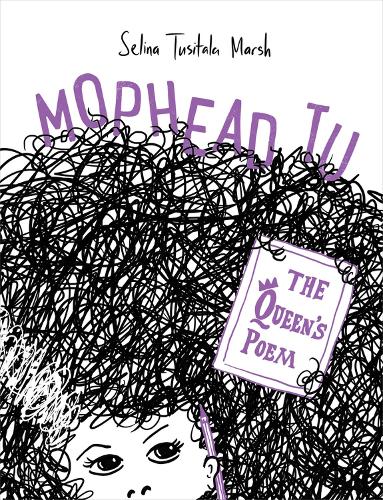
Less than five minutes after arriving in my letterbox, Mophead Tu disappeared into my 10-year-old daughter’s bedroom and didn’t come out for days. Such is the powerful influence and aura associated with the character Mophead who first made her way into the hearts and minds of families around Aotearoa less than a year ago in Tusitala Marsh’s debut graphic memoir.
In Mophead Tu: The Queen’s Poem, we walk with Mophead as she seeks to stand with integrity navigating a difficult and complex inner conflict. Can she accept an invitation to write and perform a poem for the Queen while at the same time stay true to her values and stand up for indigenous communities in our Moana region? This was clearly not an easy decision to make, or an easy topic to write about, yet with exquisite execution and deep authenticity and vulnerability Tusitala Marsh ‘goes there.’
In the book, we journey with Mophead as she grapples with criticism from peers and works through the frustration of writing a poem within the constraints of stringent rules and expectations outlined by the Palace (there were five!). Throughout this journey, Tusitala Marsh also seeks to provide a degree of context and explanation for what colonialism is – briefly stepping us through the shape and experience of it.
In this section, there are definitely a couple of big concepts that I think some young readers may find challenging so I’d recommend that an adult is near to hand. For example, some of the questions my 10-year-old asked me that I wasn’t quite prepared to respond to on the spot included what it means to “shame” someone or “tame” someone as well as - and this is especially important for parents and children who are indigenous to our Moana region - why our homes and placenames were renamed and what it means to decolonise.
In the end, by staying true to her cultural values and identity, as well as her personal commitment to building bridges and connections, our wonderful Mophead perseveres despite the challenges thrown at her and writes and performs a poem that achieves both what the Palace wants and what Mophead needs to do (stand in her integrity). I particularly liked the way Tusitala Marsh managed to capture this through her narrative because this is the hard (often unseen) gritty work that many of us committed to decolonisation can relate to everyday - how do we exist and engage with settler-colonial and Crown power dynamics and stay true to who we are. This is especially so given that we know that colonialism is not a historical artefact, as Moana Jackson has aptly said, but very much (especially in Aotearoa) an ongoing process of dispossession and control.
Speaking into this contested space is, I think, perhaps even harder to do and is something Tusitala Marsh endeavours to speak into as she briefly walks us through what happens after the poem is performed. It was this part of the book, for me, that was most important, as least as an indigenous mother-reader stepping through the book with my child.
In outlining two moments of power imbalance experienced by Mophead – whereby the Duke “forgets the poem” and Prince Harry makes fun of her tokotoko – Tusitala Marsh describes the injustice and predominance of white privilege that indigenous peoples are still subjected to and experience daily all around the world.
For me, just these two moments alone are worthy of a whole graphic memoir and it was perhaps because of this that the race to the end of the book from this point felt rushed and unsatisfactory. Rather than ending on a powerful reflection about what this ongoing power dynamic and imbalance might mean for indigenous peoples today and for Mophead herself or leaving space for those two moments just to be processed and considered, the narrative arc instead moves quickly onto shining a light on positive examples of how things are changing.
In this section of the book, Mophead outlines how rules are being broken primarily through representation but the examples provided felt shallow and a little tokenistic in comparison to the depth of what the narrative had bravely spoken into in the preceding sections.
These examples, I felt, also left a glaring gap in relation to acknowledging the ongoing and devasting effects of colonisation on Māori in Aotearoa where, unlike many of our Moana island homelands, the reality is different because the powers that uphold colonial structures are still in place and very active today.
Because of this, I felt particularly unsettled by the final note the book ends on: that Mophead sits “alongside” colonialism and that the poet from the sea and Queen from the Palace are left “sharing thoughts over a cup of tea.” This could be interpreted in multiple ways but it certainly didn’t feel like the right ending for an otherwise powerful and brave book.
Reviewed by Leilani Tamu