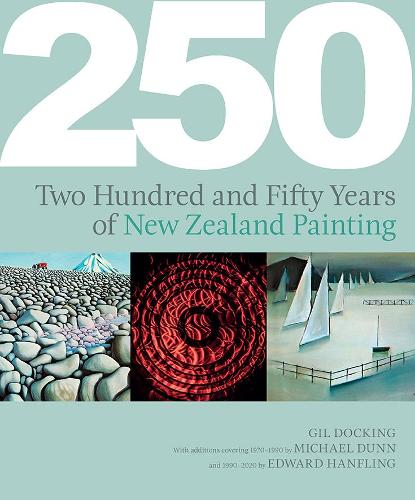
Review: 250 Years of New Zealand Painting
This book is something of a publishing phenomenon. While not quite in the same iconic category as the Edmonds Cookery Book or Yates Gardening Guide, it has for an art book had extraordinary longevity. This is the fifth edition; its first edition being published exactly 50 years ago hence the change of title from the original 200 Years of New Zealand Painting (1971).
It has since gone through several revisions and updatings with additional chapters by Michael Dunn, covering the years 1970-1990, and Edward Hanfling covering the period from 1990-2020 bringing it up to date. The book thus represents three distinct generations of critics and art historians as well as 250 years of painting in this country and remains a standard work of reference.
It is a generously scaled book with just over 200 images from 165 artists, stretching from Sydney Parkinson, who accompanied Cook in 1769, to Patrick Lundberg, born in 1986. Most artists are represented by a single image, around 30 by two images and a select few by three. Those in the last category are Colin McCahon, Milan Mrkusich, Ian Scott, John Weeks, Petrus Van der Velden and Toss Woollaston, a not uncontentious list reflecting the preferences of the three authors.
Sometimes the distribution of images seems a bit strange. Among those with only one image, for example, are Don Binney, Shane Cotton, Tony Fomison, Bill Hammond, Jeffrey Harris, Louise Henderson, Doris Lusk, Evelyn Page, Michael Smither, Olivia Spencer Bower, Gordon Walters, and Robin White.
Some names are unexpectedly altogether absent including, for example, Leo Bensemann, Rata Lovell Smith, Douglas MacDiarmid, Theo Schoon, Dennis K. Turner, Grahame Sydney, Michael Hight, Tony Lane, Allen Maddox, Paul Hartigan, Stanley Palmer, Tony de la Tour, Richard McWhannell, Joanna Pegler, Karl Maughan, Chris Heaphy, John Walsh, Martin Ball and Judy Millar – other readers would doubtless have a different list of absences.
What this list points to is one of the problems inevitably associated with updating a previous book by adding chapters at the end covering recent developments but leaving the main text unaltered. This means that artists from the past who are rehabilitated as a result of new scholarship or changing fashions are left behind. Examples of these artists would be Bensemann, MacDiarmid, Lovell Smith, Schoon and Turner.
An associated problem is that when the book was first published in 1971, the youngest artists included were (inevitably) at the beginning of their careers and in some cases were represented by works which did not reflect their mature styles that only emerged later. In many cases, the inclusion of later works by these artists in the additional chapters corrects the impression. Examples of this are Richard Killeen and Gretchen Albrecht, whose uncharacteristic early works are complemented by later more characteristic examples.
But in some cases, artists are represented only by a single early work. This is the situation, for instance, with Geoff Thornley, Gordon Walters and Don Binney all of whom are left out of the updated chapters and are therefore represented in the book by a single early work. In the case of Walters and Binney, this is less a problem because their signature style emerged early but with Thornley it is completely misleading. This leading abstractionist is represented only by a most untypical early figurative painting.
These are offered as examples of the kinds of problems associated with the successive updatings approach. It tends to fix art history as it was at a moment in time and thus ignores the subtle and continuous evolution of our collective perception of the past over time. As a consequence, art history is skewed and the effect of the book appears old-fashioned, despite the superficial impression of being up to date. Only a more thorough-going and comprehensive revision of the whole book could have avoided this problem.
Of the two updated chapters, Michael Dunn’s appears the more balanced and reliable, perhaps because the time elapsed since 1990 allows him greater perspective. Ed Hanfling’s chapter includes many of the expected names of artists who have flourished in the last three decades – Hammond, Pick, Pule, Cotton, Robinson, Dashper, Reynolds, etc; but some of his choices are quite idiosyncratic and unfamiliar. For example (to confine the list to names not previously known to me), Lorraine Webb, Rebecca Wallis, Patrick Lundberg and Raewyn Martin. This may not be a bad thing. We are still too close to the art of recent decades for a settled view to have emerged; better perhaps to have a selection which raises eyebrows than one which merely reflects the currently fashionable.
Reviewed by Peter Simpson