Review: Fish of the Day
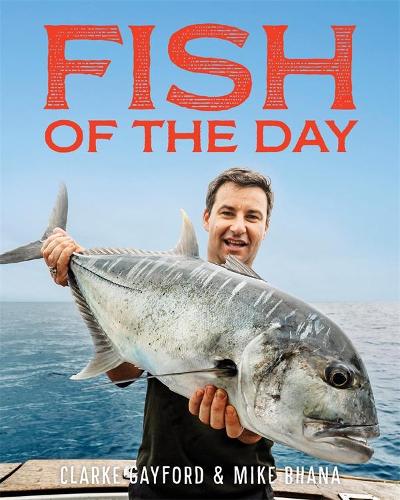
At Ngunguru School they ring the bell when a pod of dolphins enters the bay and all the kids get to abandon their lessons go out and watch them. This is the sort of detail that neatly brings together a slice of life with larger environmental preoccupations to create Clarke Gayford and Mike Bhana’s companion book to their Fish of the Day television series.
Gayford says Fish of the Day saved him from disillusionment after 20 years in light entertainment by letting him combine his lifelong love of fishing with his adult concerns for environmentalism – what he calls advocating “spare fishing” over “spear fishing.”
This is a book about fishing, of course, and for those who know their braided line from their silicone smelt there is plenty of free diving and long retrieves. (For us non-fishers long retrieves are the endless scenes of thrashing fish on strained lines that you get on television fishing shows.) The TV version of Fish of the Day always aimed to be much more than that and in this hefty hardback there is a bit of something for everyone: history, marine biology, environmentalism, travelogue, charter recommendations, recipes and lots (and lots) of photos.
In text, Gayford is able to go into a lot more detail than the once-over-lightly nature of a half hour of television but Fish of the Day is far from a treatise. Just like on TV, Gayford’s enthusiasm is very natural and genuine. His easy writing style allows him at times to take us on a bit of a boys’ own wild ride. In the space of one page, he’s choppering into the remote Hope River where the trout are easy because they don’t see a lot of anglers and next the helicopter swoops him into Minaret Station for more highly exclusive fly-fishing. In the Solomon Islands he’s conquering jobfish, then having the bejeezus scared out of him on Skull Island, then wreck-diving – all in the space of one page. And then in Hawai’i he jumps from the lava flows of Kilauea to explaining why purified water is used to clean a boat.
The New Zealand chapters are certainly a good advertisement for getting out into the salt air, whether you aim to fish or not.
You can dip in and out of the self-contained short chapters, each visiting a location in New Zealand or the Pacific Islands, like they did on TV. With some of the scientific topics, he’s purposely not being boring or complicated and in his casual style, he explains things like how in Fiordland the tannic run-off from streams into the cold water creates an environment where life that normally lives in the very deep can thrive; or the tropical fish migration to the Hauraki Gulf. I learned something about the sea life just a few kilometres from my home!
I have been crediting Gayford as the author because the text is written in Gayford’s first-person voice but Bhana, as the producer, director and camera operator on the TV series must have been responsible for most of the source material, and with a co-author credit here it’s probably as much his voice. All the photos in the book are Bhana’s too.
The recipes, unfortunately, don’t translate well from television, where being able to watch the chefs cook (usually on location) gives context to the rare, expensive ingredients, specialist equipment and drawn-out cooking methods. However, Gayford and Bhana do acknowledge that our fish of the day is most likely to be skinless terakihi fillets from the supermarket by providing an index of recipes by fish type, with a note explaining how to substitute the fish discussed in the chapters.
And ultimately Gayford also gives New Zealanders what they really want: the recipe for election-night fish bites.
Reviewed by André Taber