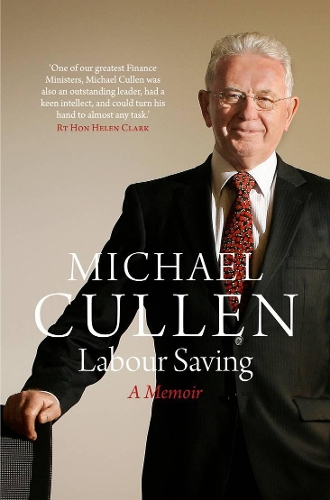
Review: Labour Saving: A Memoir
Michael Cullen explains in his preface that this memoir was written as a form of therapy for a sense of loss at being obliged by ill-health to give up the public work which has been the focus of his life for 40 years. But unlike most therapy it is not about feelings and does not involve a lot of introspection. It is all about what happened.
As he also says in the preface, there is a substantial focus on the development and implementation of policy, an area in which he thrived. Particular policies are analysed in loving detail, usually to make it clear why he was right and others wrong.
People don’t appear a lot. Helen Clark, with whom he was – in a memorable phrase – joined at the hip for so long is an almost spectral presence. From time to time, her performance in the House is praised. Her toughness in facing down a coup early in her reign, when she was failing to get traction with the public and there were probably enough votes in the caucus to reinstate Mike Moore, is noted. But there is no indication of how they got on personally or what he thought of her.
Similarly, we learn very little about Cullen himself. Was he ambitious, for instance? At one point during Clark’s rocky period, Jonathan Hunt asked him if he would be prepared to replace her as leader. Cullen says he replied that he would be available if asked but was not prepared to lead a coup. The moment passed. But there’s no indication of whether Cullen was disappointed or relieved.
But don’t get the idea that this lack of introspection means this is a dull book. How could it be? This is an account of one of the most tumultuous periods in our political history by someone who was at the heart of it all.
Indeed for much of the 1980s and 1990s, Michael Cullen was arguably the dominant figure in Parliament: always firmly on top of his subject, combative and sometimes brutal in debate, unashamedly intellectually arrogant, pragmatic rather than an ideologue, capable of carrying a huge workload, perceptive and witty, and rarely reluctant to speak his mind.
In the book, as in Parliament, opponents are mostly dispatched with a well-turned phrase. Ruth Richardson was a kind of cross between an Energizer Bunny and a Transformer toy. Jenny Shipley spoke as though she was Queen Victoria addressing Gladstone. She and Richardson were the Sisters Grimm. Don Brash was cerebral and unfailingly polite but his inflexible beliefs made him easy to torment in the House.
There is grudging respect for a few. He acknowledges that Labour under-estimated Jim Bolger’s wiliness. John Key had a genial persona and was so flexible it was hard to find anything he really believed in, making him hard to hit. But there’s no real indication what Cullen felt about any of them.
Intriguingly, the nearest we get to any sort of verdict on others involves his great ideological opponent, Roger Douglas, the man whose economic reforms Cullen spent a great deal of his political energy trying to undo. In later years, Cullen says, Douglas “gave off an air of seeing himself as a failure, an extraordinary self-judgement of a man who, whatever other assessments future historians may make of him, remains one of our most influential politicians ever.”
Then there are the detailed accounts he gives from that unrivalled perspective of a few key events – chosen, he explains, because they are still controversial or he considers the received wisdom about them to be wrong – which are fascinating.
One of those events is the biggest upheaval of all, the clash over economic policy between David Lange and Roger Douglas which destroyed the Fourth Labour Government. The basic story is well known but three interesting points emerge from Cullen’s account of it.
First, he argues strongly that, contrary to a persistent left-wing narrative, much of what the Lange Government did was in fact entirely in line with traditional Labour policy – though some was certainly not – and some was forced upon it by outside events. The real problem arising from Rogernomics, for him, is that the myths surrounding it “made it much harder to move Labour to a sensible social democratic position akin to those of a number of our cousins in Europe. Any mention of market mechanisms led to an attack of the pink-coloured vapours . . . Saving Labour has at times been as much about saving it from itself as from its various enemies.”
Second, while deploring the likely effects of Douglas’s market-driven policies and the underhand tactics he used to push them through, Cullen is convinced that he believed sincerely that what he was doing was in the best interests of the people that Labour existed to represent.
Thirdly, he considers at least some of the blame for what happened must rest with Lange. Partly that is because he proved to be “politically and personally incapable” of leading a Team Lange to combat the influence of the very tight-knit Team Douglas. But it is also because Lange undermined his own credibility by being less than forthright in his views to caucus and cabinet, and choose to break rules, ignore agreements and unilaterally announce policy – such as the end to ANZUS – when it suited him.
Needless to say, Cullen gained much more satisfaction from his second spell in Government, as Deputy Leader and Finance Minister for nine years under Clark. But what he did not find so agreeable was having to work under MMP. Certainly he did not enjoy post-election negotiations with the unworldly Greens or the all too worldly Winston Peters. After one such session, he recalls, “I went into Hawkes Bay Hospital for a medical procedure which involved a tube being stuck up my bottom. Making general conversation, as one does in that circumstance, I was asked what the talks were like. I replied, ‘Just like this without the benefit of the Vaseline.’ That is still the best description I can make.”
More significantly, he points the finger at MMP for making it harder to deal with the significant issues facing the country. On the subject of Māori rights to the seabed and foreshore, for instance, he says the chance to find a lasting legislative solution was blocked when he had to accept some retrograde changes from NZ First in order to get the votes. “In many ways,” he says, “this was the first big test of the ability of an MMP Parliament to resolve an issue of such deep division. It would have to be said it largely failed that test.” MMP similarly prevented the introduction of the preferred weapon for fighting climate change, a carbon tax, leading to a less satisfactory Emissions Trading Scheme instead.
In the end, after what Cullen labels “nine short years,” the fifth Labour Government was defeated and he moved into a very active retirement. Now, after what he describes as “a reasonably long and very fulfilling life,” there is a different challenge. In a postscript to the book, he acknowledges that while recent chemotherapy went better than expected he accepts it is highly likely that his cancer will return. “I am not fighting a battle against my cancer. It will do what it will do, and in the meantime, I will do what I can. Death is no more than the space we make for others.” That typically indomitable response serves to further highlight what an extraordinarily talented politician he was. This memoir is a hugely valuable account of a significant period in New Zealand political history.
Reviewed by Jim Eagles