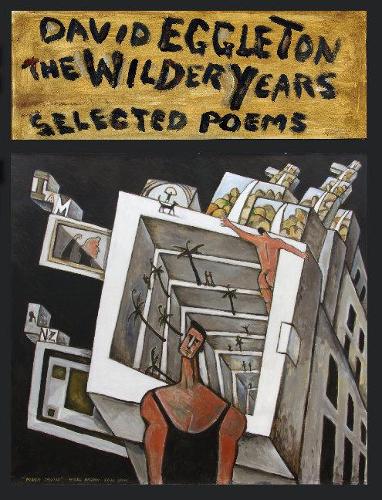
Review: The Wilder Years
David Eggleton is something of a rarity among the celebrated poets of our age. Like Sam Hunt, he is from the other side of the tracks. He has avoided both the ensnarement of academia and the easy lure of the creative writing industry. Dropping out of school as a teenager to work at odd jobs and become a poet, he would grow into a broadsheet-wielding, public bar and street performer, go on to publish nine acclaimed poetry collections (plus several nonfiction works and a collection of short stories), receive the 2016 Prime Minister’s Award for Literary Achievement in poetry, and be appointed as Aotearoa New Zealand’s current Poet Laureate. In short: David Eggleton has made of poetry a life in the world.
The Wilder Years is the first survey to bring together work from some 30-plus years of publishing. It gathers work from his nine collections as well as a substantial number of new poems. To read this retrospective selection is to again be reminded of his many gifts as a poet: the alertness of his eye and ear, the freshness and rapture of his language. And of course, the formidable technical ability and craftsmanship driving the show:
Full-grown rivers sob stories of sunken dinghies,
of whaleboats bobbing above anchor stones,
of bullock eyeteeth, foxed with leaf mould,
gnashing genealogies of sun-bleached bones.
— from Deep South
Eggleton’s subject is the postcolonial Pacific. What is evident from the earliest poems in The Wilder Years, right through to those written in 2020 that conclude the book, is how his language functions as a prism; a nexus where the sounds, rhythms and signifiers of high and low culture are focalised, interrogated and metricated. From Auden, he has learnt to hammer down both demotic and high-minded speech into complex metric patterns. The poem is a political event and, like Swift or Burroughs, Eggleton’s lampooning and satirising mirrors back to us the strange (and at times, grotesque) tenor of our age. Here’s a few lines lifted from an early poem The Werewolf of Grafton Gully, originally published in the 1986 collection South Pacific Sunrise:
Bring on the nuclear-free lunch of Mr Banana Skins
and his transformer robots,
because I have seen this computer-generated generation
stampede the admass barricades of bubblegum,
storm the seven veils of wet Kleenex,
send a Cadillac into orbit, put a man on a life raft,
and build an MX factory on Ronnie’s Ranch.
— from The Werewolf of Grafton Gully
For readers unfamiliar with this poem, Eggleton has borrowed the opening line from Howl - Allen Ginsberg’s peyote-inspired vision of absolute evil - using it as a springboard for his own meditation on the ballooning influence and globalisation of neoliberal economics in the early 1980s. In his unique way, Eggleton’s body of work is the closest thing we have today to a transgressive public poetry. In the aptly titled, President Fillgrave, he writes: ‘Death rides a white golf cart,/wearing its invariable smiley orange face,/despite the grey of the crowd.’ These are not the lines of a solipsistic navel-gazer but rather of a poet who is attuned to the currents of the world geopolitical situation, Aotearoa New Zealand’s notion of itself as a clean, green haven at a remove from the rest of the world’s troubles, is a notion challenged throughout the book:
Flag, anthem, dairy herd, rugby team identity
are carried on the narrow back of the new Hawaiki,
to the jeers of old-time mountaineers
whose core-sample memories are all that remain
of a rattletrap past wrapped in its own bombast,
its own jars of extract of sticky black yeast.
— from The Wilder Years
David Eggleton’s reputation as an electrifying performer is certainly well-deserved too. He is one of Aotearoa New Zealand’s original oracular poets and mic men. Drawing on the abrasive energy of punk, Dada and Surrealism (by way of Beat poets like Corso, Ginsberg and Kaufman), the watermark of his performative style can be seen in that of dancehall toasters, hip-hop and rave MCs, and also in the work of Tusiata Avia, Hinemoana Baker and the younger generation of spoken word poets operating today:
Fatigued hipster seeks hipster replacement therapy:
escape from the knowing winking calculating flattery;
the quantitative easing for the squee and the twee;
yet another colloquy of sippers and gurglers
fumigating their bridgework with finest pinot noir,
— from The Testament of Databody Dave
Otago University Press is to be commended for creating such a beautiful book, honouring Eggleton and his life commitment to poetry, and publishing it as he reaches the end of his tenure as Poet Laureate. There is, however, one complaint I have to make about the book (albeit a very minor one), and that is the omission of certain earlier poems like dolebait, which appeared only in broadsheets and fugitive publications. Such poems may only be of interest to scholars and poetry trainspotters like myself. This is, after all, a selected poems, not a collected. As it stands, The Wilder Years serves as a comprehensive introduction for new readers while functioning as something of a “best of” or “greatest hits” for established readers and fans.
Reviewed by Michael Steven