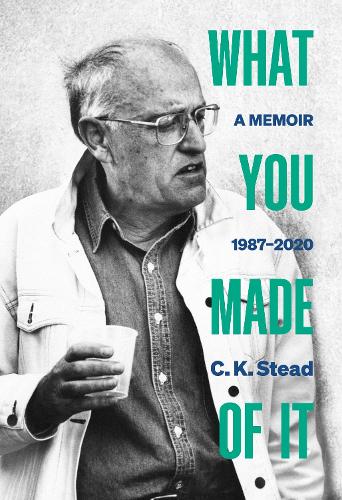
Review: What You Made of It: A Memoir 1987 - 2020
If we imagined the Stead Family as a listed company specialising in literary works, then its 2021 stocks have been trading well. Patriarch C.K. Stead has released the third volume of his autobiography, What You Made of It: A Memoir, 1987-2020, while novelist-daughter Charlotte Grimshaw’s best-selling fly-on-the-therapist’s-office-wall account of her childhood and subsequent events, The Mirror Book, has been extremely well publicised and well-reviewed.
With What You Made of It, Stead, a prolific writer of poetry, fiction, and literary criticism, now exceeds Witi Ihimaera’s previous record as the writer of the longest New Zealand autobiography. Ihimaera’s 832 pages over two volumes are so-far a slow striptease where he has not yet broached his adult homosexuality, with at least one volume to come.
Now, at his own conclusion, Stead has reached 1264 pages and, like Ihimaera, there are omissions and much is smoothed over. In the wake of Stead’s second volume, You Have a Lot to Lose, with its media-friendly admissions of extra-marital affairs, What You Made of It returns to a more circumscribed course. This is the autobiography of an academic éminence grise, now retired from an official University position while maintaining and enlarging his cultural role. That said, readers familiar with Stead’s sharpness and his settling of old scores will not be disappointed.
His dealings with Fiona Kidman are a case in point. Stead points to her loud opposition to the 1990 government purchase of a centrally-located London flat for writers and artists as a reason why the project he championed was scuppered – and then to her later reversal of her opinion because in the interim she had gained the Menton fellowship and fallen in love with France. “You can read her voice into every sentence she writes on this subject and I wouldn’t buy even a used car from it,” he writes, “certainly not a piece of real estate.”
Albert Wendt, Witi Ihimaera, and Vincent O’Sullivan are flash-photographed complicit in behind-the-scenes publishing shenanigans, with the additional proof of intercepted faxes. New Zealand’s sometimes fraught literary race-politics and their consequences are given full review. Stead also reveals his own habit of “rummaging” when left alone in other’s houses. Even Allen Curnow, his neighbour across Parnell’s Tohunga Crescent, comes in for occasional waspish commentary in-between the respectful judgement of his achievement. Stead, it seems, is a total package: buy the praise and you get the asperity as well.
What You Made of It also continues the long cataloguing of Stead’s writings. Each novel is considered from its first inkling, through the various strands of its writing, to its reception, along with copious quoting from reviews, both positive and negative, but with Stead inevitably having the last word. His sexual life, in this volume, after the exposures of the last, has been relegated to the back seat.
It is a strange book to read in light of Grimshaw’s own recent autobiographical revelations of supposed lofty parental neglect, complicity, or fury, and her own feral teenage years in The Mirror Book. “When we speak about the past, we lie in every breath we take,” Sigmund Freud wrote in a 1936 letter. “Whoever turns biographer commits himself to lies, to concealment, to hypocrisy, to embellishments, and even to dissembling his own lack of understanding, for biographical truth is not to be had.”
Grimshaw’s view of the family and the many behavioural currents beneath the alleged laissez-faire of the 1970s inevitably reflect upon Stead’s own account. However, What You Made of It is resistant in ways that seem to confirm the warring viewpoints. A reader must ask where - if anywhere - a truth lies and, in all likelihood, decide it lies in neither account, Stead’s executive viewpoint or Grimshaw’s more contemporary “involved” psychotherapeutic download.
In What You Made of It, the action is largely over: peers die, funerals are attended, careers are recalled, though Stead, however, keeps on swimming against the tide. In spite of his reiterated jolly accommodation with death, it now seems impossible to imagine a world without the master’s hand, controlling as always, still with its sharp rapier, even backed against the wall.
Reviewed by David Herkt