'The heart of the book': Kiri Lightfoot and Pippa Keel Situ
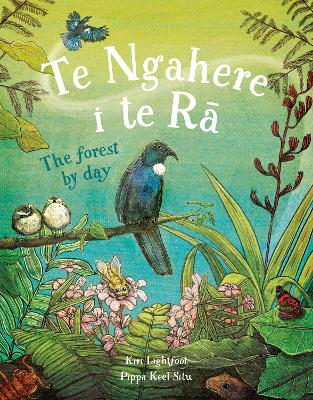
Te Ngahere i te Rā: The forest by day is a beautiful introduction to the creatures that are busy during the day in the forest of Aotearoa New Zealand. As the sun rises, which creatures come to life and greet the day? This beautiful picture book explores the busy world of the daytime creatures in Aotearoa New Zealand's bush. It includes many reo Māori phrases that we use to greet others. Kai pai te rā!
This recent publication is author Kiri Lightfoot and illustrator Pippa Keel Situ's third collaboration, and the pair are busy working on another for release next year. Here they discuss author-illustrator collaborations, favourite picture books, and writing routines! Read on...
.jpg&w=1920&q=75)
Kiri: One of my favourite things about being a writer for children is working with illustrators. It's like Christmas morning every time I see what my words have inspired for an illustrator. What's your favourite part of being an illustrator?
Pippa: Oh, I have a few favourite bits, but one perk is getting to read a lot of great stories. I'm an avid reader with a vivid imagination, so reading can feel like watching a movie!
When I read a good manuscript, it's all clearly there in my head. Being able to put pen to paper and draw what I'm seeing so that others can see it too... that's an awesome feeling. I'm interested in your process. When you sit down to write a book, how do you start?
Kiri: Well, I start not ‘sitting down’, actually! For me, a good chunk of the early writing is done off the page. There’s a lot of thinking time, and while I jot things down, the journey is 90% thinking, 10% writing (but maths is not my strong point, so those stats are made up). I have a vivid imagination as well, so I suppose it starts there for me too. Who are your biggest visual influences in the children’s book world?
Pippa: Growing up, Mum was very picky about the books she bought for her four children. This has really shaped my work. We had a lot of Maurice Sendak (In the Night Kitchen, Where the Wild Things Are), Richard Scarry, Kevin Henkes and, of course, Aotearoa classics like the books of Dame Lynley Dodd. But my parents had also lived in Russia and Scandinavia, so we grew up with books like Tove Jansson's Finn Family Moomintroll as well. Just a lot of beautifully hand-painted stuff, sometimes woodcut or printed, and big explosions of colour.
Kiri: Your use of colour astounds me, especially for our ngahere books because you bring sunrise and sunsets to life so beautifully. Do you choose a colour palette for a story before you start? Or does that come last?
Pippa: Thank you! I said before that I can almost see a good story as I'm reading it. The colour palette is part of that... although obviously sometimes it's altered as I'm working.
I’m so in awe of your ability to write such vivid stories! Where do you draw your inspiration from? Do you ever use your real life as a starting point?
Kiri: I always do, really. I often say to children at school visits, if you read my books, you learn what I care about because at the heart of the book is something I care about or am curious to explore. That’s certainly the case with our stories about the ngahere because the forest is definitely my happy place, surrounded by birdsong.
Pippa: Did you have a favourite picture book growing up? And does that influence how you write today?
Kiri: My favourite author/illustrator as a child was Shirley Hughes. I just adored her books (anything with Alfie and Annie Rose in particular). Her stories spoke so beautifully to childhood and all the emotions that come along with it. She had a wonderful way of writing about real life. My writing tends to be grounded in real emotions, particularly my books for older children. I hope that when readers read my book, they feel seen, validated, and that they see themselves in the stories just as I did when reading about Alfie and Annie Rose. So when did you realise that illustration was something you’d like to do as a career?
Pippa: I truly adore being an illustrator; it's something I've wanted to do since I was seven years old, heavily influenced by Quentin Blake/Roald Dahl. The dream sort of fell away as I grew older and thought I needed to choose something practical. But at high school, I had an excellent art and design teacher who was completing her master’s degree, and she said to me that drawing things for a living could be a very respectable career path! She recommended a design degree. Studying illustration at CoCA Massey was the best thing I could have done; I loved it!
Kiri: Your husband, Ricky Situ, is a photographer; you've mentioned you use his work to inspire yours. That's so cool. Tell us more!
Pippa: Ricky is a really great photographer of the natural world, and it's selfishly SO useful for me for reference imagery! We’re often out hiking and exploring together, and when we're back at our desks I'll be asking if he got a photo of this tree or that bird... little bits and pieces that I can use to inspire my drawings or a setting. I'm really glad I don't have to rely on my own terrible phone photos! So I’m so curious, Kiri, what does an average working day look like for you?
Kiri: I don’t have a strict writing routine. There’s usually some reading and writing in there somewhere. One day a week I write with a writers’ group, and that’s my favourite day. We share ideas and talk them over, which is immensely helpful, then it’s quiet writing time. I get distracted easily, so it’s also when I’m most productive. Some weeks there are other odd jobs to pay the bills, and I love visiting schools to talk about reading too. I do a bit of acting work as well, so some days there’s no writing at all!
Pippa: Something I think you really excel at is the combination of English and te reo Māori you use — it feels very much how people use the two languages in day-to-day life. Has it been hard to find the right balance for this in your writing?
Kiri: This comes quite naturally to me, and reflects my family and how we speak. I'm not Māori but feel lucky to be surrounded by reo Māori. When I was nine, my sister Anahera was born. We have the same father, but her mother was Māori. Many of my nieces and nephews are in kura kaupapa now, and while I’m still very much at the start of my journey learning to speak with confidence, I try to make steps forward so I can keep up with them!
I love learning new kupu (words) and incorporating them into my writing. I wish I had learnt more as a child. Children absorb languages like sponges; it's definitely the time to surround them with new words to learn. Picture books are a great way for adults to learn too.
Pippa and Kiri’s latest book Te Ngahere i te Rā / The Forest by Day is out now. It’s a follow-up to their book Te Ngahere i te Pō / The Forest at Night. Together, they celebrate our native bush and all the creatures that call it home. They include many reo Māori greetings and phrases.