Extract: New Zealand Place Names, by Peter Dowling
.jpg&w=1920&q=75)
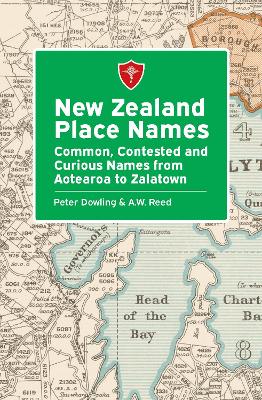
Extracted from New Zealand Place Names: Common, Contested and Curious Names from Aotearoa to Zalatown. Peter Dowling & A.W. Reed. (Oratia Books; 978-1-99-004288-1, 228 pages, $39.99)
New Zealand Place Names explains the most common, contested and curious names that populate our islands. Over recent years author and publisher Peter Dowling has worked closely with Ngā Pou Taunaha o Aotearoa – New Zealand Geographic Board (NZGB) to build on the foundational research of the late A.W. Reed and enrich the official New Zealand Gazetteer. The latest outcome is this attractive book presenting short accounts of the history, origin and meaning of around 870 names, along with glossaries, maps, a te reo pronunciation guide and three appendices.
In the book’s introduction Dowling sets the scene:
‘The vast majority of New Zealand names derive from either Māori or English, with Moriori names in the Chatham Islands. Some of the oldest names are transplants from elsewhere in Polynesia, reflecting the commonalities between places here and ancestral homelands, particularly Tahiti and Rarotonga. From the eighteenth century came the French (early explorers and settlers, especially on Banks Peninsula), with a pocket of Spanish names in Fiordland recalling the visit here in 1793 led by Italian navigator Alessandro Malaspina (see Bauza Island and Febrero Point). Australian, North American, Scandinavian and even Italian names came with settlement from the mid-nineteenth century. The transfer of Australian First Nation names to the South Island, for example, followed the arrival of gold-diggers from the fields of Victoria and New South Wales.
‘Place names speak to collective and personal identity and links to the land, so it is no wonder they excite passion. Recent spats over the spelling of Wanganui or Whanganui or whether to use Aotearoa in place of New Zealand follow a long line of controversies: in the 1920s to 1940s it was whether the Tongariro River should be called the Upper Waikato, and thereafter the battle to keep the apostrophe in Arthur’s Pass. By recommending that National Park revert to Waimarino — a decision confirmed in December 2024 — the NZGB was merely adding a chapter to a story that had evolved almost since its inception. In the appendices you will find a survey of contests over how a place should be named, along with pen portraits of some of the most prolific namers, and the process to follow when applying to have a name made official.’
New Zealand Place Names is laid out from A to Z (Aotearoa to Zalatown). The following sampling from letters A to E demonstrates some of the beauty and quirks of place names — words we use every day, often without knowing their meaning.
Aotea Locality, Waikato. The settlement and harbour were named after the Aotea canoe commanded by Turi, which made the long journey from Hawaiki and finally arrived at this sheltered spot. The settlement of Aotea has also borne the name Ruapuke, lit. rua: two; puke: hills, but this is little used. The suburb of Aotea in Wellington is similarly named for the canoe; it was originally shown as two separate locations, Okowai and Strathhaven.
Bombay Locality, Auckland. Formerly known as Williamsons Clearing, after John Williamson, a contractor to the colonial forces in the 1860s. Most of the early settlers came from England in the vessel Bombay in 1865. ‘Bombay’ is derived from the Portuguese Boa Bahia, meaning Good harbour; the great city in India was renamed Mumbai in 1995.
Bowyang Mount Hill, Otago. Named by R.W. Willett of the New Zealand Geological Survey in 1938, after a well-known brand of beer brewed in Dunedin. Bowyangs were leather straps worn below the knee by navvies to keep the cuffs of trousers from being soiled, and by quartz miners to reduce wear on knees of trousers when kneeling.
Cape Reinga / Te Rerenga Wairua Cape, Northland. Te Rerenga Wairua is part of the spiritual pathway, of which Te Aupouri are kaitiaki (guardians). Kupe named Te Rerenga Wairua and declared it the departure point for the spiritual return to Hawaiki, as recalled in the ancient whakatauakī: ‘Papaki e ngā i te Rerenga Wairua, Te tutakinga o Rehua, o Whitirea, He ara wairua i te Rerenga Wairua’; ‘Hear the resounding tides at Te Rerenga Wairua, It is the meeting place of Rehua, of Whitirea, The flight path of the spirits.’ At the time of his departure, Kupe dedicated the promontory at Te Reinga as the place from where the spirits of the dead may take their departure for the Spirit World. He named it Te Rerenga Wairua. Cape Reinga derives from the use of Te Reinga for the locale, lit. te: the; reinga: leaping place.
Cook Strait Channel, Marlborough. First seen by a European when Captain James Cook viewed it from a hill on 23 January 1770, and first traversed by him on 7 February of that year. Cook makes no mention of the strait by name in his journal. It seems likely that he was persuaded to inscribe it on his chart by some of his officers and, in particular, by Joseph Banks. Māori name: Raukawa Moana: lit. raukawa: bitter leaves or leaves of the kawakawa (Macropiper excelsum); moana: sea. Tikanga held that kawakawa leaves be worn by those crossing the strait. Kupe, the Polynesian explorer who pre-dated Cook by many centuries in passing through the strait, bestowed a number of names on its natural features.
Dannevirke Town, Manawatū- Whanganui. First known as Seventy Mile Bush, the district was settled and renamed by 13 Danish and six Norwegian families in 1872 and 1873. Dannevirke means lit. Danes’ Work; the original Dannevirke was a huge defensive entrenchment built across the southern neck of the Jutland peninsula in Denmark between the seventh and eleventh centuries.
Epuni Suburb, Wellington. Lower Hutt. Named after Honiana Te Puni, the Ngāti Awa chief who left Pukeariki Pā near modern New Plymouth to follow Te Rauparaha. Te Puni greeted Colonel Wakefield when the Tory arrived off Petone beach in 1839 and was relied on by the first settlers of the New Zealand Company. His name is perpetuated in the vocative form ‘E Puni!’ meaning ‘Hi Puni!’
Euchre Creek Stream, Southland. So named because a party of sightseers marooned here for a fortnight whiled away the time by playing the card game euchre.
New Zealand Place Names: Common, Contested and Curious Names from Aotearoa to Zalatown is available in bookstores now.