A house-truck across the world: Hannah Bulloch
.jpg&w=1920&q=75)
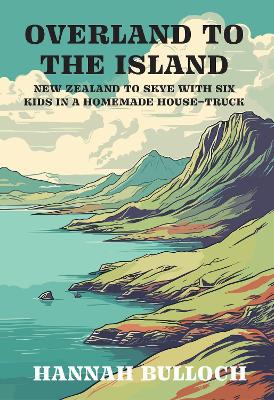
Overland to the Island tells the lively and frequently jaw-dropping story of Alan and Joan MacLeod’s 1963 journey from Dunedin to the Isle of Skye in Scotland with their six children, aged five to fifteen. Alan MacLeod – a Dunedin farmer and former WWII artilleryman – whose grandparents emigrated from Skye to New Zealand in the 1860s, had decided it was time to reconnect the family with their clan ancestry and revisit old haunts from his days fighting in the Italian campaign. Travelling in a homemade house-truck called Holdfast – built by Alan using a Ford tractor engine, a city bus cab and the chassis of a WWII armoured scout car – the family embarked on an extraordinary adventure around the world. Apart from Alan, none of them had ever left New Zealand’s South Island.
Hannah Bulloch, author and Joan and Alan's granddaughter, fills Kete in on writing the book, interviewing her relatives and family, and how her anthropology training influenced her approach.
Kia ora Hannah! Your book is about an epic journey, bravery, and adventure. But I can’t help thinking that tackling writing the book must also have been an epic journey. Tell us more about that?
Yes, writing the book was a journey in itself. As I travelled around talking to various family members, the research threw up far more great material than I’d anticipated. It was a mammoth effort to organise it all, piecing together bits of the puzzle from interviews, diaries, letters, photos, newspaper articles and more. At times, I felt like a detective. ‘Archival research’ has a boring ring to it, but the regular quirky, poignant or surprising discoveries kept it compelling.
When I started working on the manuscript, my background was in the academy, and academics are seldom taught to write engaging prose. To develop skills in narrative nonfiction and to push myself to produce a draft, I did an MA at the International Institute of Modern Letters. Thereafter, I kept reading about writing as I went along. I didn’t want the writing to draw attention to itself. The Macleod family are plain-spoken and unsentimental, and I strove for prose that was sympathetically simple in tone, and that would hold the spotlight on the fascinating details of the family and their journey.
I also decided early on to situate the travels in broader histories – of the family, clan, Aotearoa and the world – but also to avoid a straightforward chronology. The narrative stays grounded in the 1960s but shifts back and forth in time as various historical threads are interwoven. The challenges here were to hold the interest of different readers and avoid confusing them. Part V, focused on Italy, was the hardest to get right because my grandfather travelled southeast to northwest through Italy during the war, and the family revisited his haunts in 1963, travelling in the opposite direction. I’ve interspliced these two narratives, rather than telling them consecutively, but this means that parts of each story are told backwards. Writing it felt like a feat of literary gymnastics, but I worked hard for the flow to feel natural to the reader.
Another challenge was to fit in writing between part-time and full-time work and, later, cancer treatment. I have four fewer organs now than when I started the book. So to at last see it published is, for me, an arrival that I don’t take for granted.
And every member of the family had a different story, a different experience?
Yes and no. Initially, I imagined that, from the six surviving members of the trip, there might be six different travel tales. In fact, they usually agreed on what happened, or had different details that I could combine to construct a fuller picture.
However, their interpretations of events and people were at times dramatically different. For instance, the eldest siblings have divergent feelings about their father compared to the younger ones. And while the youngest reminisce fondly about their childhoods, my mother’s experience was grimmer.
It was a bit sad to hear about Holdfast’s fate. It must have become almost part of the family to Alan, especially.
I thought of Holdfast as a character in its own right – a temperamental but steadfast creature. Through the writing process, I referred to the house-truck as ‘her’ because the pronoun seemed to convey a sense of personhood rather than objecthood, but I was a little inconsistent, and in the end, the editor sensibly replaced ‘her’ with ‘it’.
Thirteen-year-old Flora expressed sadness to see Holdfast go. While I can’t speak for Alan, I imagine him feeling more pragmatic about it.
Just days after the book was published, I discovered that Holdfast’s motor lives on. Alan Junior (Ginger) has now reinstalled it in a Fordson Major – the same type of tractor from which it originally came. It’s a well-travelled engine, having been forged in the UK, shipped to New Zealand as part of a tractor, transferred by my grandfather into a Bren Gun Carrier (which looks like a small tank), then transferred into Holdfast, travelling largely overland back to the Ford factory in England, then sailing for a second time to New Zealand.
You work as an anthropologist. How much did your background affect how you approached the book?
My training as an anthropologist was hugely influential. Anthropologists take a holistic approach to the topics we study, so I was interested not only in the MacLeod travels but also in a range of historical and contextual factors that would bring depth to the story.
Also, anthropologists tend to be attentive not just to exceptional events, but also to everyday happenings, and we look for patterns relating to factors like class, gender, age and of course culture. For the most part, I don’t mention those terms in the book. But in interviews, I asked a lot of questions about who did what, how and how much.
I think it puts the travels into context when we know details such as that, even at home, the MacLeods had no washing machine, fridge or vacuum cleaner. The eldest girl, Marilyn (my mother), would boil the family’s clothes in the copper. The eldest boy was driving trucks on the farm when he was eight years old. There weren’t enough beds for everyone in the house-truck, so Marilyn slept on the floor.
However, while an anthropologist would typically then provide a good deal of analysis, I followed a narrative nonfiction approach of giving the reader more leeway – allowing them to see the patterns for themselves and draw their own conclusions.
It was useful that I had travelled a wee bit for anthropological fieldwork. I lived for two years in the Philippines, and for much of that time I inhabited a one-room bamboo hut with no running water and intermittent electricity. Despite my best efforts, I was often covered in mosquito bites. As there were no other foreigners in the village, I was a curiosity and people would stare at me. At the same time, I was constantly learning – new customs and language – and meeting new people. The hospitality was humbling. So I had a sense of some of what the MacLeods experienced.
What is next on your writing journey? Do you have another project in mind?
The MacLeods set off on a second trip in 1967, and I’ve collected a good deal of material about that, but I don’t think I have it in me to tackle another odyssey right now. I may have to hand it down to the next generation, if any of them are game.
I’m thinking about a rather different book project that would combine my research background, narrative nonfiction skills, and experiences over the past few years. Those ideas are still taking shape, but I’ve realised that, perhaps like my grandfather, I like undertaking a big endeavour.
Overland to the Island (Otago University Press, 2025) is available in bookstores now.