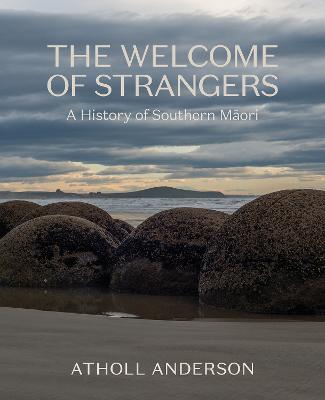
Review: The Welcome of Strangers, by Atholl Anderson
David Veart is impressed by Atholl Anderson's THE WELCOME OF STRANGERS, a definitive history of Ngāi Tahu.
Atholl Anderson’s magisterial work, The Welcome of Strangers: A History of Southern Māori is one of those books you’ll never really finish reading. The amount of detail and interconnected data is such that it will reward continued engagement for years to come.
Anderson is an archaeologist and initially I was expecting a book heavily reliant on archaeological data. But as the author notes, the discipline can only take you so far, especially when dealing with ‘Pre-European’ material. This branch of archaeology cannot name names, name groups and often cannot even tell us accurately when something happened. For this you need to look elsewhere, something Anderson does with consummate skill. Using a combination of whakapapa, traditional histories, written records and archaeology, we are taken on a detailed exploration of the story of Ngāi Tahu from arrival and the subsequent development of a mobile, dispersed society based on hunting, fishing and gathering.
This economic strategy is the major driver of the Ngāi Tahu story; south of Horomaka (Bank’s Peninsula) it was too cold for the tropical cultigens of Polynesia. People therefore needed to develop a complex system of seasonal resource exploitation over very large areas rather than rely on gardening, the basis of much of the northern economy. The areas where this ‘wild’ kai was to be found were mahinga kai, the most famous of which are probably the tītī islands, the source of mutton birds. Anderson describes how people travelled large distances, for example a 300 km round trip to hunt weka; the technology of this travel is illustrated in finds of remains of things as simple as sandals and backpacks.
My particular archaeological interest is Māori food production and I read the sections on kai in the south with great interest. There is, for example, a graph recording the seasonal calendar of Ngāi Tahu hunting, fishing and gathering with an accompanying text. Seals, albatross, flounders, tītī, weka, eels and more are mapped according to season, a fascinating page which I have returned to often.
Graphics and illustrations are an important part of this book. Population histories are listed on the maps of the areas involved, traditional foods are extracted from earlier documents and listed by region, the part eaten and the method of harvest for birds, fish and animals. Census figures are also broken down by rank, gender and age, descent lines are plotted forming an easily accessible source of data from which the reader can explore further.
The hundreds of important illustrations ease the reader through the many pages of text, sometimes expanding the main narrative and occasionally exploring a fascinating footnote. The images are a diverse collection ranging from fading maps of the mahinga kai drawn by kaumatua in the 1800s through to a modern painting by artist Tony Fomison.
Hovering in the background of all this is the arrival of Pākehā and the changes this would bring. One of the main artefacts relating to these changes were firearms. Historian Vincent O’Malley and others have written that Pākehā need to address their history warts and all. Here we have an example of how this can be achieved although without a colonial overlay. Anderson graphically describes the violence of the invasion by musket armed taua from the north, the Kai Huānga feud and the raid by Te Rauparaha using the brig Elizabeth. It was the use of muskets, sometimes asymmetrically, that made these conflicts so bloody.
The book explores the huge changes that Pākehā arrival caused. Southern Māori with their hunting, fishing and gathering economy were affected differently to Māori in the north and within 60 years Ngāi Tahu, masters of most of southern New Zealand, were, in the words of the author, ‘shoved-to the margins of their former lands’. The last part of the book records how Ngāi Tahu dealt with this.
Atholl Anderson has written a definitive history of Ngāi Tahu using a wide range of sources both traditional and modern. It describes the iwi within a historical context and explains how they arrived at the place they occupy today. The use of illustration and graphics adds to this. The Welcome of Strangers is a very important book, not only for Ngāi Tahu but for us all.