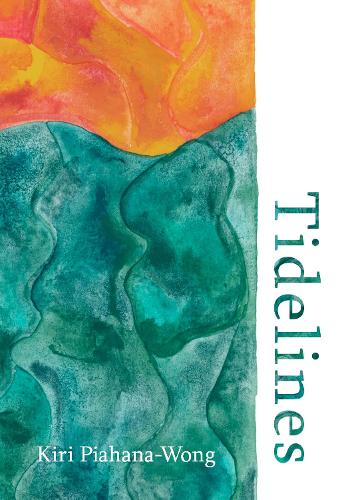
Review — Tidelines, by Kiri Piahana-Wong
Tidelines interweaves the poet's own life with the tragic story of Hinerangi, who lived at Karekare in the distant past. These are poems of Auckland's west coast, reflecting the steady rhythms of daily existence, alongside grief, mental unwellness, disintegration and resolution.
To read Tidelines by Kiri Piahana-Wong is like taking a bite of salt water. It has the brevity of a mouthful of surf along with the sting. The collection is set against Tāmaki’s West Coast, with the first person narrator switching between the personal and the voice of the mythic figure of Hinerangi. In 40 short pages, Piahana-Wong manages to deftly explore the resonance between the internal human and external natural worlds.
The collection deals with suffering and healing, and presents bodily connection to the natural world as vital for life. In ‘Piha’, the rain ‘runs down my body and pools / in my centre… And I’m part of nature too’ (p.16), while in ‘Falling’ the narrator states: ‘I am only half here… I am my worst self’ (p.26) and nature is just a wintry garden out the window. The narrator is at their apex when in touch with nature, and at their nadir when cut off from it.
A cautious hope runs through the collection. It has moments of darkness and desperation, but it also strengthens lifelines to the things that keep us here. In ‘The day I died’ no one actually dies, because the narrator’s tūpuna arrive, and with a gust of wind blow her ‘back / from the edge of the cliff / and away, until the forest / swallow[s] it from sight.’ (p.29). This speaks to how our history, our loved ones, and the inexhaustible world around us can work together to connect us to life, or at least obscure the sometimes tempting possibility of leaving it.
By the end of the collection, the narrator can ‘even catch myself / on the edge of song.’ (p.37). This book’s song is a privilege to hear. Poem ‘Piha’ demonstrates how being connected to the natural world is a lifeline.
Piha
There is a small blue pot, filled with daisies picked from the roadside, sitting on the windowsill, framed by plywood, glass, the dim, warm, pre-cyclone light – it is mid afternoon.
There are grapes, not yet ripped, hanging on a trellis above me, the trellis covered in clear plastic, giving the illusion of open space, protecting me from the rain. Behind me, pōhutukawa are flowering, our brilliant red Christmas trees.
Because, yes, it is Christmas, it is Christmas Eve, and it is where I start to lose it, I stop looking and start listening, I’m listening to you drumming, Ahurewa singing, and while I want to describe the precise nature of the sound, what I can hear, all I am thinking is
– nobody plays the drums like you do
and then I’m lost, you see, I want to be lost and I am lost and I’m gone.
Sometime later I come back to myself to the sound of flowers. I am in a high place, close to the sky.
There are light green leaves above me, as perfect as stencils. There is a creeper growing, wrapping itself tenaciously around the trunk, the limbs, of a pūriri tree. I think the vine is winning, it is smothering the tree, but then I see no, the tree is still strong, although part of it looks dead, and then I wonder if nature even thinks like that.
And I’m part of nature too, never more so than now, this day, this pre-cyclonic post- apocalypse-that-never-came rainy early- summer Christmas Eve, this early evening/afternoon. There is more rain falling now.. It runs in rivulets from the top of your head down the bridge of your nose onto my half-open mouth, running over my lips, and it runs over my chin and it runs down my body and pools in my centre, and then as I turn over to press my face, my warm, bare face, against the grass, dying leaves, the earth, I feel it – the sky’s water: all the wondrous light weeping joyous tears of the sky god, Ranginui, running down my side and into the earth, Papatūānuku, and then settling there.
Reviewed by Hebe Kearney