Review: Obligate Carnivore and Angel Train
'I am presented with two examples of one of my favourite animals: the poet writing fiction. Although these authors may not describe themselves as such since they are well established in either form...'
Reviewed by Anna Scaife
Two accomplished authors. Two notable books. One controversy. A lot to cover in not many words. I will leave the latter to last, where it belongs, and perhaps in fairness to the authors it should not appear here at all, yet it can’t be ignored.
Having been asked to review Obligate Carnivore and other stories by Stephanie Johnson, and Angel Train: Four Novellas by Elizabeth Smither, I am presented with two examples of one of my favourite animals: the poet writing fiction. Although these authors may not describe themselves as such since they are well established in either form.
Both authors boast literary contributions spanning decades. Elizabeth Smither has achieved many accolades during her expansive career, including the NZ Book Award for Poetry, and the Montana Book Award for Poetry. Her published works include 19 collections of poetry, six short story collections and six novels, along with journals and memoir.
Stephanie Johnson is an accomplished novelist and short story writer. She was the recipient of the Prime Minister’s Award for Fiction (2022) and won the Deutz Award for Fiction at the Montana Book Awards in 2003. Her published works include novels, short story collections, poetry, stage plays and radio dramas.
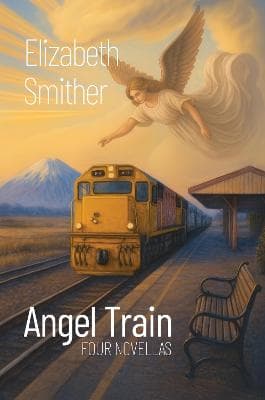
Angel Train comprises four novella length stories which skillfully combine the immersive power of the novel with the lyrical brevity of short fiction. The opening story, The Glass-sided Hearse, weaves a strand of connection between two women authors, one of whom has terminal cancer, who meet on a book tour in Edinburgh. In this moving story, Smithers’ selection of insightful detail and lyrical language creates a remarkable rendering of the pedestrian obligations of everyday life set against the exquisite aloneness of the dying person moving through the world.
The novella form offers the author the chance to dwell with characters, to shapeshift through time and place, and expand into the shadowed corners of the imagination. Each of these stories is curious and insightful, the characters vividly alive and flawed. All contain women of strength and spirit, yet they are told with a gentle hand; as if, like the women, the language feels it should not make an example of itself. Throughout this unique and powerful book, I was floored by the near-perfect prose and sharpness of the storytelling.
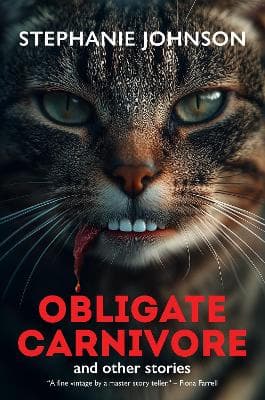
In Obligate Carnivore Stephanie Johnson too employs a mastery of prose that is the earned result of a prolific career. Again, there’s not a word out of place. The book contains 27 collected stories spanning twenty years of writing. All are skillfully crafted, and many reveal a sharpened edge, with darkness just around the corner. The title story’s narrator is an environmentalist and zero-waste advocate who acquires a cat named Gareth Morgan. It’s a killer story riffing on nature fighting back against the forced constraints placed by humanity and doing so with gleeful horror. The economically told Bear throws a satirical spotlight on toxic masculinity with a wry humour that’s as dark as it gets.
Obligate Carnivore is a fine example of short stories at their pithy best. An excellent book to dip in and out of, each is bite-sized but truly self-contained and satisfying. None shy from the jagged edges of human nature, and they are told with wit and enviable economy.
This review wouldn’t be complete without mention of the storm surrounding the use of AI in the cover design. This came to the fore recently when the Ockham New Zealand Book Awards banned the use of AI in cover design, thereby removing these books from contention. However, after consideration of the unique circumstances, both books have been reinstated, with the rules to be enforced strictly going forward.
And as for the lively AI debate: there’s a good argument that the cover design has nothing to do with the quality of the writing. Importantly, there is also the issue of the sector continuing to support the work of illustrators and designers.
Honestly, the covers were the first thing that hit me about these books. I messaged a writer friend with the question, ‘why would they just plug the cover brief into AI?’ That may be unfair to all involved, but it IS what I thought. If the publisher’s job is to market the work of the writer, then impressions are surely at the top of the priority list, and from 2026, the Ockhams have shoved a stake in the ground.
And as the whole predictable adage about publicity is true, these books will make it into the hands of more readers than they might have, which is the whole point.