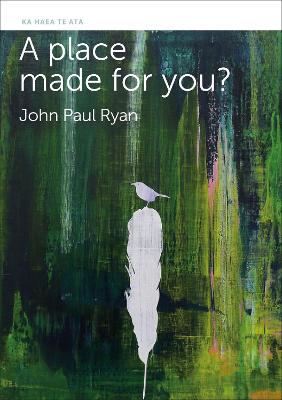
Review: A Place Made For You?, by John Paul Ryan
David Hill contemplates place and its minutiae in Ryan's debut book.
Why do some places remain in your consciousness all life long, even though you may be years and hemispheres away?
In my case, it's an old cottage and adjacent gulley on Napier Hill, plus a cul-de-sac and a stand of puriri, pohutukawa, rimu in suburban New Plymouth. For teacher and conservationist John Paul Ryan, it's the Hokonui Hills in Murihiku/Southland, near 'the southern edge of the world'. In this respectful, quietly searching study-cum-meditation, he presents the small world on which he's walked and pondered for decades.
His opening sentence – 'this is really a book about place' – says it all. He acknowledges that to someone driving by, the Hokonui Hills, with their profile of a heading dog or 'a genial Tyrannosaurus Rex falling through space', may not seem spectacular. But they're his. 'I've known them all my life.'
And here I need to note that Ryan's is an emphatically Christian life and viewpoint,'a Christian lens to writing about the natural world'. The word 'creation' beats steadily. The Book of Genesis, plus other religious texts and writers are quoted. Land is best seen as ultimately belonging to the Lord.
Is it obtrusive? Integrated, rather. You're sharing a meditation, not sitting through a sermon. It brings moments of fulfilment and joy as well as moments of lamentation ('our age lacks a religious sense of the places where we choose to live'). It can mean some nice bits of whimsy: Ryan wonders what sort of tree made the cross for Christ's crucifixion; struggles to make something called a Scripture Cake.
The book steps across multiple facets of land and its implications. Chapter titles provide a neat summary: 'Streams and watersheds', 'The Tussock grasslands', 'Acts of habitation', 'Eating, drinking and feasting in the Hokonui'.
Topics such as species decline, the kauri planted by a local school and the arson of an ancient rata, picnics down the years and irresponsible littering from the Waterside Workers' Social Club, the lizard dreams of two Māori hunters, 'the battle for supremacy between manuka, gorse and broom' are typical. Ryan even gets endearingly lyrical over Hokonui rain.
A trout caught and eaten with a friend in boyhood becomes a form of sacrament. He admires his practical father's currant-planting and harvesting, the meals from a mother so appreciative of the world that she sometimes thanked automatic doors for opening. (Isn't that last bit great?)
Indeed, Ryan is moved by people as well as places. He honours the farmer who put his money where his beliefs were, buying and preserving ten hectares of kahikatea. He respects hunters, including the bow-carrying one who 'looked at me with eyes straight out of the Paleolithic'. He notes the bloke who tried out his new motor-mower inside his house, with predictable results for the rug. He records women who played major roles in the district, from widowed Mrs Fletcher thwarting her 'alcohol-fuelled adult son' to the thousands labouring over their Dunedin-made Shacklock stoves.
And he ponders changing attitudes to the land; worries that it's been impoverished, treated as just an economic resource, 'desacralised' – which is an excellent choice of word. He mourns the 59 extinctions of species that have accompanied human presence in Aotearoa.
Regret, recognition, celebration and thanksgiving all feature. So do moments of illumination, which bloom out of the quiet, scrupulous writing style. '(T)ussock lands....with flaring gold and rippling bronze'; 'Forest canopies with kakariki remind me of a junior classroom on a wet lunchtime.' You may not have been there, but you recognise and believe it.
Courteously, fittingly, Ryan prioritises Māori names, spelt in the southern dialect, for places, animals, plants. He includes extensive footnotes and a full reading list; generously acknowledges other writers. It's a multi-faceted, meticulous tribute to the author's turangawaewae. Read it slowly; immerse yourself as John Paul Ryan so obviously has done.