Review: Bill Hammond: Across the Evening Sky
“A dawn chorus of praise for an exceptional artist.”
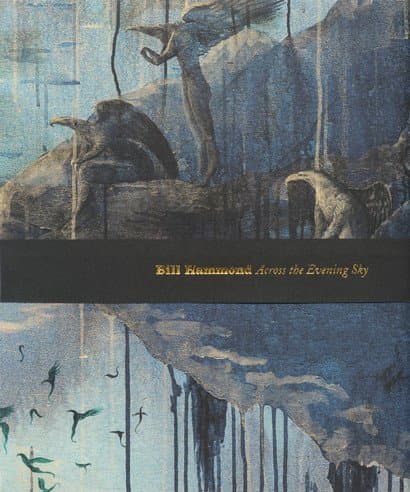
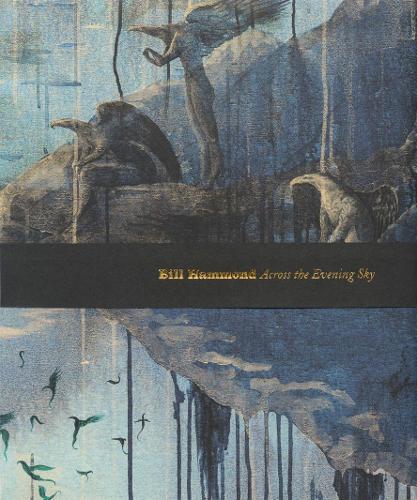
This striking hardback, designed by the talented Aaron Beehre, is a companion book and virtual twin of Bill Hammond: Jingle Jangle Morning (2007). Across the Evening Sky was initiated while the Lyttelton artist was still alive but published after his death in January 2021. The two books thus become a memorial and testament to the life work of this remarkable artist, widely admired as one of this country’s finest.
Jingle Jangle Morning documented a major exhibition of Hammond’s work at Christchurch Art Gallery which included more than 60 works from 1985 to 2007. Across the Evening Sky, while similar in design, differs in several important respects. It does not document a particular exhibition; rather it reproduces works from the last decade or so of Hammond’s career, painted between 2007 and 2018. Also, the number of works reproduced is much smaller than the previous book: 33 as compared to 62. Because the books are consecutive in contents, it would be advisable to acquire both for comprehensive coverage of Hammond’s career. No more handsome pair of books could be found in any library of New Zealand art.
Because the new book reproduces about half the number of paintings as its predecessor, designer and publisher have taken the opportunity for an unusually lavish presentation of the works. Each receives two double-page spreads. On the first, information about the work is given on the left page (title, date, medium, size, collection), while the right page reproduces the full painting. On the second spread is an enlarged detail from the painting, the image being bled out to the edges of the page on all sides.
This innovative design provides the reader with the sort of double perspective (up close, further back) experienced by viewers in a gallery. It is particularly apposite for Hammond in that it provides both the over-all impression of the complete work and a close-up of some of the fascinating detail his paintings typically entail. The enlarged portion, near to actual size I imagine, also enables close inspection of the colour and texture of the individual paintings – a bonus given Hammond’s technical wizardry.
A dawn chorus of praise for an exceptional artist.
As is well-known, Hammond had a life-changing experience in 1989 when, with other artists, he visited the sub-Antarctic and Auckland Islands south of New Zealand and discovered a world of birds virtually free of mammals or humans. Before long a magically transformed version of this world had entered his paintings. In a series called Watching for Buller (1993) he first introduced his idiosyncratic humanoid/bird hybrids, dressed as humans in smart frocks with bird-like heads and beaks, standing on cliff tops and gazing out to sea, as he had seen seabirds do on Enderby Island.
Walter Buller (1838-1906), named in the series, was a colonial ornithologist who slaughtered tens of thousands of native birds, some almost to extinction, in assembling his famous collections and books (Buller’s Birds of New Zealand, 1872-73). There is a melancholy and elegiac mood and a sharp environmental consciousness in Hammond’s painting as he recreates a vanished world teeming with bird life but doomed to destruction by human and animal predation.
Hammond’s ‘bird’ paintings struck a chord with New Zealanders in the 1990s and rapidly elevated him to fame and fortune. By 2007 when the paintings in Across the Evening Sky begin, Hammond’s bird-paintings had already gone through several transformations as documented in Jingle Jangle Morning. In particular images of the extinct Haast’s Eagle (Pouākai), a giant avian predator that feasted on moa and became extinct when the flightless birds died out, had entered his painting, often in the setting of capacious volcanic caves such as those found on Banks Peninsula, Hammond’s tūrangawaewae. The new book opens with several of these, such as the vast (2.2 x 4.2 metres) Bone Yard Open Home, Cave Painting 4, Convocation of Eagles (2008) now in Christchurch Art Gallery (the only painting in the book, incidentally, held in a public collection).
Hammond’s commanding eagle-people perch, strut, lounge and hover, their giant wings spread or folded, carrying in their hominoid hands bones or eggs or musical instruments or chunks of bloody meat; they inhabit cavernous dim interiors looking out on the dazzling exterior world, like viewing a brightly-lit stage from within a darkened theatre. In the series Wishbone Ash (2010-11), large decorated urns or burners smoking with the ash of sacrificed creatures share space with the bird people. Sometimes the creatures are richly garbed in crimson, yellow, rose-pink, blue or purple gowns, some are mounted on horseback, some brandish bones, others pluck at harps or violins. It is a weird, fantastical, enigmatic, noble and often gorgeous vision that Hammond invents.
This book is all about the pictures; the accompanying texts by Peter Vangioni and others, a miscellaneous group, are of secondary importance. In the words of Blair Jackson’s Preface, they “create contexts from within which readers might view the works: caves and landscapes, mythologies, the process of story telling” etc. There is also a typically evasive interview with Hammond by artist-friend Tony de Lautour. Some of the most interesting textual material is found in short pieces headed Beating the Drum in which friends and fellow-artists write warmly about ‘their Bill.’ They include Mark Adams, Shane Cotton, Jason Grieg, Gerda Leenards, Liz Maw, Fiona Pardington, Nathan Pohio, Francis Upritchard, Ronnie van Hout and Marlon Williams. A dawn chorus of praise for an exceptional artist.
Reviewed by Peter Simpson
Gallery