Body insecurity, dissatisfaction, voyeurism: THE STARVING BRIDE
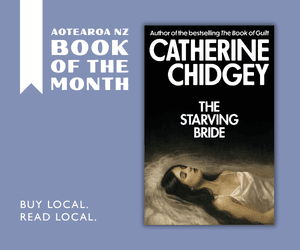
Josie Shapiro discusses the body and its importance in Catherine Chidgey's latest novel.
‘Stare all you like!’ they cried. ‘Say what you want! It’s the good old days here, folks – let it all out!’ – The Starving Bride, Catherine Chidgey
There’s a young woman on my phone screen. She’s wearing a purple crop top and baggy barrel leg jeans. Written over the video is a short message, in a plain white font: ‘If I had 12 weeks until my wedding and wanted to lose 8kg, these are the five things I’d do first and the third one is the most important.’
Scroll down, another video: a young woman in a strapless wedding dress and veil. The text across her reads: ‘Kinda chic to go from a size 14 to a size 2 and not have to diet before big events in my life.’ A long message accompanies the video, detailing all the things this woman did, and at the bottom, a call to action, ‘Comment GUIDE to get started for free’. There is one comment; it doesn’t say GUIDE, instead: ‘Ozempic’.
Maybe this is just the toxic online world. I just need to touch some grass! But is the real world any different, or any better? A recent article in The Cut magazine discussed the rampant use (and abuse) of GLP-1 medications among young women in the United States right now, which described how new members of a sorority were made to sit on washing machines, while other, older sorority members circled with black marker the spots on the new woman’s body where fat jiggled as the machine went through a cycle, to humiliate her into losing weight.
Catherine Chidgey’s latest novel, The Starving Bride, takes these concerns around body dysmorphia, dissatisfaction, performance and the inherent voyeurism in social media (and real life) and mixes them with climate change and a nostalgic sentimentality about the past, along with a dose of Chidgey’s sly humour. Together, it’s a potent combination.
In The Starving Bride, we meet our protagonist Hazel while she’s working at an almond processing factory in Swindon. Aside from the title, this is our first hint that this is a novel about disordered eating – perhaps you’ve heard of the ‘Almond Mom’, the parent who’s so obsessed with thinness they project this anxiety onto their children? Hazel has a habit of carving small skulls into the almonds. Clearly, all is not well. Little hints let the reader know there’s shame in her past, and tragedy. When she falls in love with colleague Aaron, she can’t relax and enjoy the romance, because an inner voice taunts her: ‘You’re fat and he can feel it. He’s disgusted and doesn’t know how to tell you’.
When the relationship ends, she loses her job. Hazel is desperate. She reconnects with an old friend, the slim and graceful Gilda, who is working as a dancer in the Blackpool circus. In an attempt to reinvigorate tourism and distract people from the horrors of the world (‘Let’s face it, the world is a mess. Food riots, dead bees, climate change, sea-level rise. Don’t you long for the ways things used to be?’), Blackpool’s council have unleashed a new campaign, named #ASimplerTime, which means the return of sideshow attractions we might think of as outdated and problematic. Ethics aside, they certainly draw in the crowds. The promenade is brimming with tourists and drunken bachelors and bachelorettes, all misbehaving in the shadow of the Tower, which may or may not be about to topple over from years of neglect and environmental decay. Maybe The Starving Bride is speculative fiction, maybe it’s set in the very near future, or maybe our real world is already so messed up there’s no way to tell the difference. Old friend Gilda helps Hazel land a job playing the Starving Bride, one of the revived sideshow acts. The story goes: a poor woman can’t afford to pay for her wedding day, so she lies in a glass coffin without eating for forty days, while a ravenous, wild lion prowls the enclosure – all for a substantial monetary reward. It’s taking the idea of Shredding for the Wedding to a whole new extreme.
But is it the money that seduces Hazel to accept the job, or is it the implicit promise that she might get thin? ‘It was true that she needed the money, and she still needed the money – but what she’d wanted all along, what she’d secretly desired, what every woman who watched her desired, was a different body’. And, possibly, is part of the allure the knowledge that others will watch her grow thin, and in watching, make it meaningful? In Susie Orbach’s book Bodies, originally published in 2009 but updated in 2019, Orbach explains that ‘we experience the wish for more perfect bodies as our own desire, as indeed it is, yet it is hard to separate out how bodies are seen, talked about, represented and written about and the effect of that on our personal perception of our own and other bodies’. Chidgey doesn’t shy away from these questions about being seen, and how that observation changes our experience. In The Starving Bride she gives them a hyperreal world in which they can be examined. A lion prowling, a devastating storm, the literal and metaphorical hunger of a woman alive today – there’s a foreboding sense of dread and pressure that builds and builds.
But perhaps what gives the novel the highest dose of manic energy, what makes it confronting more than any of the antics of the plot (I mean, I will never look at a Toblerone the same way ever again) is the choice to use the first-person plural point of view to represent The Anabelles, an online group of young women who see the diminishing Hazel as their ‘god’. ‘Ana’ is a nickname for anorexia, and the internet is rife with pro-ana spaces where extreme thinness and disordered eating is glorified and supported, despite attempts to shut them down (if you search #weightloss on Instagram, the screen goes white and reads: ‘Help is available. If you or someone you know may be struggling, there are ways to get help’). The first-person plural point of view is uncommon, but one Chidgey also employed to great effect in her brilliant World War II novel Remote Sympathy, where the ‘we’ point of view evoked the collective voice of the people living in Weimar, beside the concentration camp. In Remote Sympathy, this technique exposed and explored deliberate ignorance, herd mentality, and our horrifying capacity to harm others, or stand by while harm is done to others. It isn’t a stretch to say these same themes underpin The Starving Bride, even if the resulting work is distinct in style and story.
The Starving Bride functions on many levels: a quick, page-turning read, and a scathing and brutal depiction of how invasive body insecurity has become. At one point, the Anabelles say: ‘We pace up and down our hallways one hundred and fifty times to walk a mile’ – and there I was, as I read the novel, walking up and down the hallway in my own house, with a familiar voice of a guilt and shame whispering to me. Uncanny, perhaps, or, more likely, the work of an observant, skilful writer, putting down on the page what she wants us to bear witness to.
Josie Shapiro is the author of the bestselling books Everything is Beautiful and Everything Hurts and Good Things Come and Go.