Review: Karl Maughan
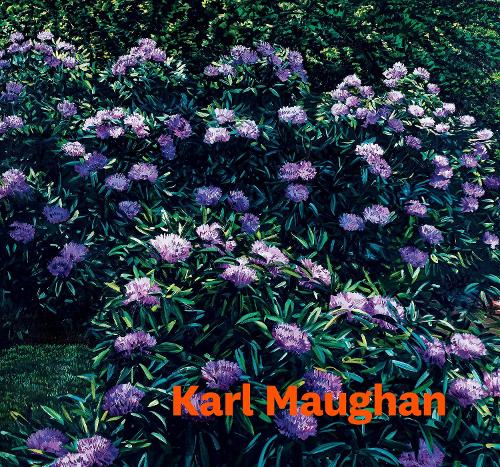
For more than three decades, Karl Maughan has created intricately painted gardenscapes, developing his own visual language to explore the forms of nature and the nature of form.
The editorial and production team at Auckland University Press have delivered an appropriately big, bold and beautiful book to document and celebrate the equally big, bold and beautiful garden paintings of Karl Maughan.
With the recent death of Bill Hammond, it is arguable that Maughan is the country’s most popular painter; his paintings are gorgeously colourful, immediately recognisable, skilfully executed, easy to like and indeed hard to dislike.
You hear the occasional grumble that his work is formulaic, repetitious and undemanding but this book will go a long way to dispelling such reservations. It demonstrates that there has been continuous evolution since his work first emerged in the 1980s, that it is capable of engaging and sustaining serious critical attention and that there is more to it than meets the casual eye. The subject matter may be narrow and unchanging, but that is not necessarily a limitation (compare for example Giorgio Morandi), and the impact of his work is undeniable.
The artist has said that he wants his work to ‘astound’ the viewer and for the most part he succeeds. The authors, assembled by editors Hannah Valentine and Gabriella Stead, provide illuminating perspectives on Maughan and his work, helpfully opening it up for critical appreciation and understanding.
Dick Frizzell’s Foreword strikes an immediate reader-friendly note. Frizzell, who was Maughan’s teacher at Elam in the early 1980s, speaks well of the art-historical moment at which Maughan emerged, a moment in which Critical Theory had arrived with a vengeance, the ‘death of painting’ was widely promulgated and artists who (like Frizzell and Maughan) were keen on brushes, canvas and tubes of paint found themselves in something of a ‘semiotic impasse’.
The editors’ introduction brings up many of the key issues which figure in the subsequent essays, such as the notion that gardens are themselves cultural constructs so that paintings about gardens are in a sense art about art. They speak of their desire to provide a kind of ‘lexicon’ to Maughan’s painterly language and introduce such notions as paintings of gardens as ‘cultural microcosms’ which combine both aesthetic and social considerations. They also reference some of the major influences on Maughan’s practice such as photography, the paintings of van Gogh, Phillip Trusttum and Pat Hanly, and explore some of the reasons for Maughan’s popularity.
Within her account of the early paintings (from art school up to his move to the United Kingdom in the late 1990s), Linda Tyler explores the early influences of father (reading, painting) and mother (gardener, landscape designer), and explains Maughan’s photographs of his mother’s garden at Ashurst as key sources for his early work. Tyler usefully explores the role of the camera and collage in his work in arriving at a unique mix of ‘observation modified by memory, imagination and photography’.
Phil King’s essay provides information about what Maughan was up to in London in the 1990s. A writer and artist from the same London milieu, King offers a fascinating glimpse of Maughan’s studio as a kind of oasis among the grime and gloom of the East End. He offers explanations of Maughan’s appeal to such important London collectors as Charles Saatchi through his ‘neurotic realism’ – a provocative insight.
Gregory O’Brien’s essay is a succession of heterogeneous notes in which he is particularly informative about Maughan’s extensive (colour-coded!) library of art books, poetry and miscellaneous other topics. He also makes some sharp points about the time of season and time of year in the pictures (high summer, midday sun, especially in the more recent pictures) and how the pictures project outward into the viewer’s space rather than recede in perspectival fashion.
Each chapter is well-illustrated with images throughout, including details and installation shots. The works reproduce well and there is a generous selection of them. There is, too, a worthwhile section on Maughan as a print maker, and a list of solo and group shows.
Karl Maughan edited by Hannah Valentine and Gabriella Stead (Auckland University Press and Gow Langsford Gallery) has been longlisted for the Booksellers Aotearoa New Zealand Award for Illustrated Non-Fiction.
Reviewed by Peter Simpson