Review: A Place to Stand, by Clare Ward
Northland is a remote, spiritual place. Humanity here is scarce and scattered. It is the earth that sings loudest here, that takes up space, that makes us slow down and take notice. The land is a multiplicity of green, stretched between oceans, buffeted by maritime weather, nibbled at by the Hokianga Harbour. The Waipoua forest grows so lush that thick kauri abuts the tarmac of State Highway 12, promising one day to restore the land to its ancient vitality. This region at the northernmost end of Aotearoa is surely a thin space, where the physical segues into the otherworldly, where the divine feels utterly tangible.
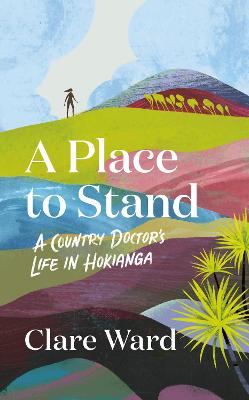
Dr Clare Ward’s memoir A Place to Stand (Allen & Unwin, 2026) is an exceptionally beautiful and indeed spiritual book. It chronicles thirty years of a country doctor’s work in the Hokianga. But it is much more than a straightforward medical memoir. It feels, instead, like a work of craftsmanship, from the solid heft of its hard covering, with the gorgeous cover art by Hope McConnell, to the calm, pensive grey-scale photographs from the author’s own collection peppered throughout. The writing is poetic in cadence and content. The presence of the landscape looms large, and not simply as a thing to be fought and overcome, but as an entity that brings deep meaning and connection. Indeed, Dr Ward opens and closes each chapter with a meditation on her surroundings, musing on the interconnectedness of life. ‘Shadows of trees fall into grass,’ she writes. ‘There is an early morning loveliness when the harbour is still and there are stars high up. To the east, the horizon starts to unfold and stretch out. Whatever you had dreamt vanishes with the night. You cannot see it anymore. The stars, too, disappear.’
This book is the telling of a journey - the journey of a Pākeha outsider in the rural Māori world. It is about learning to understand and love a culture that is different from one’s own; about learning to love a language that embraces care for the land and its people. To know a language is to know, appreciate and love the people that speak it. There is a journey here of grappling with the many lives that intersect with that of a country doctor’s. The narrative illuminates fluid and uncertain boundaries. Of being unable to sleep during on-call shifts for fear the phone may ring at any moment. Of feeling terrified and very alone while caring for sick patients while the nearest ambulance makes a multi-hour journey to arrive. Of the grief of missed or incorrect diagnoses and the resulting self-doubt. Of having to care for patients who are also friends. Of being a single woman who falls in love with a local man, and the incongruity of the strict taboo against doctor-patient relationships in a place like Northland; rules that are better suited to urban centres, that make life much too hard in this remote place.
The medical encounters are eye-opening. Our rural health practitioners work extraordinary hours with scant resources, and sometimes have to do extra-ordinary things in order to help their patients. Clinging on to a rickety swing bridge while a river is swollen with flood-waters, for example. Walking, shoes in hand, across a rain-sodden paddock because it is easier to wash dirty feet than clean silted shoes. Climbing to a patient’s house perched atop a hill slick with mud, and choosing to arrive via the scrubby vegetated hillside because it offers firmer footholds, rather than chancing it on the slippery driveway. Certifying a woman’s death in her home, then helping family members to wash and dress the body in preparation for the tangi.
This stunning memoir embraces the liminal space between doctor and patient that is saturated with the things that are not seen. Dr Ward’s opening quote, by T.S Eliot, is apt: ‘In order to arrive at what you are not / You must go through the way in which you are not.’