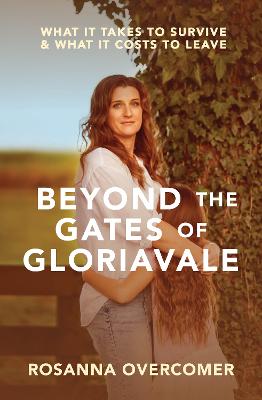
Review: Beyond the Gates of Gloriavale, by Rosanna Overcomer
'But one does not simply walk out of Gloriavale. From this point on, the Overcomers’ name seems more apt than ever...'
‘The Truth,’ Rosanna Overcomer reflects in her memoir of life on both sides of the gates of Gloriavale, ‘was whatever the leaders said was true. If we rejected it … we would burn in hell forever.’
This version of reality is the keystone in a power structure that promised heaven while relying on relentless human rights abuses. Overcomer is second generation here. Her parents met at a small church led by charismatic preacher Neville Cooper, later known as Hopeful Christian. That church grew fast, ultimately relocating to extreme isolation on the West Coast. Gloriavale.
Overcomer’s account is honest, rage-inducing, sometimes deeply painful. There are threads of light too, notably the love and trust she shares with her husband Elijah. At times she writes in minute detail; vivid moments, one after the other, but no less telling for that. This is the drip-drip-drip of cultic control: endless rules, prayer meetings, public humiliation. Child labour, forced labour, fasting, sleep deprivation. The weaponisation of shame and fear. And, with depressing inevitability, the subjugation of women.
I’m struck by the sense of total immersion, and in hindsight Overcomer sees that too. ‘I had no idea that this life was anything but normal.’
Gloriavale’s longest shadow is cast by sexual abuse. The prologue opens in 2025 as Overcomer is first witness in the trial of Howard Temple, a church leader accused of twenty years of offending against women and girls. It was her police statement, made back in 2015, that led to a broader investigation. Groping and grooming seem to have been endemic at Gloriavale, where girls were made to tie their belts in a bow so that they could be easily undone. Overcomer has a childhood memory of being taken to a prison to visit Hopeful Christian, by then a convicted sex offender but still revered as a persecuted leader, a man ‘like a God.’ She doesn’t dwell on the details of her own abuse, though we know she first experienced it as a young child. Her victim impact statement for Temple’s sentencing is a wrenching reminder that trauma does not end when abuse does.
When Rosanna and Elijah Overcomer become parents themselves, they begin to think the unthinkable: that Gloriavale can never be a safe place for any child, and the leaders may not be the arbiters of truth. There’s a fascinating moment when – having been forcibly separated from Elijah, kidnapped and hidden in a motel – Overcomer watches a documentary about the mass suicide at Jonestown. It rings bells for her. She listens to Jim Jones, and recognises the language of control.
But one does not simply walk out of Gloriavale. From this point on, the Overcomers’ name seems more apt than ever: a young family choosing exile, braving a world they’ve been taught to see as demonic and are ill-equipped to navigate. Within hours their van’s engine is dead and they are encountering the kindness of strangers who give supplies and lend a car, entirely on trust.
Twelve years later, stepping into the witness box during the trial of Howard Temple, Overcomer reminds herself that she’s learned that she has a voice – and now she’s going to use it. Others too have reclaimed their voices, and Gloriavale is changing. Court cases and investigations are ongoing. Some of the more shocking practices have been stopped, the community’s charitable status now revoked.
Overcomer’s story highlights the tension between religious freedom and society’s duty to protect individual rights. Gloriavale, ‘a factory that churns out damaged people and uses God to disguise evil,’ thrived for decades, even becoming the subject of rose-tinted television documentaries. If – like me - you watched TV2’s Gloriavale: A World Apart (2014) and wondered what you were not being shown during that wedding, you might read this book to find out.
Overcomer still visits Gloriavale and has measured, compassionate thoughts on its future. Should the government close it down? ‘I don’t believe it’s that simple,’ she replies, fearing the potential for catastrophe if everyone, including her own mother, were to be forced out. She maps a gradual process in which the harmful nature of the community gradually fades away.
It's been over thirteen years since the Overcomers were driven out of those gates in an overheating van. They’ve built a new life since. Sometimes, standing on the sidelines of kids’ sports, Rosanna Overcomer feels overwhelmed by gratitude and joy.
‘Through my children I get a front-row seat to an ordinary childhood,’ she says. ‘And what a remarkable thing ordinary can be.’