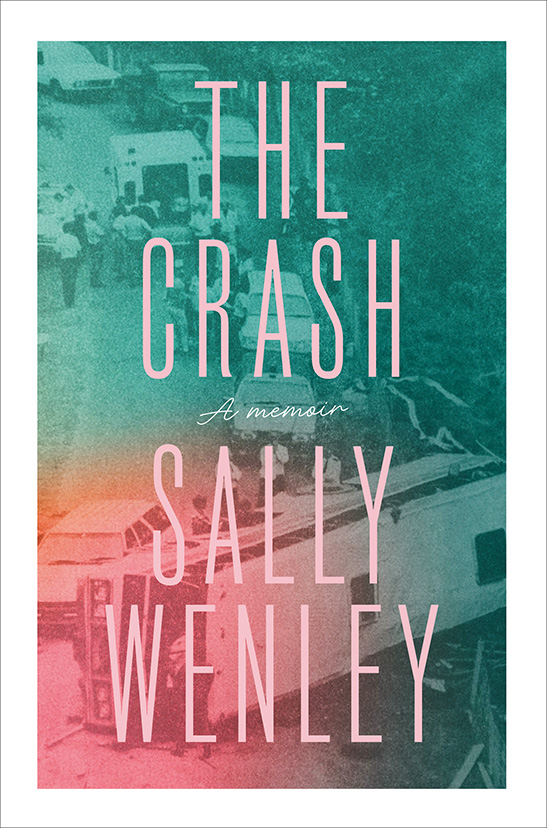
Review: The Crash, by Sally Wenley
David Hill reviews this new compelling, unflinching and insistently authentic memoir, from journalist Sally Wenley.
Dramatic events don't automatically mean a dramatic book. I can think of several 'Oh, I've had a really colourful life’ renderings that come across in print as flat and monotone.
So what have been the dramatic events in journalist Sally Wenley's life?
Well, in February 1986, the sports prefect at Woodford House School, Havelock North, was a hockey and cricket player, an accomplished road runner, a stroppy and sparky pupil who'd just had her first kiss. She was en route to the annual school picnic when the bus somersaulted down a bank. Two teachers, two girls and the driver died. Sally's spinal cord was severed; she faced life as a paraplegic.
How bald. How inadequate a summary of this compelling, unflinching narrative.
So, some more details – and The Crash is rich with them, nearly all vivid and absorbing. Sally struggles back to consciousness in Christchurch's Spinal Unit, with no memory of the accident; she cleverly saves that till later. She won't believe her prognosis at first; rips up the Get Well cards. As she slowly, painfully starts to sit in a wheelchair, she watches guys with ruined arms spill food down themselves. She helps 'Mr Gang' smoke the dope his mates smuggle in. More vivid details.
Back to school she goes. Every class and corner stabs her with reminders of what she can never do again. The crash is hardly mentioned; there's a sort of rigid-upper-lip conspiracy of silence about it. Our author neatly keeps that till the end of her story also.
She gives us the glamour-lite moments of bowel and bladder problems, and pressure sores on the bum. In spite of them, she heads to Massey University, where she has her first shot at writing, and a lot of other, prize-winning shots as a member of the rifle club. Her near-ferocious determination, her flaws – more on them later – keep glinting through.
Then a journalism course in Christchurch, a chaotic interview with Michael Laws (anyone remember him?); advice from sports-writing supremo Terry McLean (almost everyone remembers him). As an RNZ court reporter, she handles media scrums: 'My elbows are at crotch height, and male journalists.... learned to be careful of me.'
The pain persists – dreadfully. She parties, drinks, chucks herself at men for distraction. There's plenty to jolt you here; as I say, it's an unflinching narrative. 'Oral sex in pub toilets....sex clubs....twosomes and threesomes.'
She travels to the Uk and Wimbledon, to Pisa, on a girls' road trip through Colorado, to a soft sex cabaret in Vegas. It's pretty conventional reportage in these chapters, and a little trimming wouldn't have hurt.
But then, back in NZ and back into journalism, the immediacy presses again. She interviews Tom Cruise and gang members, and seems to have preferred the latter, which shows commendable taste. She likes Robbie Williams, which shows her taste lapses occasionally, but clearly dislikes Brian Tamaki's lot, which shows the lapses are few.
The pain won't stop. Nothing works. A nurse suggests she's faking it. (I wanted to find the silly medic and shake her.) The agony becomes so intense that Wenley prepares to kill herself. Quite wondrously, a risky surgery – a cordectomy, what a splendid word – makes things almost manageable.
She marries, has blue-eyed Georgia. The marriage dwindles, and she morphs into a gutsy single mum. She meets, likes, loves and marries excellent 'Bruce the Bloke'. She keeps going; you feel sure she'll always keep going.
Then the last chapters spring surprises. There's an unexpected, confronting narrative of the 1987 crash, as seen by shearer Guy; the contribution from Marcus of the first kiss; the memories of another bus passenger. Like the pro she is, Wenley interviews them all.
It's the honesty, the imperfections that distinguish this memoir, and I mean 'distinguish' in both its senses. I'm not going to call it an inspiring story; that would pigeon-hole and patronise it. It's insistently authentic, crafted and clear all the way. Read it, and you'll understand what I mean when I say Good on Yer, Wilbs.