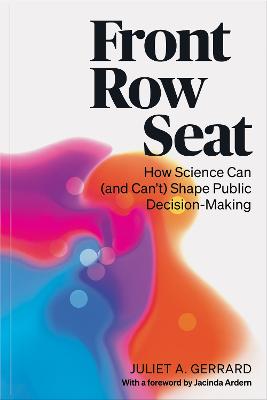
Review: Front Row Seat, by Dame Juliet Gerrard
'We witness how science can provide evidence but cannot determine exactly what a government should do. Values, politics, economics, expectations, and other practical considerations inevitably influence a final decision...'
While the title of Front Row Seat is enticing, it’s the sub-title – How Science Can (And Can’t) Shape Public Decision-Making – that speaks to the book’s substance.
Dame Juliet Gerrard served as the Chief Science Advisor to three Prime Ministers (Jacinda Ardern, Chris Hipkins and Christopher Luxon) and is currently a professor in biological and chemical sciences at Waipapa Taumata Rau, University of Auckland. Gerrard’s recently released book is billed as a readable, insider account of how science can help solve big public issues.
In comparison with the scientific literature, Front Row Seat is certainly readable. However, its specialised subject matter is likely to appeal primarily to readers with an interest in evidence, politics, and public policy. The book is at once a cautionary tale and a well of inspiration for those eager to see robust evidence harnessed for decision-making. Anyone looking for a dramatic behind-the-scenes account of government will find the book more analytical than sensational.
Gerrard begins by laying the groundwork and walking us through her unexpected path to the Office of the Prime Minister. She frames the role of Chief Science Advisor as a bridge between the worlds of science and policy. 'But a bridge is only useful if people cross it,' she explains. 'We needed to find ways to create free-flowing conversations where all views were sought, welcome, and heard.' Enter RITA – her acronym for the four principles that make evidence synthesis useful to the science–policy interface: Rigour, Inclusivity, Transparency, and Accessibility.
The body of the book consists of a collection of case-studies that tell the stories of projects she led or contributed to. As it happened, Gerrard’s tenure as Chief Science Advisor coincided with a turbulent period for New Zealand, one in which science advice played a crucial role. Standing alongside the Prime Minister, Gerrard was called upon to provide scientific insights during the aftermath of the Christchurch terrorist mosque attack, the volcanic eruption of Whakaari White Island, and during the Covid-19 pandemic.
In each of those instances, the need for science advice was triggered by an emergency. Many of the book’s other case studies feature longer-term issues: How can we change our relationship with plastic to reduce environmental harm? What does the science say about cannabis? How can we capture the benefits of AI in healthcare in Aotearoa? Gerrard groups the book’s fourteen case studies thematically and considers what can be learned from each cluster.
The impact of consensus connects the two case studies in the chapter: When Are Hearts and Minds Open to Evidence? Where a topic sits in terms of both scientific and values consensus is an important consideration, Gerrard explains, noting: 'Presenting the ‘facts’ rarely changed anyone’s minds and as such policymaking has been characterised as a political struggle over values and ideas…' Notably, one of Gerrard’s most prized accomplishments – having her recommendation to phase out single-use plastics accepted – came at a time when there was broad consensus on both the science and underlying values.
As each case study unfolds, we witness how science can provide evidence but cannot determine exactly what a government should do. Values, politics, economics, expectations, and other practical considerations inevitably influence a final decision.
Gerrard concludes the book with a chapter on lessons learned and an epilogue: Did we make any actual difference? (Spoiler alert – sometimes). After six years on the bridge spanning science and policy, Gerrard now knows that what flows beneath is no meandering river. 'For most of our projects, the bridge was more of a motorway flyover, with complex traffic flows and a tendency to snarl up when roadblocks appeared,' she writes. 'Unexpected traffic from new on-ramps appeared all too frequently, and the exits weren’t always entirely clear.'
Snarl-ups and challenges certainly feature throughout the case studies: How to present the available evidence with an acknowledged level of uncertainty without suggesting a lack of evidence prevents a barrier to action? How much influence should experts have in a democracy? When to foreshadow the likelihood of advice shifting as evidence evolves? And in an increasingly polluted information landscape, how to protect people from falling down rabbit holes of misinformation? When scientific evidence enters the complicated world of government decision-making, roadblocks and new on-ramps are relentless.
Yet Gerrard says she was fortunate to serve three Prime Ministers, singling out Ardern (who selected her for the role) for special acknowledgement. The pair seem to have had a particularly effective working relationship. In Ardern’s foreword to Front Row Seat she describes Gerrard as 'one of New Zealand’s most intelligent, committed, and thoughtful scientists,' while Gerrard characterises Ardern as a Prime Minister with a thirst for detail who wanted responses to be fully grounded in evidence. It’s clear Gerrard greatly valued her time as Chief Science Advisor and is justifiably proud of the role she played during the Covid era – writing: '…contributing to a team that saved up to 20,000 lives during the pandemic was almost certainly the most useful thing I will ever do.'