Review: Great Hearts, by Hazel Phillips
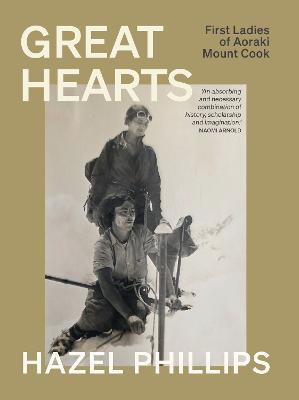
'Joanna Harper leads the way, as the first European woman to set foot on Mount Cook's glaciers, in 1873...'
‘Once I got into tramping it was goodbye teacloths.’ In late 19th century New Zealand, wealthy Victorian women were wrapped in layers of extravagant hoop skirts and impractical footwear, packaged up to look splendid and moulded into subordinate roles. While most early settlers were getting on with the business of survival, the privileged, either moneyed or married to wealth, had time on their hands. Social appearances were stifling. Some women saw the opportunity to break out somewhat, and carve their freedom outdoors.
Great Hearts: First Ladies of Aoraki Mount Cook gives voice to these women and those following them. Journalist and keen mountaineer Hazel Phillips has researched adventurous British and then New Zealand-born women who ventured onto the ice and glaciers around Aoraki Mount Cook. As a Pākehā New Zealander, Phillips has limited her scope to other Pākehā, stating that Māori women's stories are for their own people to tell. Additionally, only a small number of Pākehā women were so moneyed. However, this does not make their stories any less worthy.
This collection is speckled with ‘firsts’. Joanna Harper leads the way, as the first European woman to set foot on Mount Cook's glaciers, in 1873. Legendary Freda Du Faur was the first woman to climb Mount Cook in 1910. There are countless more firsts: these women tackled the Hochstetter Dome, Mount Sefton, and the Copland Pass. They sat astride the cheval on Malte Brun, and are recorded, terrifyingly, beaming out of photographs from this sheer knifelike ridge. They climbed in mixed teams before embracing women-only teams, facing constant disparagement from the climbing establishment and the particularly conservative Canterbury set. These women carved the way by turning up and not giving in, revelling in the challenge and exhilaration. Through their personal records, the reader gets a full sense of their excitement.
For Muriel Graham, once she got the ‘microbe’, that was it. For Gillian Jackson, climbing had ‘That lovely feeling of floating in space...dancing in it’. Doctor and psychiatrist Anne Conyngham, of a later, highly educated generation of women, loved everything about climbing: from the smell of oiled boots to the midnight starts. Some were proud of their femininity, retaining this in the mountains. A couple of stories feature endearing father and daughter partnerships where these men held high ambitions for their daughters.
Traces of records remain. There are crevasses ‘large enough to swallow a church with comfort’ and peaks which were ‘glowing like burnished silver in the autumn sun’. There were innumerable new experiences, such as eating a thrush, breadcrumbed and fried; sleeping with one's head in a large biscuit tin to shelter it from the rain; and finding a decades-old ice-entombed camp. Much of this was done in ‘tempestuous petticoats’ and bonnets. Their feats and honour live on in place names of glaciers and summits.
Locked out of alpine clubs and belittled, many aspects were trials. Phillips fills in the social circumstances. She traces the shifts towards the emergence of a ‘new woman’ and their high expectations for themselves, where some had no tolerance for the ‘cotton-wool tourist’. She also creatively interprets their experiences, so that while the basis of the book is non-fiction, she gives each climber a first person, fictional segment based on historical records. These make up for the dearth of surviving records, for many of the historical accounts erase women in favour of male success. The Du Faur section stands out, for it is recreated explicitly through Phillip's prose.
There is one small niggle, which is the repetitive introduction to mountaineering historian Jennie Gallagher, who could have been succinctly referred to once.
It is difficult to do justice in so few words to the research and stories in Great Hearts. One must delve into the tales and perhaps explore further online. Each woman has her own remarkable story. Phillips' recording and imaginative interpretations, complemented by copious archival photographs, make this record of women's climbing in southern New Zealand an imaginative, vital achievement.