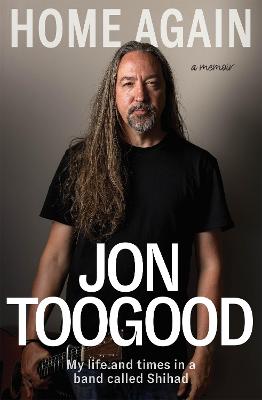
Review: Home Again, by Jon Toogood
Graham Reid takes an approving look at the Shihad veteran's memoir.
At a structural level, this conversational memoir by Jon Toogood – frontman of our most important and much-loved rock band Shihad, and latterly prime mover behind The Adults -- falls into the familiar pattern of rock biographies: childhood, forming the band, touring, album, more touring, another album…Repeat as required.
But this is Toogood's recollection of events public and personal, of family and friends, the fame and the toll it takes, not a Shihad biography. Toogood's personality is preeminent, and he's an interesting character, standing outside himself to analyse the emotions or personality traits offered without guile and often with humility.
A music obsessive since childhood, he was also a handy sportsman and talks about cricket bats with the same passion he later does about guitars. He admits being driven: 'One thing I've struggled with my whole life is that I only want to do things I can be competitive in from the word go … I wanted to win.' He was lucky, then, to meet the band's drummer and equally focused Tom Larkin at school. A shared love of AC/DC bonded them immediately.
When the band forms with guitarist Phil Knight and later bassist Karl Kippenberger – sketched lightly but appearing when necessary – Toogood finds the pressure on him to write, then write again. His singular passion and drive pushed Shihad and Toogood to take themselves further and higher. But the restless striving for the band to be more powerful and the passions deeper make for a punishing life. At times it broke him.
Most rock memoirs catalogue the fall through drugs, liquor or lifestyle: Toogood's issues were rarely those but the pressure he put on himself. He speaks candidly throughout and the book reads like it's been written up from conversations with the credited rock writer Karl Puschmann, conversations about anger, disappointments, successes and shortcomings. There's the same rare honesty on these readable pages as there was in Shihad's emotionally powerful shows, which perfected the performance art of tension and release.
Toogood studied other bands to see how they conducted themselves on stage and off, intuitively pushing himself and the band to constantly be better. It was a punishing way to live but the highs are there, sometimes tragically ripped away, like when Gerald Dwyer died of an overdose the very night the two bands he managed, Shihad and Head Like a Hole, had triumphed at Auckland's Big Day Out in 1996.
Other deaths have an impact too, notably Toogood's supportive father who died listening to an Adults album at his own request. Each passing is like tear in a carefully prepared canvas. He writes with deep affection about his family, on-going problems with his first wife (judgmental only of himself) and how sickened he was when, in the aftermath of 9/11, Shihad was forced to change their name to Pacifier: 'I wasn't prepared for how heavy the backlash was… we'd made a major compromise and I regretted it instantly.'
There's redemption too, as when Sudanese Muslim Dana Salih walks into his life like a beam of light and says, 'You look interesting.' Toogood is certainly that. He speaks with clarity about his lengthy study and considerations before converting to Islam, the comfort and quiet it brings him, especially his three-day wedding in Khartoum with his widowed mother present: 'She didn't just look happy. She looked alive.'
His mother's subsequent death appears ('I was hurting for a long time after that'), terrible tinnitus and the end of Shihad: 'We'd started as boys but we were now men in our 50s.'
Home Again is a remarkable story towards the simple joys of family life.
'As I watched Dana herding our children Yasmine and Yahia playfully towards a pie shop for lunch, I stopped and thought to myself, 'What is this feeling?'
'Then it dawned on me. It was peace. I felt at peace.'