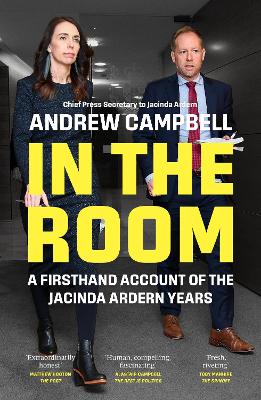
Review: In the Room, by Andrew Campbell
'Campbell reminds us that behind the public figures making consequential decisions are people navigating uncertainty...'
Andrew Campbell almost didn’t write his memoir. Jacinda Ardern’s former Chief Press Secretary admits, ‘My career has been spent supporting others from behind the scenes, and it proved surprisingly hard to find my own voice and perspective.’ It’s a funny quirk of comms people: they can write about anyone or anything with a deadline of yesterday, but ask them to write about themselves and they’re suddenly blocked.
Thankfully, Campbell did get his story down. In the Room is a compelling account of a man who worked behind the scenes during an extraordinary time in New Zealand history. It also makes an ideal companion to Ardern’s memoir. Reading her account, I often wondered what those working alongside her made of the situations she described. Campbell offers one answer.
Campbell delivers on the title, taking us inside the high-stakes discussions that shaped Ardern’s premiership. For four years, he served as her strategist, speechwriter and media manager. He wasn’t afraid to challenge Ardern, including over her reluctance to sack ministers entangled in scandal. ‘Thank God I wasn’t the one making the decisions,’ he writes. ‘There wouldn’t have been a Cabinet left.’
While Campbell questions Ardern’s decisions, he also learns from her. He was ‘genuinely worried for her safety’ as the Prime Minister entered a chaotic room of grieving family and friends following the Christchurch mosque shootings. He watched as Ardern calmly relayed what she knew. Campbell writes, ‘She converted what could have been a powder keg into another lesson in leadership – front up, share what you know and, if it feels right, share in the grief’. Campbell reminds us that behind the public figures making consequential decisions are people navigating uncertainty, questioning their judgement and learning on the fly.
In the pandemic chapters, Campbell traces decisions that may have contributed to Ardern’s changing public image. He proposed the 1pm daily press conferences, but the Prime Minister worried they would focus too much attention on her. In hindsight, Campbell believes that her daily presence on TV screens was ‘fundamental to our success in fighting Covid,’ yet would also ‘lay the seeds of part of the PM’s undoing.’ To his credit, Campbell questions his own advice rather than defending decisions he helped make.
Campbell also examines the growing hostility directed at Ardern, offering another perspective on a period that remains difficult to make sense of. How did Ardern go from the heights of Jacindamania to becoming a target of anti-vax hate during the 2022 protests and beyond? It’s a question Campbell, who was close to the centre of power and deeply involved in the communications strategy, could shed some light on.
One of Campbell’s striking observations concerns the apparent change in online hostility when Chris Hipkins became Prime Minister: ‘…all the anti-vax and anti-government rage seemed to have stopped. Chris had of course been the Covid-19 Response Minister, and had overseen the vaccine rollout. But it appeared the vitriol had been reserved for her alone.’
Campbell could have confined his memoir to political events, but his willingness to explore his personal life makes the book much richer. He charts a career spanning student politics, trade unions, the Green Party and New Zealand Rugby. He also doesn’t shy away from his alcoholism – blackout nights ending in concussions and confrontations with those closest to him. Even in sobriety, celebrating could be a challenge. When Ardern appoints him as Chief Press Secretary, he buys himself an ice cream cone: ‘a quiet party of one to commemorate the start of the most exciting chapter of my life.’
The time it took Campbell to write his memoir also gave him the benefit of hindsight. He’s now able to recognise how his ‘growing inability to delegate’ developed as the demands of the job intensified. Campbell is also frank about the personal cost of giving everything to the job: ‘In order to do it well, I lost myself in it.’ At the time, Campbell struggled to talk even to those closest to him about what he was going through. Revisiting those experiences so openly gives the memoir an added poignancy.
In the Room is written with clarity, humility and often a dash of humour. His proximity to Ardern gives us the rare perspective of someone who helped influence the decisions that shaped her premiership but wasn’t ultimately responsible for making them. That he also turns the same scrutiny on himself makes the account even more compelling. Not bad for a reluctant memoirist.