Review: Jason Grieg Blood is Thicker
'Greig is something of a cult figure in the New Zealand art world. The reasons for this are well presented in this powerful and comprehensive study...'
Jason Greig is a singular figure among New Zealand artists for two reasons in particular. First is his primary dedication to printmaking (at least until fairly recently – he has begun using oil paints in the last decade or so), especially monoprints. It is rare in New Zealand (or anywhere for that matter) for artists whose primary medium is printmaking to break through and receive equivalent recognition to painters or sculptors in terms of exhibitions, institutional support and critical attention. Mervyn Taylor, Barry Cleavin, Eileen Mayo, Marilyn Webb and Marion Maguire are among the few other notable examples of such printmakers in this country. Of course many of our best known printmakers are better-known as painters. Their prints, though excellent examples of their medium, are partly popular as less expensive ways for collectors to acquire original works by artists such as Gordon Walters, Pat Hanly, Don Binney, Gretchen Albrecht, Ralph Hotere and Robin White.
Second (among his notable attributes), Greig has a singularly ‘dark sublime’ outlook or vision. Tony Fomison would be his only local equivalent in this regard. As the authors of Jason Greig: Blood is Thicker say: ‘[His] work probes fear, addiction, desire and despair… [a] personal pantheon of inner demons…werewolves, fools, syphilitic courtesans, gravediggers, saints and slaters: each is a role, a mask, a projection of some deeper psychic truth’.
Monoprints, incidentally, are a form of printmaking in which an image is made from a smooth surface or ‘plate’ such as a sheet of glass or metal, coated in printing ink by various means. The painted image is transferred to paper either by manually rubbing or using a press. Unlike other printing techniques, only one final image is made, making the technique closer to drawing or painting than other print processes. Greig studied printmaking at the University of Canterbury where Barry Cleavin was a teacher and an important mentor. Greig also occasionally practices other forms of printmaking such as etching, aquatint and lithograph, but found that monoprints best suited his particular ‘dark’ sensibility.
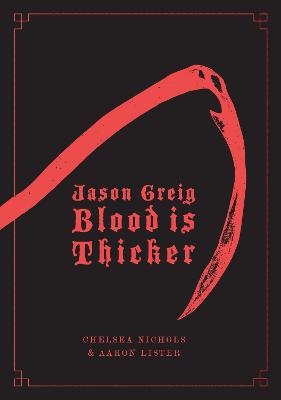
This handsome hard-backed book is connected to an exhibition of the same name shown both at the Dowse in Lower Hutt and at Christchurch Art Gallery; the authors Chelsea Nicholas and Aaron Lister were the curators, and were joined in Christchurch by Peter Vangioni who also a contributes a chapter to the book.
It is evident that great care has been taken by the designer Stu Forsyth and the publisher, Massey University Press, to produce a book that does as full justice as is possible in a printed book to Greig’s art. This is especially commendable because (as with other artists with a penchant for dark, subtle and often monochromatic effects, such as Fomison or Hotere) the work is difficult to photograph effectively. The results here are truly impressive. One device that contributes to the successful visual presentation is that in the Plates section of the book, the works are reproduced in their frames which have clearly been chosen with care and are very much part of the total effect. Many other images (around 70 by Greig and others) are distributed throughout the text.
The main body of the book consists of four chapters jointly written by Nichols and Lister. After ‘Initiation’ (so-called instead of Introduction), ‘The Creepy Continuum’ is largely devoted to major influences on Greig’s art, especially Francisco Goya, Odilon Redon, the stories of Edgar Allan Poe, Mary Shelley’s Frankenstein, Bram Stoker’s Dracula and R.L. Stevenson’s Dr Jekyll and Mr Hyde. Beyond these and equally important are influences from popular culture such as heavy metal music (Black Sabbath et. al. – Grieg himself has been a musician in this mode) and horror movies from Hammer Films to David Lynch’s Eraserhead.
Later chapters headed ‘Inner Demons’ and ‘Otherworlds’, deal severally with the inner (psychological) and outer (mythic, historical and environmental) worlds as they pertain to Greig. At one point the authors’ write: ‘The engine driving Greig’s images is not occult belief, but cultural obsession and recall. Romantic melancholy, gothic excess, Symbolist gloom, horror cinema, album-cover metal, and art history’s undercurrents bleed together into what he terms a "layer cake” of worlds…’. These sentences are typical of the somewhat overheated rhetoric that the authors favour. It is something of a relief to turn to the more prosaic but informative contribution by Peter Vangioni, ‘Blackbird Wannabe’; he is especially good at sketching the Christchurch/Lyttelton context of Greig’s art and such contributing factors as alternative music, struggles with alcoholism and the baleful impact of the 2010-11 Christchurch earthquakes to his sensibility.
Greig is something of a cult figure in the New Zealand art world. The reasons for this are well presented in this powerful and comprehensive study of his life and work.