Review: Maybe Baby, by Emma Neale
Claire Williamson finds compelling depth in Emma Neale's exploration of complex families and parenthood.
Nate and Kelly had just decided to try for a family when the worst happens: Kelly is diagnosed with terminal ovarian cancer. As a last resort, they elect to preserve several embryos. In her last moments, Kelly asks Nate to promise to have the babies for her: ‘Our love won’t go away. It’s in the children. We’ve stored it with them. Pictures on an undeveloped film.' Her passing leaves Nate – who had been the more eager of the two to have children – mired in a toxic cocktail of grief, guilt and anger.
Poet and writer Emma Neale (most recently publishing the Ockham award-winning Liar, Liar, Lick Spit, 2025, and The Pink Jumpsuit: Short Fictions, Tall Truths, 2021) flips the usual narrative by giving Maybe Baby a male protagonist. In stories about people desperate to be parents, the female or mother-centric perspective dominates (Seed, by playwright Elisabeth Easther, and The Mother Hood by Vanessa De Carvalho being but two recent examples). The equally real and valid desires of fathers-to-be are frequently subsumed, so it’s good to see someone adding a new facet to the conversation.
Through Nate, Neale seeks to explore complex aspects of parenthood, love and family. But Maybe Baby struggles somewhat in pacing, and is very much a story of two halves. The first half, as Nate sink into catatonic numbness, is slower while he’s unable to move past Kelly’s death. Efforts to find a surrogate for the embryos go nowhere, and spurts of online dating – attempts to move on, strongly encouraged by his worried friends and family – flop in various comedic ways. In an ironic twist to the stereotype, it’s Nate’s desire to have children, this wanting his ‘soft, pink-skinned underbelly,’ that’s the significant barrier to intimacy and trust with potential partners.
Eventually, in his quest to become a father, Nate stumbles across a radical medical study to enable men to gestate pregnancies, and volunteers for the human trial in London.
This second half of the book, in contrast, zips through nearly two years at dizzying speed. Neale misses a bit of opportunity to properly muck around in the fertile ground of thorny ethnical implications of Nate’s participation in the trial, of society’s expectations of parenthood, on gender, on isolation, and even of the many physical consequences being pregnant has on physical health and wellbeing. (Beyond some token weepy hormones and nausea, Nate somehow seems to escape most of pregnancy’s usual physical complications or body dysmorphia, and bar some relatively light initial hesitation from his parents and sister they come around pretty quick, aided by some convenient geographic distance.)
Maybe Baby is strongest when it’s addressing the various complex shapes family can take in the 21st century. ‘Wanting to have a family isn’t just about sex. It’s about everything. All of life. Future-present-past. It’s about wanting the best parts again,’ Kelly tells Nate early on. ‘Best’ is necessarily relative, meaning family can be what you make of it.
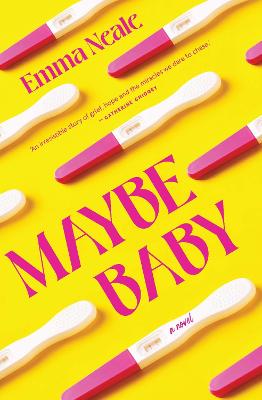
A final thing that bears mentioning: though likely unintentional, the cover – with its striking neon, pink pregnancy test pattern – does this novel a disservice. It acts as a very real barrier to people of who may well find the story compelling, but who wouldn’t want to tote around what looks like a guide to family planning. A more neutral design would make the book significantly more approachable.
Maybe Baby opens the door to an interesting discussion about what the future of parenthood and family planning could be, aided by genuine desires and a bit of revolutionary science.