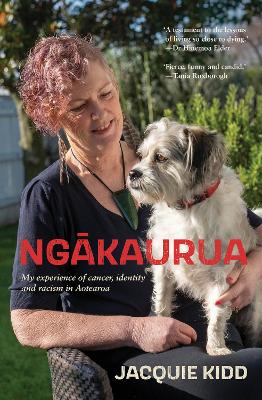
Review: Ngākaurua
My experience of cancer, identity and racism in Aotearoa
'She invites us in her world in a way that is vulnerable, that invites us to make ourselves vulnerable, to gently walk alongside her...'
Ngākaurua is a memoir that reflects on life experiences from the perspective of a wahine Māori with a terminal illness. Jacquie Kidd (Ngāpuhi) is a nurse and academic, who has spent her career championing health equity for Māori. At the time of writing, Kidd has been living with a terminal cancer diagnosis for the previous four years, exceeding her anticipated life expectancy.
Memoirs can be fruitful, interesting, boring, exaggerated, honest, and at times, eclectic spaces. As with life, a person’s recorded experiences are made up of the personal, the political, shared and cultural, and the often-messy work of making sense of these connections. My (admittedly subjective) measure of a memoir, then, is how successfully does the author situate their own experiences within the wider socio-cultural-political context? Does the memoir have the potential to foreground voices that have been historically marginalised, contributing to the broader project of social change.
A memoir is a difficult genre to critique, particularly when the subject is not a celebrity, but an ordinary person with a story to tell. To critique a memoir is to critique a person’s life, their experiences, and their telling of them. It is intensely personal. Memoirs often read as public relations exercises, presenting a behind-the-scenes, how-it-really-happened account of events that already exist within the public record and the collective consciousness. It is often about reframing, and ultimately, controlling the narrative.
In Ngakaurua, Kidd does not seek to control the narrative. In fact, at times, she is disarmingly honest regarding her own perceived failings and those of others around her. She invites us in her world in a way that is vulnerable, that invites us to make ourselves vulnerable, to gently walk alongside her with compassion for her, and for ourselves. Thoughts, feelings, experiences and things ā-wairua, of the spirit, sits alongside antiracist analysis and factual accounts of her professional experiences.
Kidd operates as an Insider-Outsider, described in the book as a “stealth Māori” who is Pākehā presenting but who has Māori whakapapa and enduring cultural connections. She documents the birth and development of her political consciousness, recording her influences: books and theory she read, political activism she was involved in, the teachers and colleagues who were pivotal to her own burgeoning political consciousness. In doing so, Kidd situates her own experiences within the shifting political context of Aotearoa New Zealand, providing a first-hand record.
The most interesting parts of the book are the parts where Kidd critically examines nursing practice in Aotearoa, past present and future, through a decolonial and antiracist lens. The at times stagnant or regressive trajectory of change within the profession was familiar to me through the lens of my own profession of architecture. I too share her hope in the transformative power of the kura kaupapa generation, and the need for established practitioners to work hard to make room and to make spaces safe for them.
Kidd is unflinchingly honest in sharing her whakapapa, her cultural connection and reconnection, her long journey with her reo, tikanga and whakapapa and how this intersects with her nursing and research practice. She is honest about the areas in her life in which she lacks confidence, but despite the fear, anxiety, and feelings of not being good enough, she has remained committed throughout her lifelong journey to fight for health equity for Māori, and to remain staunchly accountable to the communities she works alongside.
Ngākaurua is an acceptance of a life lived including all the messy bits, an invitation to be kind to ourselves but relentless in striving for social change and more equitable outcomes for Māori. In reflecting on Kidd’s tenacity in consistently showing up for Māori and as Māori, I am reminded of the whakatauki, ‘Tūwhitia te hopo, mairangatia te angitū!’ (loosely interpreted as 'feel the fear and do it anyway').