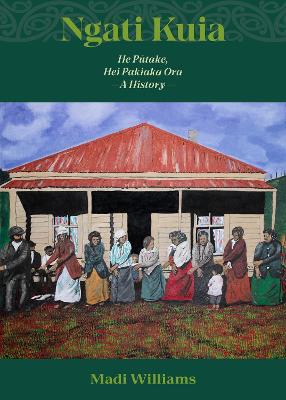
Review: Ngāti Kuia: He Pūtake, Hei Pakiaka Ora A History, by Madi Williams
'There are vast expanses of this country where the mana of the whenua has not been acknowledged by the conquerors. To learn the whakapapa we need to listen, but to whom? This book, the story of one iwi, provides a model...'
Near the beginning of this book there is a description by historian Professor Te Maire Tau of the duties of anyone claiming land by right of conquest. It is not enough, he says, to intermarry with the locals, you must also ‘…learn the whakapapa or the spiritual essence of the land.’ There are vast expanses of this country where the mana of the whenua has not been acknowledged by the conquerors. To learn the whakapapa we need to listen, but to whom? This book, the story of one iwi, provides a model, where histories are told by the people the history is about, rather than being filtered through external sources.
The people are Ngāti Kuia, tangata whenua of Te Tauihu-a-Te-Waka-a-Māui, the northern part of the South Island. Using whakapapa, pūrākau, waiata, karakia and the deliberations of the Waitangi Tribunal Madi Williams relates the history of her iwi. The author takes the story almost to the present day noting toward the end, ‘Recent developments…following the 2023 election do not look promising.’ A prescient observation.
Stories central to the identity of Ngāti Kuia illustrate iwi history, creating some fascinating conjunctions. In one example Kaikaiāwaro, one of the three taniwha of Ngāti Kuia tradition is initially described using the whakapapa and karakia associated with the taniwha to weave the story. Later however the taniwha was co-opted to create another story by linking him with Pelorus Jack, the dolphin which escorted ships up Pelorus Sound at the turn of the 19th century. Then, finally Kaikaiāwaro appears in a very modern context, in opposition to a proposed salmon farm which Ngāti Kuia argued would adversely impact their rohe ‘… and the residences of Kaikaiāwaro…’
In another pūrākau Madi Williams highlights the differences in Pākehā and Māori narrative tradition. In the popular story of Hinepopo, her husband, Maninipounamu abandons her on Kapiti Island. She then swims Raukawa Moana, Cook Straight arriving home on Rangitoto, D’Urville Island where she enacts utu. An adventurous tale with a traditional beginning, middle and end. The Ngāti Kuia versions are much more complex with whakapapa, more taniwha, storms, many karakia, journey to Hawaiki, and the role of women. Williams examines the differences and notes how by setting out a more complex story Ngāti Kuia claim mana and land, issues absent from the popular account.
Iwi history after Pakeha contact, including the parallel arrival of muskets, is the focus of the latter part of the book. The devastating defeat of Ngāti Kuia at Hikapū by musket armed Ngāti Toa is central to much of the rest of their history. As a result of these wars Ngāti Kuia was badly placed to deal with a Pākehā controlled future. Their losses were so great they were later described as the ‘poorest tribe under the heavens.’ As well as the poorest they seem to also be the ‘most forgotten’ with numerous examples of being ignored or left out of events with which they had strong connections.
Despite this Williams portrays a group with a stubborn resilience which began in the 19th century and led to the Ngāti Kuia claim to the Waitangi Tribunal. Williams’ detailed description of the complexities of the settlement process is useful in understanding the background to these claims. In the end Ngāti Kuia succeeded and redress, both cultural and financial, was awarded. This process and the outcome suggest that the mechanisms put in place to deal with breaches by the Crown are working and that the future looks positive. But, as with the story of Hinepopo there is to be no neat beginning and end. As I read, I was aware of another Waitangi Tribunal claim underway challenging the government’s plans to remove or water down Te Tiriti in 19 pieces of legislation. For all our histories it seems there is never a neat beginning and end.
A truly fascinating iwi history with an intimacy rarely encountered in more conventional accounts, a forerunner I hope of more to come.