Review: Patron Saints of Roadkill and other stories
'Quiet seriousness sits at the heart of these stories, alongside a steadfast commitment to going deeper, getting under the skin...'
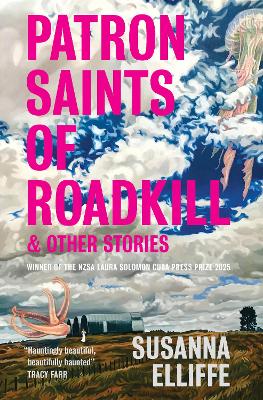
Susanna Elliffe is a writer based in Ōamaru. Patron Saints of Roadkill & Other stories, her debut and 2025 winner of the NZSA Laura Solomon Cuba Press Prize, is a collection of seventeen short stories. Taken together they read like a book of spells and at times, prayers.
These stories are different and unexpected. They confidently wade into the experimental, surreal and speculative, and at times horrific. These are stories that demand attention at the character, plot and sentence-level—they had me guessing, in the midst of all the magic, where we were going, and where our characters (and I as a reader) might end up.
Elliffe has a talent for opening lines. I sat in a café with a friend and opened her collection, read to him the first lines of a few stories at random and they all snapped, made me instantly want to read more:
‘When Atlas dies, they’ll cut off his head.’
‘They meet when she is half formed (a ghost, a paper-thin silhouette).’
‘A human can swim through a blue whale’s veins.’
‘Inga Barons was born in multitudes.’
Quiet seriousness sits at the heart of these stories, alongside a steadfast commitment to going deeper, getting under the skin of what is happening in search of new beginnings, enlightenment or transformation. There is also sadness, loneliness, hunger, regret and tragic mothers. Children are left to wander and roam, there are ghosts (more than one) and break-ups, sea creatures, famous sharks and my personal favourite: a tender octopus BFF with pottery skills.
In 'Blue Blood, No Bones' a seven-armed octopus escapes its tank to help mend a broken-hearted woman:
'Together, we have a shower, the octopus and me. Two of the arms shampoo my hair. Another moulds the soap to my back. The others trail down to the water like ribbon curls, and I watch them, splash and dance and bounce. When we open the fridge to pour milk on my cereal, one arm curls around a piece of salmon, lifts it to the beak, throats it whole.'
While Jia and Frannie become unlikely best friends in Inhabit:
'Problem is, Frannie was born to be a feral dog, ruff ruff. That’s what her mother says, born to gnaw animal bones and piss on doorsteps, born to light fires and build a home in a carcass. Jia was born to eat little cubed sandwiches at garden parties—Frannie’s seen her, before, in a white dress frilled like a fried egg, pinching clubs with cucumber and cream cheese and cress, and cress, and cress.'
If Elliffe’s characters and their unlikely (yet at heart, universal) dilemmas weren’t enough to lose yourself in—there is the prose itself, which while at times snagged, overall was entrancing, with confident use of metaphor and poetic rhythms as seen in 'Patron saints of roadkill', as Elliffe describes kids walking to school unattended:
'Morning frosts the town in morgue sheets. We bare our arms to the air, barking at ghosts of our breath. We wear school jumpers at our waists, carry our shoes by their laces, toes poking through holes in our socks, kicking rocks down the street, clack, clack, clack.'
Or in 'Ellipsis', this delightful description of library books:
'They come with leather coats and fresh white pages. They come with straight margins and hand-picked words. If people wish to read them, they may be taken away, but they must always come back.'
There is playful presentation of words on the page, used not as a gimmick but to strong emotional effect. These gave me the sense of the story quite literally moving through the characters and myself as I read. In 'Embody' Inga is living many lives following the simple suggestion, curse or wish that she might look like someone else:
'Inside Inga, something bubbled. A her, it grew …
her in her throat,
her in her hands,
her in the soft backs of her knees,
her,
her,
her'
Elliffe’s stories have been recognised in many prestigious national and international competitions, and she was first short-listed for the NZSA Laura Solomon Cuba Press Prize in 2023 before winning in 2025. She has honed her craft working with Whiti Hereaka, Thom Conroy, Bryan Walpert, Joan Fleming and Laura Jean McKay while studying for a Masters in Creative Writing at Massey University, working as a librarian, and acting.
Throughout her collection, Elliffe resists neat resolutions or praising inspirational persistence in the face of devastation; instead, she rests with the beautifully eerie, surreal, and deeply visceral ways we process trauma and isolation. Whether it is grief manifesting as a physical, vomiting ‘Ugly Ghost’ of a dead mother, a broken heart soothed by a phantom pottery-making octopus, or a loss of innocence processed by children obsessively burying and making shrines to roadkill, Elliffe shows us that the strangest coping mechanisms are often the most profoundly human.